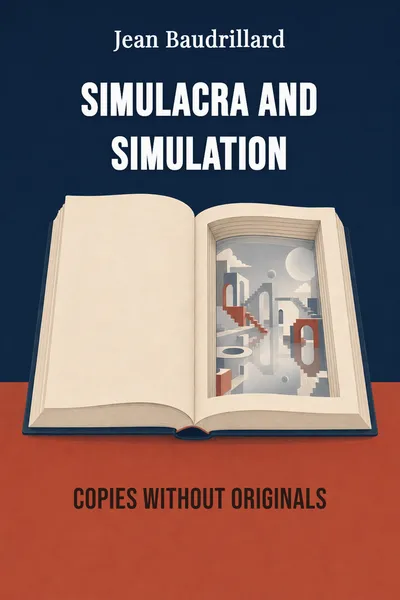
Simulacra and Simulation
Copies without originals
Description
In 1981, a French sociologist named Jean Baudrillard published a slim, difficult book called Simulacres et simulation. It opens with a borrowed image: a map so detailed it covers the entire territory, point for point, until you can no longer tell which came first. Jorge Luis Borges had written a version of that fable, and Baudrillard uses it to flip the old order on its head. In his telling, the map no longer traces the land. The land has quietly rotted away, and only the map survives — shreds of it drying in the sun across a landscape that no longer has an original to refer back to.
That reversal is the whole book in miniature. We are used to thinking of representations as copies: a photograph of a thing, a model of a building, a word standing in for an object out in the world. Baudrillard's claim, written at the peak of the television age, is that something has broken in that relationship. The copies have stopped pointing back to anything. They circulate, reproduce, and feed off each other, generating a reality that feels more real than real — and he gives this condition a name that has since escaped the book entirely.
Simulacra and Simulation is often quoted and rarely finished, which has turned it into a kind of intellectual rumor. It is the book the Wachowskis slipped into the first Matrix, hollowed out to hide a disk. It supplied a phrase that now gets thrown around loosely whenever the world feels fake. Reading it as Baudrillard actually wrote it — tracking the argument rather than the vibe — is a stranger and more precise experience than the reputation suggests.
The question we’re asking : What does Baudrillard mean when he says the copy has outlived its original, and where does that leave the real?What we’ll see : How a book about maps, television and theme parks argues that reality itself has quietly been replaced by its own signs.
Table of contents
01 Chapter 1 — A map that swallowed its territory
Baudrillard starts with that Borges fable because it lets him stage a reversal cleanly. In the original story, imperial cartographers build a map so exact it coincides with the empire itself, and later generations, finding it useless, let it fray in the desert. Borges meant it as a parable about the vanity of perfect representation. Baudrillard reads it against the grain. For him the interesting part is not that the map is too detailed; it is what happens when the territory disappears and the map keeps going. The copy survives the thing it was supposed to copy.
That is his definition of the simulacrum. A simulacrum is not a lie about reality, not a distortion of some underlying truth we could in principle recover. It is a copy for which no original ever existed, or for which the original has become irretrievable. The counterfeit still gestures at something genuine. The simulacrum has cut the cord. It refers only to other signs, other images, other copies, in a closed circuit that produces its own effects of reality without any reality behind them.

02 Chapter 2 — Four stages, from reflection to pure sign
Baudrillard does not treat this collapse as a sudden event. He sketches it as a slow drift, famously laying out what he calls the successive phases of the image — a short genealogy of how a sign comes loose from reality. It reads less like a timeline than like a dial being turned, each notch a further step away from any original.
In the first phase, the image is a faithful reflection of a reality. It is a good copy, a sacramental sign; it points honestly at something that exists. In the second phase, the image masks and distorts that reality. It is now a bad copy, a sign that lies — but a lie still implies a truth it is covering, so the real is at least being invoked, even in its betrayal. These two stages belong to a world we recognize, where representations can be judged true or false against the thing they represent.
03 Chapter 3 — Disneyland exists to hide that America is Disneyland
The most quoted passage in the book is Baudrillard's reading of Disneyland, and it is worth following closely because it shows the argument doing real work rather than floating as theory. The obvious view is that the theme park is a fantasy, a bubble of make-believe set apart from the serious adult reality of Los Angeles outside its gates. Baudrillard turns this around with a single move. Disneyland, he writes, is presented as imaginary in order to make us believe that the rest is real.
The function of the park, in other words, is to anchor a reality that has itself become uncertain. By concentrating all the obvious fakery in one fenced-off, ticketed zone — the cartoon castles, the costumed characters, the engineered wonder — America gets to reassure itself that everything beyond the turnstiles is genuine. But the freeways, the parking lots, the shopping malls and the highways carrying people to and from the park belong to the same order of simulation. Disneyland is the alibi. It is there to conceal that the whole country has already become hyperreal, a landscape of signs with no stable original underneath.
04 Chapter 4 — When the real can no longer be produced
Step back from the examples and a single anxiety runs through the whole book: a culture caught endlessly manufacturing proof that reality is still there. Baudrillard's claim is not that nothing is real, which would be easy to dismiss. It is subtler and bleaker. The categories we use to sort true from false, real from fake, have stopped functioning — not because they were destroyed, but because they have been so thoroughly saturated by signs that there is no longer an outside from which to check them.
He pushes this toward what he calls the precession of simulacra. Normally we assume the real comes first and the model copies it afterward. In hyperreality the order flips: the model precedes and generates the real. Genetic codes, statistical models, media formats, polls and tests produce their outcomes in advance, and the world is then made to conform. The map no longer follows the territory; the territory is laid out to fit the map. This is why he says it is now impossible to stage an illusion, because reality itself has absorbed the whole apparatus of the imaginary — there is no longer a stable real against which a fantasy could even register as fantasy.
05 Conclusion
The book ends where it began, in the desert, with a map that has outlasted its territory. Baudrillard never claimed to have escaped the condition he described; he wrote from inside it, which is part of why the prose spirals rather than resolves. Hyperreality, the four orders of the image, the precession of simulacra, the desert of the real — these are not steps in a proof but circling descriptions of a single situation, a world where the copy has stopped answering to any original and we have mostly stopped noticing.
Related books