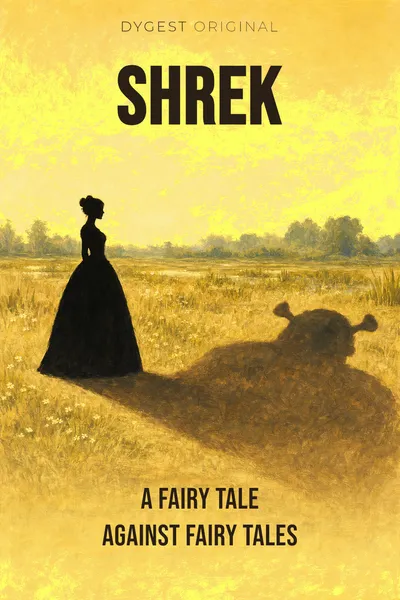
Shrek
A fairy tale against fairy tales
Description
On May 18, 2001, a green ogre walked out of an outhouse, tore a page from a storybook to use as toilet paper, and belched his way into the opening minutes of a major studio release. The book he defiled told the kind of story every child in the theater already knew by heart: a princess, a curse, a prince, a happily-ever-after. Shrek used it to wipe. The gag lasted a few seconds, and it announced everything the next ninety minutes would do — take the fairy tale, the most sacred format in family entertainment, and treat it as something to be laughed at rather than believed in.
The film was made by DreamWorks Animation, a studio barely six years old, and it became a phenomenon almost immediately. It grossed roughly $484 million worldwide, won the first Academy Award ever given for Best Animated Feature in 2002, and spawned a franchise that ran for two more decades. But the strange thing about Shrek is not that a cartoon about an ogre made money. It is that a cartoon whose entire comic engine was mocking Disney beat Disney, in Disney's own house, at Disney's own game — and the audience laughed along the whole way.
A parody usually needs its target to survive; you cannot poke fun at a thing that is already gone. So the film had to love the fairy tale enough to know it cold, and resent it enough to take it apart. That double posture — affection and contempt in the same frame — is what carried it, and it is worth looking at how, exactly, a movie manages to be both the joke and the thing being joked about.
The question we’re asking : How does a film mock the fairy tale so thoroughly and still end up being one — and why did that trick work as well as it did?What we’ll see : A young studio with a score to settle, a comic method built on affectionate sabotage, and the moment computer animation stopped taking orders from Disney.
Table of contents
01Chapter 1 — The studio built on a grudge
DreamWorks was founded in 1994 by Steven Spielberg, the record executive David Geffen, and Jeffrey Katzenberg — and it was Katzenberg who mattered most for Shrek. He had spent the previous decade running Walt Disney's animation division, where he oversaw the run of hits that revived the whole studio: The Little Mermaid, Beauty and the Beast, Aladdin, The Lion King. He knew the fairy-tale formula better than almost anyone alive, because he had helped rebuild it. Then, in 1994, after being passed over for a promotion following the death of Disney president Frank Wells, he left on famously bad terms and sued the company. The settlement reportedly ran into the hundreds of millions.
So the studio that made a film ridiculing Disney's fairy tales was run by the man who had recently made Disney's fairy tales. That is not a coincidence you can ignore. Katzenberg understood the formula from the inside — its beats, its clichés, its saccharine reflexes — which meant he understood exactly where to aim. The princess who sings to woodland creatures, the villain with a private complex, the noble prince, the tidy moral: he had built those parts, and now he had a company positioned to take them apart for laughs.

02Chapter 2 — How to insult a fairy tale and keep its heart
The method Shrek runs on is almost mechanical once you spot it. Take a beloved fairy-tale convention, set it up exactly as the audience expects, then puncture it at the last second. A princess waits in a tower guarded by a dragon — the oldest setup there is — and when the ogre finally reaches her, she is annoyed he skipped the ceremonial kiss and got straight to the rescue. Later she out-fights the bandits, belches after dinner, and turns out to carry a curse of her own. Every beat begins as reverence and ends as sabotage.
The soundtrack did the same trick with tone. Where a classic fairy tale scored its emotional peaks with orchestral swell, Shrek reached for Smash Mouth's All Star over the opening and closing credits and a knowing needle-drop of pop songs throughout. The film refused the earnest register the genre depended on. It kept undercutting itself, deflating any moment that threatened to turn sincere, training the audience to expect the wink before it arrived.
03Chapter 3 — The swamp that everyone recognized
Shrek arrived at a specific cultural moment, and it read the room precisely. By 2001, two generations had grown up on the Disney fairy-tale renaissance Katzenberg himself had engineered. The formula was so familiar it had become almost invisible — which is the exact condition under which parody works best. You cannot spoof a convention nobody knows. You can only spoof one everybody knows by heart, well enough to feel the joke land before it is fully spelled out.
So the film was pitched at parents as much as at children, and that dual address was part of its engine. Kids got a talking donkey, a dragon, and fart jokes. Adults got the recognition — the ex-Disney man's inside knowledge of every cliché, the quicker double meanings, the sense of being let in on a joke about the very stories they had been raised on and were now raising their own children on. The film assumed a viewer who was tired of being told fairy tales with a straight face, and it rewarded that fatigue.
04Chapter 4 — The ogre in the machine
Step back from the jokes and Shrek marks a genuine hinge in the medium itself. For most of the 1990s, computer animation meant Pixar, and Pixar meant a partnership with Disney — Toy Story in 1995, A Bug's Life, Toy Story 2 — films that were technically astonishing and emotionally sincere, and that broadly carried Disney's storytelling values into three dimensions. The new technology was still, in spirit, taking its cues from the old studio. Shrek was the moment a rival used the same tools to point the other way.
What is telling is that the technical leap and the tonal rebellion arrived in the same film. Shrek pushed hard on rendering human-ish faces, skin, mud, and light in ways that felt new for the time, and it used those advances not to deepen Disney-style wonder but to stage a comedy at Disney's expense. The medium that Disney's rivals had spent years catching up on was now being turned into a weapon against the house that had defined family animation. The tools had changed hands, and with them, the attitude.
05Conclusion
The ogre who tore a page from a storybook in the first minutes got the last laugh in a way the gag could not have promised. Shrek set out to defile the fairy tale and ended up as one of the most durable fairy tales of its era — a franchise, a cultural shorthand, a green face recognized on every continent. The film held its two opposite instincts, mockery and belief, in the same frame the whole way through, and never resolved the tension so much as ran on it. That is the trick, and it worked because the man who built it knew both halves from the inside.
Related books