Victor Hugo
Writer, exile, national monument
Description
On the evening of May 22, 1885, a man died in a house on the Avenue d'Eylau in Paris, and within days the city renamed the street after him while he was still lying inside it. Victor Hugo was eighty-three. His last recorded words, more or less, were about seeing black light. Two million people — more than the population of Paris at the time — came out for the funeral procession that carried his body from the Arc de Triomphe to the Panthéon. Cafés were told to close. The government had debated for years what to do when this particular death arrived, because everyone knew it would not be an ordinary one.
He had earned all of it and none of it in the usual way. Hugo was a poet before he was twenty, a playwright who caused riots, a novelist whose books sold in numbers that embarrassed his rivals, and, for two decades, a political exile who ran a resistance against an emperor from a rock in the English Channel. He had been a royalist, then a liberal, then a republican, then a kind of secular saint. By the end, he was less a man than a fixed point around which France arranged its idea of itself.
That trajectory — from ambitious boy to national altarpiece — is stranger than the summary suggests. It involves a coup he lost, a country he refused to re-enter on the wrong terms, and a slow transformation in which the writing and the myth stopped being separable. We tend to receive Hugo already finished, already carved. It's worth going back to how the carving happened.
The question we’re asking : How did a working writer become a monument a whole nation buried as one of its own?What we’ll see : A life that ran from teenage ambition through political rupture and long exile to a funeral that turned an author into a civic institution.
Table of contents
01 Chapter 1 — The prodigy who wanted to be Chateaubriand or nothing
Hugo was born in Besançon in 1802, the son of a Napoleonic general and a mother whose royalist sympathies pulled the household the other way. The marriage was unhappy and the boy grew up shuttled between camps, in more ways than one. What he decided early, and wrote in a notebook around age fourteen, was that he wanted to be Chateaubriand — the towering Romantic writer of the day — or nothing. It was the kind of line an ambitious teenager writes and then, improbably, delivers on.
The delivery came fast. He was winning poetry prizes before twenty and drawing a royal pension from the restored Bourbon monarchy for his early collections. But the real rupture arrived in the theater. In 1830, his verse drama Hernani premiered at the Comédie-Française and set off what became known as the battle of Hernani — organized brawls in the stalls between young Romantics and defenders of classical rules, night after night, over questions of poetic form that now sound almost quaint. Hugo, not yet thirty, had made himself the leader of a movement.

02 Chapter 2 — The barricade in the mind
Hugo's politics moved leftward across his life, but not in a straight line. He began as a royalist, softened into a liberal constitutional monarchist under Louis-Philippe, and only became a committed republican in middle age. The catalyst was the Revolution of 1848, which toppled the monarchy and briefly opened a republic. Hugo, by then a deputy, watched the new order struggle with the same question every French regime of the century faced: how much democracy could the propertied classes tolerate.
His speeches from those years show where he was landing. He spoke against the death penalty, which he opposed his whole life. He spoke about la misère — poverty as a social crime rather than a private failing — with a directness that made his fellow deputies uncomfortable. He was assembling, in public, the moral framework that would later fill the pages of Les Misérables. For Hugo the political and the literary were never two departments; the same convictions ran through both, and the novels were arguments as much as entertainments.
03 Chapter 3 — Nineteen years on a rock
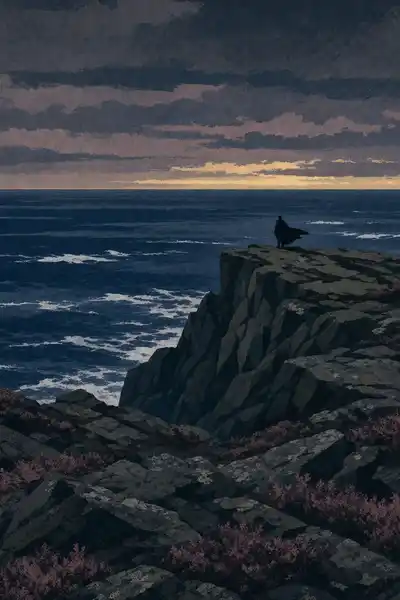
Exile settled eventually on Guernsey, a Channel Island under the British crown, where Hugo bought a tall house called Hauteville House and refused every amnesty Napoleon III offered. When a general pardon was declared in 1859, Hugo answered publicly that he would return when liberty returned — not before. It was a grand gesture, and it was sincere, and it also kept him at the center of French moral life precisely by keeping him outside French borders. Absence, handled this way, became a kind of presence.
The isolation was extraordinarily productive. On Guernsey he completed Les Misérables, published in 1862 to immediate international success — the novel of Jean Valjean and the stolen loaf of bread and the years of pursuit, a story about mercy and law and poverty that reached readers who would never open a philosophy book. He wrote The Toilers of the Sea and The Man Who Laughs. He worked standing at a small desk facing the window, watching the water toward the French coast he could not step onto.
04 Chapter 4 — The state funeral of a novelist
Consider what the Third Republic actually did in June 1885. It took the Panthéon — a church that had been converted, reconverted, and argued over for a century — and formally rededicated it as a secular temple for the nation's great men, specifically so that Hugo could be buried there. A building's meaning was changed to accommodate a writer's corpse. The state was not just honoring a novelist; it was using him to define what the Republic worshipped now that it had decided not to worship in the old way.
This is the odd thing worth sitting with: France invented, around Hugo, the idea of the author as public institution. Not the author as celebrity, which existed before, and not the author as court poet, which existed for centuries — but the writer as a load-bearing part of the national structure, a figure the state itself leans on to explain who it is. The two million mourners were not only grieving a man. They were participating in a civic ritual the government had half-designed for them, a Republic performing its own values through a coffin.
05 Conclusion
The street that was renamed for Hugo while he lay dying inside it is still called Avenue Victor-Hugo. He got the monument, the Panthéon, the two million mourners, the schools and squares and stations bearing his name across the country and beyond it. The teenager who wrote that he would be Chateaubriand or nothing had, in the end, overshot — he became something Chateaubriand never was, a writer the nation could not bury as a private man.
Related books