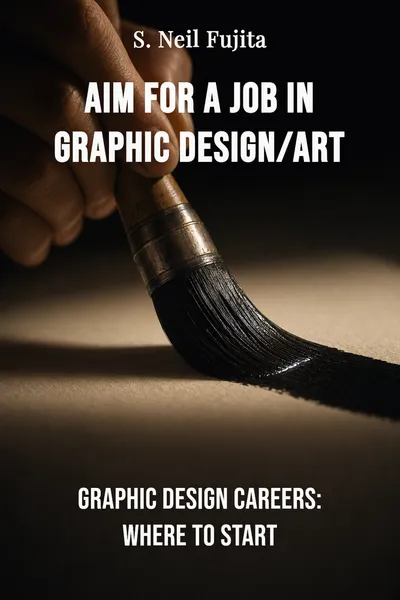
Aim for a Job in Graphic Design/Art
Graphic design careers: where to start
Description
There is a kind of career-guidance book that reads less like advice and more like a door being held open. S. Neil Fujita's Aim for a Job in Graphic Design/Art is one of them. Fujita knew what he was talking about — he was the designer who gave The Godfather its now-iconic cover lettering and the sleeve art for jazz records that people still frame. When he sat down to write for young people wondering whether they could make a living with a pencil and a sense of composition, he did not begin with inspiration. He began with the work itself: what a graphic designer is hired to do, day in and day out.
The book belongs to a modest genre — the vocational primer aimed at teenagers deciding what to become. But Fujita treats the question seriously, because in his telling graphic design is neither a hobby nor a lucky knack. It is a trade, with tools, training, employers, and a body of people who came before. He wants the curious reader to understand that the field is real, that it pays, and that getting into it follows a path anyone can walk if they are willing to learn the craft rather than wait to be discovered.
What makes the book worth revisiting is its plainness. Fujita does not sell a dream; he describes a job. He walks through what the work involves, where to get trained, and how to knock on the right doors — and then, almost as an afterthought that turns out to be the point, he introduces the men and women who made the profession what it is.
The question we’re asking : How does someone with a feel for form and color turn it into an actual working career in graphic design?What we’ll see : A practical map of the trade — its daily work, its schooling, its job hunt — and the practitioners who gave it a lineage.
Table of contents
01 Chapter 1 — What a graphic designer actually does
Fujita starts by clearing up a confusion that trips up most beginners: graphic design is not fine art, though it draws on the same eye. The painter works for herself; the graphic designer works for a client, a message, a product that has to reach a specific audience. The skill is the same feel for line, color, balance, and type — but it is bent toward a purpose set by someone else. Understanding that difference, Fujita suggests, is the first real step, because it reframes talent as a service rather than a form of self-expression.
From there the book lays out how wide the field runs. A graphic designer might lay out a magazine, design a book jacket, build an advertisement, shape a company's logo and letterhead, or plan the packaging that makes a box stand out on a crowded shelf. There is work in publishing houses, advertising agencies, printing firms, television, and in the design departments of large corporations. The point Fujita keeps returning to is that the trade touches nearly everything a person sees in a day — the cereal box, the movie poster, the newspaper column — and that all of it was arranged by someone paid to arrange it.

02 Chapter 2 — The training that makes a portfolio
Fujita is direct about schooling: talent is a start, but it is training that turns a promising teenager into someone an employer will pay. He walks through the options as they stood in his day — the art schools and design institutes, the university programs, and the practical courses that teach the mechanics of the trade. He does not pretend all paths are equal, but he refuses to be snobbish about them either. What matters, he argues, is what the student comes out able to do, not the name on the diploma.
The fundamentals get named plainly. A designer needs drawing, an understanding of color and its behavior, a working knowledge of typography — the shapes and families of letters and how they read — and grounding in the composition that arranges all of it on a page. Beyond the eye, there is the hand and the shop: how printing works, how a job goes from sketch to finished piece, the materials and processes that impose their own rules. Fujita treats these technical matters as inseparable from the creative ones. A beautiful design that cannot be printed cheaply is a failed design.
03 Chapter 3 — Finding the first job
With a portfolio in hand, the book turns to the hunt, and here Fujita is at his most matter-of-fact. He maps where the jobs live — advertising agencies, publishers, printing houses, department stores with their own art departments, corporations, studios that take on freelance work. Each has its own rhythm and its own kind of assignment, and part of the beginner's task is to figure out which environment suits the work they most want to do. A person who loves books should look toward publishing; one who loves persuasion, toward advertising.
On the mechanics of getting hired, he is refreshingly unglamorous. The beginner writes letters, makes appointments, shows the portfolio, and takes the criticism that comes with it. Fujita frames rejection as ordinary rather than fatal — every art director has an opinion, and a no from one is not a verdict on the work. What separates the person who lands a job from the one who does not is often persistence and the willingness to present, revise, and present again.
04 Chapter 4 — The people who built the field
Where the book steps back is in its portraits of the people who shaped graphic design, and this turns out to be more than a courtesy. By naming practitioners — the designers, illustrators, and art directors whose work defined the standards a beginner is being trained toward — Fujita quietly makes his largest argument: that this is a profession with a lineage, built by identifiable human beings who learned it, practiced it, and passed it on. The field did not fall from the sky. It was made.
That framing matters because it dissolves the myth of the born genius. If graphic design were a gift, biographies would be irrelevant. But Fujita shows careers as trajectories — people who trained, took jobs, struggled, developed a style, and earned reputations through accumulated work. The reader meant to be encouraged by these lives is not being told to admire untouchable talents; they are being shown a path that others have already walked, with a beginning that looked much like the reader's own.
05 Conclusion
Fujita's little guide ends where it began — with the work. The message that runs from the first page to the last is that graphic design is a job before it is anything else: something a person can define, train for, apply to, and grow within. The talent that draws a teenager toward it is only the raw material. Everything that turns that material into a career — the schooling, the portfolio, the letters and interviews, the humble first assignments — is described as a sequence of ordinary, doable steps.
Related books