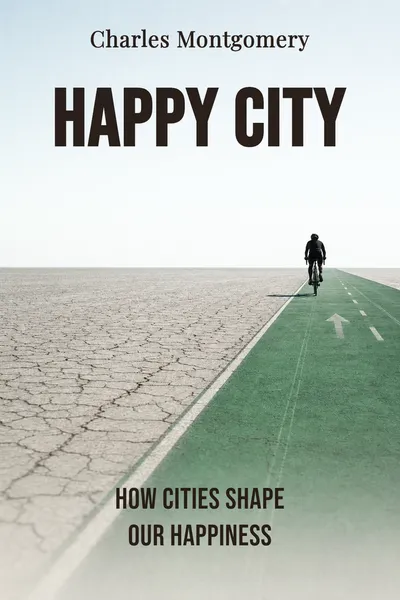
Happy City
How cities shape our happiness
Description
In 2007, a former mayor of Bogotá named Enrique Peñalosa drove Charles Montgomery around the Colombian capital, and the ride doubled as an argument. Peñalosa had spent his three years in office, starting in 1998, doing things that made economists wince and citizens furious: he blocked plans for new highways, jacked up parking restrictions, built hundreds of kilometers of protected bike lanes, and poured money into libraries and a rapid bus system instead of freeways. The premise underneath all of it was almost embarrassing in its simplicity. A city, he insisted, should be judged by whether it makes the people in it happier. Not richer, not faster — happier.
Montgomery, a Canadian journalist, went looking for whether that claim could survive contact with evidence. He is not a planner or an economist by training, and Happy City, published in 2013, is his attempt to reverse-engineer the feeling of a good place. He talks to neuroscientists measuring stress hormones in commuters, to behavioral economists who have put a price on friendship, to sprawl refugees deep in the American suburbs. What he assembles is less a manifesto than a case: the everyday texture of our lives — how far we drive, whether we know our neighbors, how often we bump into a stranger — is quietly engineered by decisions most of us never see.
The uncomfortable part is that the engineering has often been aimed at the wrong target. For most of the last century, we built cities to move cars efficiently and to give families their own patch of lawn, and we assumed the happiness would follow. Montgomery's book is the story of what happened when it didn't, and of the people trying to build the reverse.
The question we’re asking : Can the way a city is built actually make the people inside it happier — and if so, what have we been getting wrong?What we’ll see : A journalist's tour through the science, the sprawl and the experiments that connect concrete decisions about streets to how good our days feel.
Table of contents
01Chapter 1 — The mayor who took the cars away
Peñalosa is the human anchor of Happy City, and his Bogotá is Montgomery's opening exhibit. When he took office, Bogotá was choking — violent, congested, dominated by cars that only a minority could afford while the majority walked or waited for crowded buses. The obvious modern fix was more road capacity. Peñalosa did the opposite. He reasoned that a city spends its scarce space on either private cars or shared life, and that pouring it into cars quietly hands the best of the city to the wealthiest.
So he redistributed the space. The TransMilenio bus rapid transit system gave buses their own dedicated lanes, so a bus carrying dozens moved faster than the private cars carrying one. He built the Ciclovía into a weekly ritual, closing roughly 120 kilometers of road to traffic every Sunday so families could walk, cycle and mingle. He constructed a car-free promenade cutting through poor neighborhoods, an act that struck critics as almost provocative — why build a park for the poor when they need jobs? His answer was that dignity and everyday joy were not luxuries to be earned later.

02Chapter 2 — The dispersed dream that turned lonely
From Bogotá, Montgomery turns to the model that most of the wealthy world spent the twentieth century building: the dispersed city. The suburb was, on paper, the happiness machine. A detached house, a green lawn, quiet streets, distance from noise and crime and strangers — everything the crowded industrial city seemed to punish, the suburb promised to cure. And for a while it felt like a triumph. Montgomery is careful not to sneer at it, because the desire underneath it is real and old.
The trouble showed up in the accounting he lays out. The dispersed pattern only works if you drive, and driving turns out to be one of the reliably worst things for daily well-being. He cites research finding that commuting ranks near the bottom of activities people enjoy, and that long car commutes correlate with worse health, less sleep, and thinner friendships. A frequently cited Swiss finding suggested that a person with an hour-long commute would need a substantial raise — on the order of forty percent — to be as satisfied as someone who walks to work. We rarely take that trade consciously; we take it one house purchase at a time.
03Chapter 3 — The math of trust and the shape of a street
The heart of Happy City is Montgomery's insistence that these are not soft, unmeasurable claims. He spends much of the book with researchers who put numbers on the social fabric. The behavioral economist John Helliwell, whose work feeds the World Happiness Report, tells him that trust in one's neighbors is worth a startling amount to life satisfaction — that a small increase in how much people trust the strangers around them can move well-being as much as a large jump in income. Connection, in this accounting, is not a nice extra. It is a primary good.
And connection is shape-sensitive. Montgomery reports on experiments and observations — including work associated with Berkeley's Donald Appleyard decades earlier — showing that people on quiet, low-traffic streets have several times more friends and acquaintances nearby than people on identical streets carrying heavy traffic. Same houses, same incomes, same city. The only variable was the volume of cars, and the cars were eating the neighborly relationships. What we treat as private character — being sociable, being isolated — is partly a product of how loud and fast the space outside our door is.
04Chapter 4 — A design problem we can actually solve
Step back from the tour and Happy City is making a larger, quietly radical claim. We tend to treat happiness as a private project — the right mindset, the right job, the right relationship, the work each of us does alone on ourselves. Montgomery's whole argument pushes against that. A meaningful share of how good our days feel is decided upstream, by zoning codes, road budgets and street widths set by people we will never meet, often before we were born. Happiness, on this view, is partly infrastructure.
That reframing matters because it moves the lever. If loneliness and stress were purely personal failings, the only response would be individual — try harder, connect more, meditate. But if a heavy-traffic street reliably strips people of neighbors, and a long car commute reliably erodes sleep and friendship, then these are collective problems with collective fixes. Urban design becomes something close to a public-health tool, on the order of clean water or vaccination — an intervention that shapes millions of lives at once, mostly invisibly.
05Conclusion
The ride with Peñalosa where the book begins was really a demonstration that a city is an argument made in concrete — every lane, every setback, every stretch of missing sidewalk taking a position on how its people should live. Montgomery went looking for whether the feeling of a good place could be traced to those decisions, and came back convinced that it could: that the commute we resent, the neighbors we don't have, the strangers we never meet are not accidents of temperament but outputs of design. The happy city, in his telling, is less a dream than an accounting error we keep declining to fix.
Related books