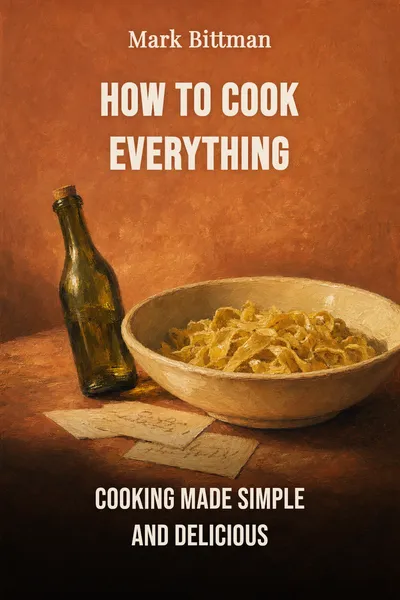
How to Cook Everything
Cooking made simple and delicious
Description
In 1998, a food writer named Mark Bittman published a cookbook of roughly nine hundred pages with the almost comically confident title How to Cook Everything. Bittman was not a trained chef. He had spent years as a home cook and a columnist, someone who thought about food the way a friend does rather than the way a restaurant does. The book won the two big awards American cookbook writers care about — a James Beard and an IACP prize — and went on to sell over a million copies. Two decades later it was reissued, revised so heavily that nearly half of it was new, and it kept doing the same quiet thing it had always done: convincing people who thought they couldn't cook that, in fact, they could.
What made it land was not a gimmick. There was no diet attached, no single cuisine to master, no photography of impossibly plated food. The premise was almost stubborn in its plainness — that most of what happens in a home kitchen comes down to a handful of techniques, decent ingredients, and the willingness to not treat dinner as an exam. Bittman wrote the way he'd talk you through a recipe on the phone: here's what matters, here's what you can skip, here's what to do if you don't have the pan the recipe wants.
That flatness of tone is deceptive, because underneath it sits a real argument about what cooking is and who it belongs to. A cookbook this thick could easily read as a reference you consult and shelve. Instead it reads as an invitation to relax — which, for a genre built on aspiration and anxiety, is a genuinely odd move.
The question we’re asking : What does a nine-hundred-page cookbook actually teach, if not just recipes — and why has that approach outlasted so many trends?What we’ll see : How Bittman turned the intimidating idea of cooking "everything" into something an ordinary person could pick up on a Tuesday night.
Table of contents
01Chapter 1 — The book that assumes you can figure it out
Most cookbooks published in the late nineties came with an implicit posture: the author knew things you didn't, and the recipes were the proof. Bittman's book starts from the opposite assumption. It treats the reader as a capable adult who simply hasn't done this particular thing yet — no condescension, no hand-holding disguised as encouragement. The instructions are written so that a person standing in a kitchen at seven in the evening, mildly hungry and not especially patient, can follow them without feeling stupid.
This shows up in small choices throughout. Recipes tell you what the food should look and smell like at each stage, not just how many minutes to set the timer for, because Bittman trusts your senses more than your clock. They flag where a step is genuinely important and where it's optional. They name substitutions openly, so that a missing ingredient becomes a shrug rather than a reason to abandon the whole plan. The effect is that the book keeps handing responsibility back to the cook.

02Chapter 2 — Technique first, recipes second
The organizing insight of How to Cook Everything is that recipes are downstream of technique. You don't really learn to cook by memorizing a thousand dishes; you learn a few reliable operations — roasting, braising, sautéing, boiling, making a basic sauce — and then apply them across ingredients. Bittman structures the book so that these fundamentals sit at the front of each section, with specific dishes hanging off them as examples rather than as the point.
Take something as basic as cooking a vegetable. Rather than giving you forty separate recipes, Bittman explains what steaming does versus what roasting does versus what a quick sauté does, and what each is good for. Once you understand that roasting concentrates flavor and browns edges, you can roast almost anything without a recipe at all. The specific dish becomes a suggestion. The method is what you actually take away and reuse for the rest of your life.
03Chapter 3 — One dish, then a hundred variations
The most characteristic feature of the book is the variation. Bittman rarely leaves a recipe standing alone. He'll give you a master version — a simple roast chicken, a basic vinaigrette, a plain risotto — and then follow it with a run of variations that change one variable at a time. Swap the herb. Add a citrus. Cook it a little longer for a different texture. The variations aren't padding; they're a teaching device, showing exactly how flexible the underlying method is.
This does something subtle to the reader's confidence. Once you've made the master recipe and two of its variations, you understand the recipe as a set of moving parts rather than a fixed sequence. You start to see where the room is. The next variation, the book implies, could be your own — and by then it doesn't feel like a leap, because you've already watched Bittman make three small ones. Improvisation stops being the scary thing that experts do and becomes the natural next step.
04Chapter 4 — The case against the celebrity kitchen
Step back from the specific dishes and How to Cook Everything is making a quiet argument about what cooking is for. It arrived in a culture increasingly organized around the celebrity chef — food as spectacle, the kitchen as stage, the meal as an achievement to be photographed and admired. Bittman's whole design pushes the other way. He treats cooking as ordinary competence, the kind of thing a person does several times a week without ceremony, closer to knowing how to do laundry than to performing an art.
This matters because the spectacle model tends to leave the home cook feeling worse. When the reference point is a plated restaurant dish or a television demonstration by someone with a full brigade off camera, your own weeknight dinner can only look like a failure by comparison. Bittman removes that reference point entirely. He isn't showing off, and he isn't asking you to. The bar he sets is simply: good food you actually made, that you actually want to eat.
05Conclusion
That confident title turns out to be less a boast than a promise about scope rather than difficulty. How to Cook Everything doesn't literally catalog every dish on earth; it hands over enough technique, and enough permission to improvise, that the reader can eventually cook almost anything without the book open. The revised edition kept faith with that original idea — more dishes, more variations, but the same underlying trust in the person holding it. A million copies later, the approach has outlasted the diet books and single-cuisine trends that surrounded it.
Related books