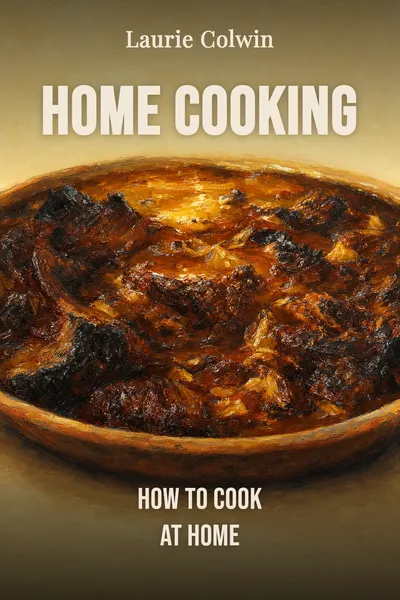
Home Cooking
How to cook at home
Description
In 1988, a New York novelist named Laurie Colwin gathered a run of essays she'd written for Gourmet magazine and published them as a slim book called Home Cooking. She was already known for her fiction — warm, sharp, domestic — and the cooking pieces carried the same voice into the kitchen. They were not recipes dressed up as prose. They were stories about eating, feeding, failing, and trying again, with the actual cooking woven in almost as an aside. The book found readers who had never once made her exact chicken and kept it on the shelf next to the stove anyway.
What makes the collection unusual is that Colwin refuses to perform expertise. She tells us about the disastrous dinners, the eight-by-eight-foot apartment where she cooked on a hot plate balanced over the bathtub, the beef stew she once served that could have doubled as roofing tar. The confident chef of most food writing is absent. In her place is a friend who cooks a lot, has strong opinions, and would rather laugh about a ruined meal than pretend it went to plan. The recipes come, but they arrive inside the anecdote, not on a pedestal.
Home Cooking has quietly outlasted most of the glossy cookbooks published the same year. Colwin died young, in 1992, and the book has kept circulating by word of mouth ever since — the sort of title people press on friends. It is worth asking what a book of comfortable, funny kitchen essays actually teaches, and why so many cooks return to it long after they've stopped needing anyone to explain how to roast a chicken.
The question we’re asking : What does a book of funny, unpretentious kitchen essays actually teach us about cooking — and about why we cook at all?What we’ll see : How Colwin turned real kitchens, real failures, and a handful of plain recipes into a case for cooking as ordinary, generous, deeply human work.
Table of contents
01Chapter 1 — A kitchen the size of a closet
Colwin opens with a confession most food writers would bury: for years she cooked in an apartment with no kitchen. There was a bathtub with a board across it, a small refrigerator, and a two-burner hot plate. On this she produced dinner parties. The point isn't nostalgia for hardship — it's that she wants to knock the whole apparatus of proper cooking off its perch before she says another word. You do not need a professional range or a wall of copper pans. You need a pot, a heat source, and the willingness to feed someone.
This bias runs through everything. She is suspicious of gadgets, of intimidating equipment, of the idea that good food requires an arsenal. Her advice on stocking a kitchen is almost aggressively practical: a few sharp knives, a heavy pan, decent olive oil, salt, garlic, canned tomatoes, a lemon. The pantry she describes is the one a person actually uses on a Tuesday, not the aspirational shelf photographed for magazines. She trusts the reader to figure out the rest, because figuring it out is most of what cooking is.

02Chapter 2 — The gospel of unfussy food
Colwin's taste is firmly on the side of the plain. She loves roast chicken, buttered toast, garlic soup, a good stew, gingerbread, a baked potato eaten with real attention. She is openly skeptical of the elaborate, the towering, the food designed to impress rather than to be eaten. Restaurant flourishes leave her cold. What she wants is the dish you can make a hundred times, that improves with repetition, that tastes like itself.
Her recipes reflect this. They are written the way a friend would tell you over the phone — a handful of ingredients, a rough method, a warning about the part that usually goes wrong. She'll admit when she's guessing at quantities, when a dish is forgiving enough that precision doesn't matter, when the printed instructions of some famous cook led her astray. There is no false authority. A recipe, in her hands, is a starting point and a conversation, not a contract.
03Chapter 3 — Feeding people is a form of love
For Colwin, cooking is never just about the cook. It's about the people at the table. Again and again the essays circle back to feeding others — friends dropping by, a sick friend who needs something gentle, a child who will only eat certain things, a crowd assembled for no reason but company. The food is the medium. What's actually being served is attention, welcome, the plain message that someone thought about you and made you something.
She writes beautifully about the anxious host and quietly talks them down. The perfect dinner party, she argues, is largely a myth, and chasing it wrecks the evening for everyone including you. Better to make something you can cook in your sleep, keep the wine flowing, and pay attention to your guests rather than your sauce. The meals people remember are almost never the technically flawless ones. They're the ones where the host was relaxed enough to actually be there.
04Chapter 4 — What a recipe can't put on the page
Step back from the individual essays and Home Cooking is arguing something larger about the place of cooking in a life. Colwin is writing at the end of a decade that had increasingly turned food into performance — into restaurant worship, celebrity chefs, the meal as status object. Against all that, she makes a stubborn case for the domestic and the unglamorous. Cooking at home, in her telling, is not a lesser version of what professionals do. It's a different activity entirely, with different rewards, answerable to no one but the people you feed.
The deeper claim is about self-reliance and pleasure held together. Knowing how to feed yourself and others is a kind of quiet independence — you are not at the mercy of a restaurant, a delivery, or your own helplessness. But Colwin never lets it curdle into virtue or discipline. The independence is inseparable from the pleasure: the smell of a chicken roasting, the first bite of gingerbread warm from the oven, the satisfaction of a stew that came out right. Competence and delight arrive together, and neither requires an audience.
05Conclusion
The book that began in an apartment with a hot plate over a bathtub ends up making a surprisingly whole argument. Cook plainly. Cook often. Don't be afraid to fail, because the failures are funny later and rarely fatal now. Feed the people around you, and pay more attention to them than to your sauce. Colwin never states this as a program — it accumulates, essay by essay, recipe by recipe, until the reader has absorbed a whole disposition toward the kitchen without ever being lectured.
Related books