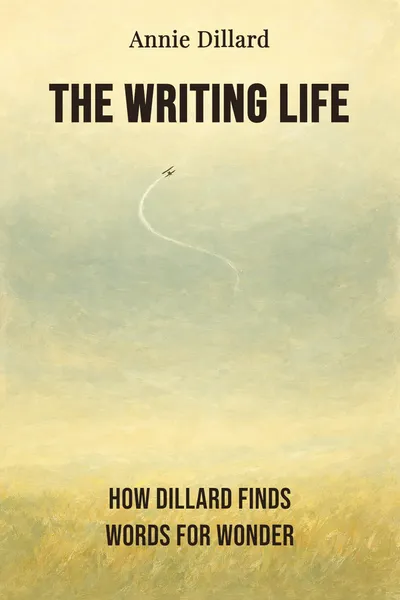
The Writing Life
How Dillard finds words for wonder
Description
In 1989, Annie Dillard published a slim book called The Writing Life. She had already won the Pulitzer Prize for Pilgrim at Tinker Creek, written back when she was in her late twenties, and by the time she sat down to describe her own craft she had a shelf of finished work behind her and no illusions about how any of it got made. The book runs to barely a hundred pages. It is not a how-to. There are no chapters on plot, no exercises, no encouragement of the kind writing manuals usually sell. What there is instead is a series of vignettes — a cabin, a moth, a stunt pilot, a felled tree — arranged the way a poem is arranged, by association rather than by argument.
The strange thing about the book is how physical it makes an activity that leaves no visible trace. Dillard describes writing the way a mountaineer might describe a route: as labor done alone, in bad conditions, with real stakes and no audience. A sentence is a line paid out into the dark. A page written one week gets torn out the next. She keeps returning to images of digging, of chopping, of tunneling toward something she can hear but cannot yet see. The prose is beautiful, but the beauty is not decorative — it is the residue of the effort she is describing.
That is the pull of the book, and it is worth following. Dillard is not romantic about the work. She is exact about it — about the boredom, the terror of the blank days, the way a good passage often has to be sacrificed for the book's sake. And underneath the exactness runs a question about what kind of life this is, and whether the trade is worth making.
The question we’re asking : What does it actually feel like, day to day, to make a life out of putting words on a page?What we’ll see : Dillard's own account of the labor, the solitude, the patience it demands, and what such a life costs and gives back.
Table of contents
01Chapter 1 — A line goes out, day after day
Dillard's most quoted image comes early. The line of words, she writes, is a miner's pick, a woodcarver's gouge, a surgeon's probe. You wield it, and it digs a path you follow. Soon you find yourself deep in new territory. Is it a dead end, or have you located the real subject? You will know tomorrow, or this time next year. The point is that the sentence goes first, and the writer follows it — not the other way around. You do not know what you are making until the making shows you.
This reverses the amateur's assumption. We imagine the writer has the thing in mind and then transcribes it. Dillard describes something closer to exploration, where the words themselves reveal where the work wants to go, and where most of what you write turns out to be the scaffolding you build to reach the part worth keeping. She is blunt about the arithmetic. You write a whole book, she says, and then you discover that the real book is the last third, and the first two-thirds were you learning how to write it. Then you throw the scaffolding out.

02Chapter 2 — The room with no view
Dillard is emphatic on one point that surprises people: the writing room should be plain. A window that looks onto something interesting is a hazard, not a gift. The eye wanders to the view, the mind follows, and the work stops. She recounts writing in a study whose window she eventually covered, and in a borrowed cabin on an island in Puget Sound, a bare cinder-block room with a single hard chair. The appeal of such a place is precisely that there is nothing in it to look at. Appealing workplaces, she notes, are to be avoided. One wants a room with no view, so imagination can meet memory in the dark.
The reasoning is exact. Writing draws on what is already inside the writer, on memory and on the images the mind supplies when it is not being fed from outside. A rich environment competes with that inner supply. It hands the senses something easier to attend to than the difficult, half-formed thing on the page. The blank wall, the shut blind, the featureless desk — these are not austerity for its own sake. They are a way of starving the ordinary distractions so that the harder attention can take hold.
03Chapter 3 — The moth, the fire, the patience
One of the book's central images is a moth. Years earlier, camping alone, Dillard had watched a moth fly into her candle. Its body caught and became a wick; it burned upright in the flame, still and bright, for hours, giving the candle a second, larger light. She had watched it burn. In The Writing Life she returns to the memory and lets it stand for something she will not quite name — the writer consumed by the work, the self offered up as fuel so that something can shine. It is a startling image precisely because she refuses to make it comforting. The moth does not survive. That is the point of it.
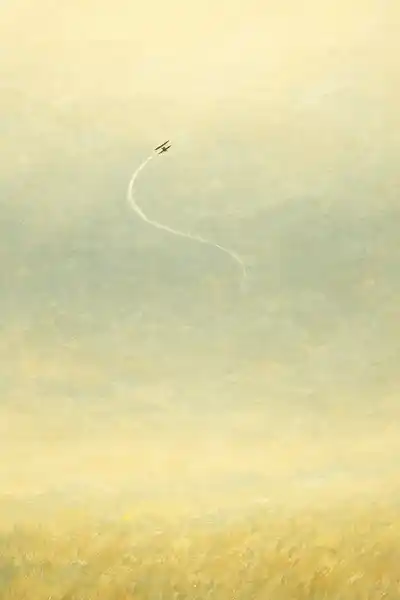
Against this she sets a second figure, drawn from a real encounter: Dave Rahm, a stunt pilot she watched perform over Bellingham. Rahm flew as though the air were a medium he could carve, drawing shapes in the sky that lasted only as long as the eye held them. Dillard was transfixed. Here was mastery so complete it looked like play, an art made entirely of motion and nerve. Rahm later died flying, performing for a king in Jordan. She lets the two images sit together — the moth burning slow, the pilot burning fast — without drawing the moral, because the resemblance is the moral.
04Chapter 4 — What the work asks of a life
Step back from the cabins and the moth and the stunt pilot, and The Writing Life is making a larger claim about how a life gets spent. Dillard's most famous sentence in the book says it plainly: how we spend our days is, of course, how we spend our lives. The line arrives almost casually, but it carries the whole weight of the argument. A writing life is not a series of finished books with intervals of leisure between them. It is the days themselves — the ordinary, repetitive, mostly unglamorous mornings at the desk. What you do with those hours is not the means to the life; it is the life.
This reframes the whole enterprise. We tend to value writers by their output, the objects on the shelf, and to treat the years of labor as the invisible cost of producing them. Dillard inverts the ledger. The years of labor are what the writer actually lived. The books are a kind of exhaust, the trace left behind by a particular way of paying attention, day after day, to something most people never slow down enough to notice. The book is really about attention — sustained, difficult, unrewarded attention — as a way of being alive.
05Conclusion
The book closes as it opens, with a writer alone at a desk, following a line of words to see where it leads. Dillard had spent the years to write it the way she describes writing everything — slowly, in plain rooms, cutting the passages she loved when the work required it. The moth is still burning at the center of the book, and the stunt pilot is still drawing his vanishing shapes over Bellingham, and neither image is resolved, because the life they stand for does not resolve. It simply continues, one uncertain morning at a time.
Related books