Marilyn Monroe
An image she did not control
Description
In August 1962, a coroner in Los Angeles listed the cause of death of Norma Jeane Mortenson, professionally known as Marilyn Monroe, as acute barbiturate poisoning, probable suicide. She was thirty-six. Within days, the newspapers ran the photographs everyone already knew: the platinum hair, the parted lips, the white dress lifting over a subway grate from the 1955 shoot for The Seven Year Itch. The face was so familiar it needed no caption. What almost none of the coverage paused on was that the woman under that face had spent much of the previous decade fighting the people who had assembled it, trying to get some say over how she was photographed, cast, paid, and sold.
The image had a life of its own long before it outlived her. Twentieth Century-Fox had signed a nervous young model, renamed her, capped her teeth, lightened her hair, coached her walk, and built a persona — the breathless, luminous, not-quite-serious blonde — that made the studio a great deal of money and made Monroe, for years, comparatively little. She was under contract at roughly $500 a week while her films grossed in the tens of millions. The persona was an asset. The person holding it up was labor.
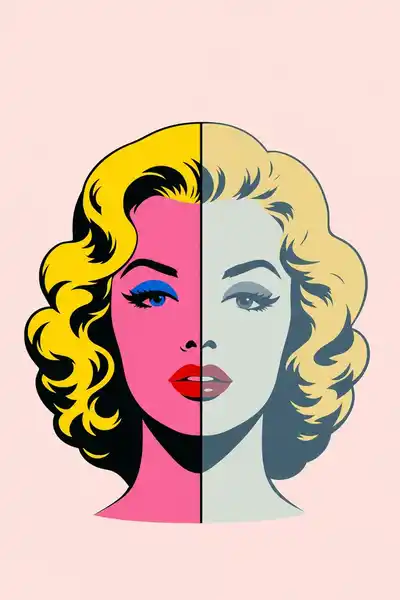
That gap — between the woman and the picture the industry manufactured of her — is the thread worth pulling. Monroe is often told as a tragedy about fame and pills. It is at least as much a story about who owns a face, who profits from it, and what happens to that ownership once the face has no one left to defend it.
The question we’re asking : Who actually controlled the image called Marilyn Monroe — and who controls it now that she can't?What we’ll see : How a studio assembled a persona, how it slipped its maker's grip, and where it ended up once she was gone.
Table of contents
01 Chapter 1 — The studio built her before she could argue
Norma Jeane Mortenson grew up between foster homes and an orphanage in Los Angeles, married at sixteen, and was working in a wartime munitions plant when a photographer noticed her. Modeling led to a screen test, and in 1946 Twentieth Century-Fox signed her to a standard contract. The studio, not the woman, chose almost everything that followed. It picked the name — Marilyn Monroe, borrowed in part from her grandmother — over the one she was born with. It adjusted her hairline, lightened her hair to platinum, and had cosmetic work done on her teeth. The nervous twenty-year-old had little leverage to object.
This was ordinary practice. The studio system of the 1940s and 1950s treated performers as inventory: signed young to long contracts, assigned to films at the studio's discretion, loaned to other studios for a fee the performer often never saw. A player could be dropped, and Fox did drop Monroe once before signing her again. Whatever bargaining power she had came later, after the persona had already been designed around her rather than by her.

02 Chapter 2 — The face that outran the woman
By the mid-1950s the image had become larger than any single film. The 1955 shoot on a New York street for The Seven Year Itch — the white dress billowing over a subway grate — was staged in front of a crowd and a wall of photographers, and the pictures circulated far beyond the movie itself. That single frame did what the persona had been built to do: it distilled Monroe into an instantly legible symbol, endlessly reproducible, detachable from plot, character, or context.
There was a genuine talent underneath, which is part of what made the situation so uncomfortable. Monroe could time a comic line as well as anyone of her era, and directors who worked with her closely, including Billy Wilder, acknowledged her instinct for the camera even as they complained about her lateness and her nerves. But the image the public consumed had no room for craft. It wanted the surface — the glow, the voice, the body — and treated the effort behind it as either invisible or as an inconvenience.
03 Chapter 3 — She tried to own it, and nearly did
Monroe did not simply accept the arrangement. In late 1954 she walked away from Fox, went to New York, and in early 1955 announced the formation of Marilyn Monroe Productions, with the photographer Milton Greene as her partner. It was a striking move for a female star of the era: an attempt to become her own producer, to control what she made and how she was cast, rather than take assignments handed down by a studio that had built her as a joke it profited from.
The gambit partly worked. Fox, unable to make films with its biggest draw while she was on strike, came back to the table. The new contract signed at the end of 1955 gave her better pay, approval over directors and cinematographers on certain projects, and the freedom to make outside films through her own company. She used that leverage almost immediately, pushing for more serious material and studying at the Actors Studio in New York under the intense, revered coaching of Lee Strasberg, chasing the credibility the blonde persona kept denying her.
04 Chapter 4 — The image belongs to everyone but her
When a public image is manufactured this thoroughly, the person's death does not end it — it frees it. The face Fox assembled had always been designed to circulate independently, and once Monroe was gone there was no longer anyone inside the image to argue with how it was used. She became, almost immediately, raw material: for Andy Warhol's silkscreens within weeks of her death, for biographies, films, conspiracy theories, and eventually for T-shirts, mugs, and phone cases sold in every airport in the world.
The legal history of that afterlife is telling. Whether anyone could own and license Monroe's likeness became a genuine courtroom question, litigated for years. The estate, controlled by heirs of Lee Strasberg — the acting teacher, not blood family — asserted publicity rights and collected licensing fees, and the brand consistently ranks among the top-earning of deceased celebrities. Yet in a 2012 ruling, courts effectively held that because Monroe's estate had claimed she was domiciled in New York for tax reasons, and New York did not recognize a post-mortem right of publicity, her image was far more open to use than the estate wanted. The face was property, but the boundaries of that property were decided by lawyers she never met.
05 Conclusion
The coroner's photographs from August 1962 closed the life and opened the franchise. In the six decades since, the white dress and the platinum hair have appeared on more surfaces than Monroe made films, detached from the roles, the strikes, the production company, and the real effort to be taken seriously that filled her actual working years. The picture that a studio built to sell tickets became a symbol that sells nearly everything, and it did so most freely once the only person who could have contested it was gone.
Related books