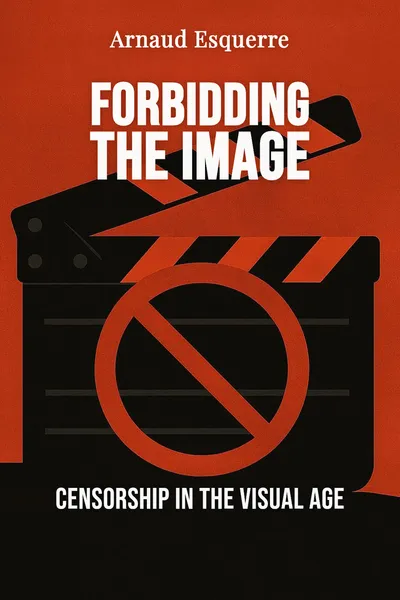
Forbidding the Image
Censorship in the visual age
Description
In January 2015, two gunmen walked into the Paris offices of Charlie Hebdo and killed twelve people. The pretext was a set of cartoons — drawings of the Prophet Muhammad that a satirical magazine had chosen to publish, and republish, over nearly a decade. In the weeks that followed, newsrooms around the world faced a small, concrete decision that turned out not to be small at all: show the cartoons, or not. Some ran them on the front page. Some blurred them. Most looked away. The sociologist Arnaud Esquerre takes that hesitation as a starting point, because it exposes something we rarely examine head-on — the quiet, constant work of deciding which images are allowed to exist in front of us.
We tend to think of censorship as a relic, something states did to painters and films in a less enlightened century. Esquerre's argument runs the other way. In a world saturated with images — screens in every pocket, billions of photographs uploaded a day, moderation systems scanning content at a scale no censor ever dreamed of — forbidding the image has not disappeared. It has multiplied, dispersed, and changed hands. What used to be the job of a bureau with a stamp is now spread across platforms, laws, communities, and algorithms, each drawing its own line.
What interests Esquerre is less the shocking cases than the reasoning underneath them. When we forbid an image, we always give a reason — it offends, it harms, it reveals what should stay hidden. Those reasons feel self-evident in the moment. Looked at together, they form a grammar, a limited set of justifications that recur across centuries, religions, and régimes. And behind every one of them sits a question the grammar tends to hide.
The question we’re asking : What do we actually appeal to when we decide an image must not be seen — and who ends up holding that power?What we’ll see : How Esquerre reads the long, shifting practice of banning images, from the sacred to the screen, and the authority quietly at stake in each ban.
Table of contents
01 Chapter 1 — The image that asks to be banned
Esquerre begins with a deceptively simple observation: an image is never just forbidden in the abstract. Someone looks at a specific picture, judges that it should not circulate, and acts. A painting is covered, a photograph is pulled, a video is flagged and removed. The ban is always a concrete gesture performed on a concrete thing. And yet the moment we try to say why, we reach for categories much larger than the single image in front of us — blasphemy, obscenity, incitement, privacy. The particular picture becomes an instance of a general danger.
This is where Esquerre's method shows its value. Rather than treating censorship as a single phenomenon with a single history, he treats it as a set of operations that share a form but differ wildly in their targets. The Byzantine iconoclasts who smashed religious images in the eighth century and a platform removing a beheading video in 2015 are not doing the same thing — but they are performing the same basic act, and justifying it in ways that rhyme. The sociologist's job is to map those rhymes without collapsing the differences.

02 Chapter 2 — Three families of reasons
When Esquerre sorts the justifications we give for forbidding images, a pattern emerges. The reasons cluster into a small number of families, and almost every historical case belongs to one or more of them. The first concerns the sacred: some images are banned because they touch what must not be depicted, or depict it wrongly. The prohibition on representing the divine runs through Judaism, Islam, and long stretches of Christianity. To make an image of the holy is to risk confusing the sign with the thing, to turn worship into idolatry. The Charlie Hebdo cartoons sit squarely here — not because they were obscene, but because they crossed a line around the figure of the Prophet.
The second family concerns decency and the body. Across centuries, authorities have forbidden images judged obscene, indecent, or corrupting — nudes, erotica, pornography, anything held to arouse what should stay dormant. The reasoning shifts with the era, from protecting public morals to protecting children, but the move is consistent: certain depictions of the body are said to damage those who see them, especially the young and the supposedly impressionable. What counts as obscene is endlessly redrawn, which is precisely what makes this family so revealing. The line moves, but the gesture of drawing it does not.
03 Chapter 3 — The machinery behind the ban
A reason is not enough to forbid an image. Someone has to act on it, and the apparatus that does the acting is the part Esquerre insists we not overlook. For most of the modern era, that apparatus was the state. Censorship boards reviewed films before release, courts seized offending prints, religious authorities condemned and administrations enforced. The ban had an address and a signature. You knew, more or less, who had decided and on what grounds, and in principle you could contest it.
That architecture has not vanished — laws against child abuse imagery, incitement, and defamation remain firmly in place — but it has been overtaken by something larger and stranger. The dominant machinery of forbidding today belongs to private platforms. Facebook, YouTube, and their peers remove images at a scale that dwarfs any ministry of culture, under rules they write themselves, enforced partly by human moderators and increasingly by automated systems trained to recognize banned categories before a single person complains. The decision to forbid has been industrialized.
04 Chapter 4 — The hand that draws the line
Step back from the particular cases and a single question organizes the whole inquiry: who decides? Esquerre's survey of reasons and machinery keeps returning to this, because it is the thing the reasons are built to obscure. When a ban is justified by the sacred, the decency of the public, or the prevention of harm, the justification presents itself as impersonal — as if the image simply is forbidden, by its nature, and the authority merely recognizes the fact. But there is always a hand drawing the line, and that hand has an interest, a position, a power it is exercising.
What the visual age changes is not the existence of that hand but its multiplication. Where once a relatively small number of authorities held the power to forbid, now it is distributed across states, courts, platforms, communities, and the automated systems they deploy. This looks, at first, like a diffusion of power — no single censor, no central bureau. Esquerre's reading is less reassuring. Diffused authority is not absent authority; it is authority that is harder to locate, harder to contest, and easier to deny. When no one admits to deciding, everyone who decides is protected.
05 Conclusion
The newsrooms that hesitated over the Charlie Hebdo cartoons were not cowards or heroes; they were, each in their own way, deciding. To publish or withhold was to take a position on the sacred, on harm, on the force of an image — and to claim, quietly, the authority to make that call for their readers. Multiplied across every platform, court, and moderation system, that same small act repeats billions of times a day, mostly unseen. Esquerre's book is an argument for noticing it.
Related books