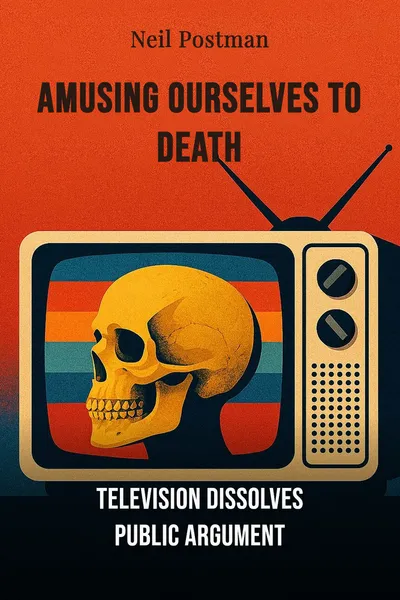
Amusing Ourselves to Death
Television dissolves public argument
Description
In the summer of 1858, in a string of Illinois towns, Abraham Lincoln and Stephen Douglas squared off in a series of debates about slavery and the future of the Union. The format was brutal by any modern standard. One man spoke for an hour, the other answered for ninety minutes, the first came back for a half-hour rejoinder. Crowds stood in the heat through all of it, following clause by clause, qualification by qualification. These were ordinary citizens — farmers, shopkeepers, people who had ridden in from the countryside — and they could hold a three-hour argument in their heads and judge it.
In 1985, a media critic named Neil Postman used that scene to open a short, sharp book called Amusing Ourselves to Death. His point was not nostalgia. It was that the audience of 1858 was shaped by a particular medium — the printed word — that trained the mind toward sequence, logic, and sustained attention. Public life in a print culture took the form of an argument you could win or lose on the merits. Then a new medium arrived, and the form changed with it.
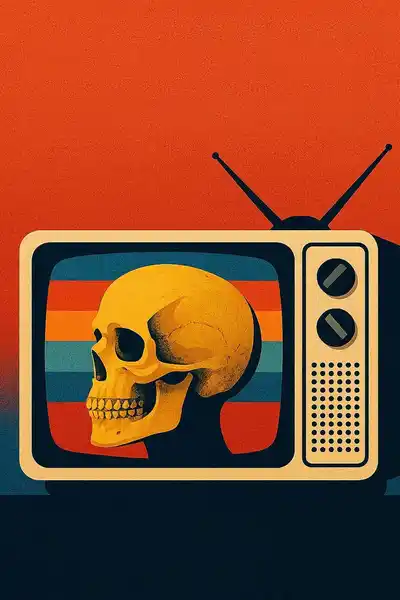
Television, Postman argued, is not merely a channel that happens to carry trivial content. It is a medium with a bias of its own — toward images, speed, and pleasure — and that bias reshapes everything it touches, including the serious business of news, politics, religion, and education. The worry is not that television entertains. It is that entertainment becomes the frame through which a whole culture conducts its public affairs.
The question we’re asking : What happens to public argument when a culture stops reading and starts watching — when the dominant medium rewards amusement over coherence?What we’ll see : How Postman traced the shift from a print-shaped mind to a television-shaped one, and why he thought the danger wears a smiling face rather than a boot.
Table of contents
01 Chapter 1 — The Lincoln-Douglas debates ran seven hours
Postman spends his first chapters reconstructing what he calls the Age of Typography — roughly the eighteenth and nineteenth centuries in America, when print was the dominant way ideas moved through public life. Literacy rates in the colonies were strikingly high, pamphlets circulated widely, and a book like Thomas Paine's Common Sense sold in numbers that, adjusted for population, would be hard to match today. Reading was not an elite activity. It was the ordinary medium of citizenship.
What interests Postman is less the volume of reading than the kind of mind it produced. To follow a printed argument, you have to sit still, hold earlier points in memory, detect a contradiction, weigh evidence against a claim. Print has a built-in bias toward exposition — toward the orderly, sequential presentation of propositions that can be examined and challenged. A culture soaked in print, he argues, naturally comes to expect public discourse to behave the same way: coherent, serious, answerable.

02 Chapter 2 — Orwell was wrong, Huxley was right
Postman frames the whole book around a contest between two famous warnings. George Orwell, in 1984, imagined a future in which freedom is crushed from the outside — by surveillance, censorship, pain, and the deliberate withholding of information. Aldous Huxley, in Brave New World, imagined something gentler and, Postman thinks, more accurate: a future in which people come to love the technologies that undo their capacity to think, in which no one needs to ban a book because no one wants to read one.
The distinction organizes everything that follows. Orwell feared those who would deprive us of information; Huxley feared those who would give us so much that we would be reduced to passivity and egoism. Orwell feared the truth would be concealed; Huxley feared it would be drowned in a sea of irrelevance. Postman's wager is that the free, television-saturated societies of the West were drifting toward Huxley, not Orwell — that the threat to public seriousness came dressed not as a jackboot but as a laugh track.
03 Chapter 3 — How the medium quietly sets the terms
The intellectual engine of the book is a claim Postman borrows and sharpens from Marshall McLuhan: the medium is the message, or as Postman prefers it, the medium is the metaphor. A medium does not just deliver content neutrally. It carries a bias about what kinds of content are natural to it, and over time that bias becomes the culture's unexamined idea of what truth and seriousness look like. Each medium, he says, has a resonance that outlasts its origins and reshapes consciousness itself.
He traces this through the history of communication. Smoke signals cannot carry philosophy; the medium forbids it. A culture that knows the world through the spoken word organizes knowledge around proverb and memory. A culture that knows it through print organizes knowledge around the argument and the footnote. And a culture that knows it through the image organizes knowledge around the arresting picture and the quick emotional hit. None of this is a matter of good or bad programming. It is structural, built into the grain of each form.
04 Chapter 4 — When news became a variety show
Here Postman steps back from any single program to the governing form itself, and his sharpest case is the one phrase every broadcast relies on: "Now... this." It is the hinge that lets a newscast pivot from a famine to a soft-drink ad to a sports score to the weather, each item severed from the last. The phrase, he argues, is an admission built into the medium — that nothing on the screen has any necessary connection to anything else, that every item is complete in forty seconds and then gone.
The consequence is a peculiar kind of informedness. Television news offers a flood of decontextualized fragments, delivered by attractive people against pleasant music, with no expectation that the viewer will act on any of it or even remember it past the next segment. Postman calls this disinformation — not false information exactly, but information so fragmented and fast that it produces the feeling of knowing while eroding the capacity to think. The audience ends up with opinions about everything and understanding of almost nothing.
05 Conclusion
Postman ends where he began, with the contrast between two kinds of audience: the crowd that stood for hours in an Illinois field to follow an argument, and the viewer who absorbs a famine and a sitcom in the same relaxed half-hour. The distance between them is not a matter of intelligence. It is a matter of the medium each was shaped by, and of what each had come to expect public life to feel like. Print asked the mind to work; television asks it to watch. Over a culture's lifetime, that difference hardens into a whole way of knowing.
Related books