Costco’s hot dog
The $1.50 price that anchors the brand
Description
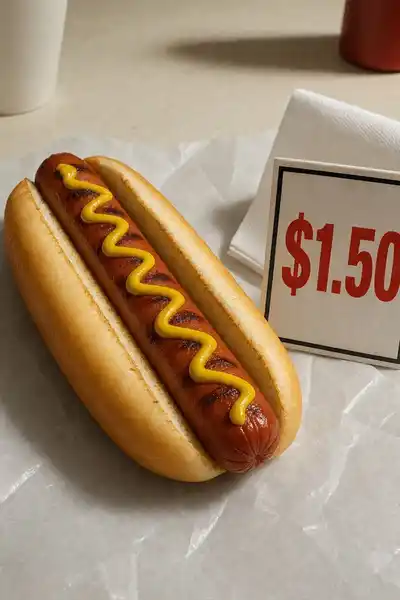
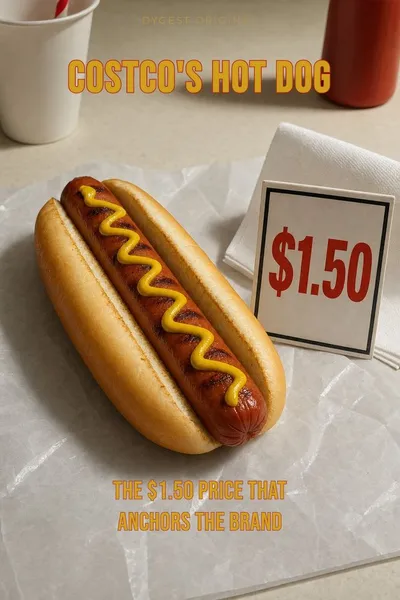
In 1985, Costco’s first food court opened at the company’s warehouse in Seattle and began selling a quarter-pound all-beef hot dog with a soda for $1.50. Forty years later, in 2025, the price is still $1.50. The cost of a quarter-pound hot dog has, by the standard measures of food-cost inflation, roughly tripled across that period. The cost of running a food court, paying the workers, sourcing the materials, processing the credit-card transactions, has risen substantially. Every other item on the Costco menu has been repriced repeatedly across the forty years. The hot dog has not. The company has refused, repeatedly and publicly, to raise the price. When a Costco CEO suggested in 2022 that the price might eventually have to be increased, the founder, Jim Sinegal, reportedly told him that if he raised the price, “I’ll kill you.” The quote may not be exactly accurate. The position it represents is.
The hot-dog price has become, across forty years, one of the most recognized commercial commitments in American retail. It appears in business-school case studies, in financial news coverage of Costco’s quarterly results, in social-media commentary every time inflation makes the gap between the price and the apparent cost more visible. The commitment is, in any conventional accounting sense, irrational. Costco loses money on every hot dog sold. The food court as a whole is, on a fully loaded cost basis, marginal at best. The decision to maintain the $1.50 price is a strategic choice the company has made deliberately, and the strategic argument behind the choice has been one of the more interesting demonstrations in modern retail of how a small commercial gesture can do disproportionate work for a brand.
Costco itself is a substantial and unusual operation. The warehouse-club model the company has built since its founding in 1983 has become one of the most successful retail formats in American commercial history. By 2025, Costco operates over 870 warehouses worldwide, has annual revenue exceeding $250 billion, and is the third-largest retailer in the world by revenue, after Walmart and Amazon. The company’s customer-loyalty metrics, its membership-renewal rates, its employee retention, and its same-store sales growth have been the envy of competing retailers for decades. The $1.50 hot dog is a small piece of this larger operation, but a piece that does substantially more work than its price suggests.
The question we’re asking: why has Costco maintained the hot-dog price for forty years, what does the commitment do for the brand, and what does the case reveal about how retailers build customer relationships?
What we’ll see: the Costco warehouse model, the strategic logic of the hot-dog price, the broader commitment to known-value items, and what survives.
Table of contents
01 A warehouse club and a different kind of retailer
Costco had been founded in 1983 by Jim Sinegal and Jeffrey Brotman in Seattle. The model was based on the Price Club operation that Sol Price had developed in San Diego in 1976, where Sinegal had worked for the previous decade. The two companies merged in 1993 to form Costco Wholesale Corporation, which became one of the dominant warehouse-club operators globally.
The structural features of the Costco model were specific. Members paid an annual fee currently $65 for basic and $130 for executive for the right to shop at the warehouses. The membership fee revenue, rather than the markup on products, was the primary source of profits. Products were marked up at 14 to 15 percent above wholesale, compared to 25 to 50 percent at conventional grocers. The low markup gave members the sense that they were getting wholesale prices, which they largely were.

02 The hot dog and the strategic logic
The hot-dog combo, priced at $1.50, became one of the most-discussed features of the Costco operation across the 2010s as the gap between the price and apparent costs became more visible. The standard cost analysis, performed many times by financial journalists and retail analysts, has placed the actual cost of the combo somewhere between $2.50 and $3.50, depending on how labor, real estate, and overhead are allocated. The food court as a whole is, on a fully loaded basis, either a small loss or a very small profit, depending on the same allocation methods. The commitment to the price is, on any conventional accounting analysis, a deliberate decision to lose money.
The strategic argument for the loss has been articulated, in various forms, by Sinegal and his successors. The hot dog is what retail analysts call a known-value item a product whose price is well-known to consumers and which therefore functions as a signal of the retailer’s overall pricing posture. A customer who pays $1.50 for the hot dog at Costco, and who has paid $5 for a comparable hot dog at a baseball game or at a movie theater, develops an emotional sense that Costco is the place where prices are better. The sense generalizes from the hot dog to the rest of the warehouse. The customer who buys the hot dog and then walks through the warehouse is, in significant part, primed to feel that the larger purchases she makes during the visit are also good deals.
03 The internal commitment and the cultural feature
The internal commitment to the hot-dog price has been stronger than for a normal product-pricing decision. The price has been treated as a sacred commitment that successive CEOs have inherited from Sinegal. The 2022 conversation between Sinegal and Craig Jelinek has become company folklore. Sinegal’s reported “I’ll kill you” comment was a joke but reflected a real organizational position: the price was not to be raised.
The reasons go beyond the known-value-item logic. The hot dog has become, over forty years, a piece of the company’s identity. It is one of the things customers tell friends about when describing Costco. It appears in annual reports. The CEO is asked about it in earnings calls. The commitment has accumulated cultural weight that exceeds the financial implications.
04 What survives, forty years on
The $1.50 hot dog has become, in 2025, one of the most-discussed commercial commitments in modern retail. The price has been maintained across forty years of inflation, multiple economic cycles, and several leadership transitions. The strategic argument behind the price that the known-value item signals the retailer’s overall pricing posture has been substantially validated by the company’s operational performance. The cultural weight the commitment has accumulated has made the price difficult to change even when the financial arguments for changing it have strengthened.
The competing retailers have not consistently been able to match the Costco model. Sam’s Club, the Walmart-owned warehouse-club competitor, has been the closest direct competitor and has had moderate success, but has not produced the customer-loyalty metrics that Costco has. BJ’s Wholesale Club, the third major US warehouse-club operator, has remained smaller and more regional. The Costco approach narrow product selection, deep supplier relationships, high employee compensation, deliberate margin compression on known-value items has been distinctive enough that imitation has been imperfect, and the company has continued to operate at scale that its competitors have not been able to match.
05 Conclusion
Jim Sinegal stepped down as Costco CEO in 2011 and as a board member in 2018. The company has continued under Craig Jelinek and, since 2024, Ron Vachris. The hot-dog price has remained at $1.50 across the leadership transitions. The cultural commitment to the price has been maintained, and the company’s public communications continue to emphasize the price as one of the features that customers recognize and value.
Related books