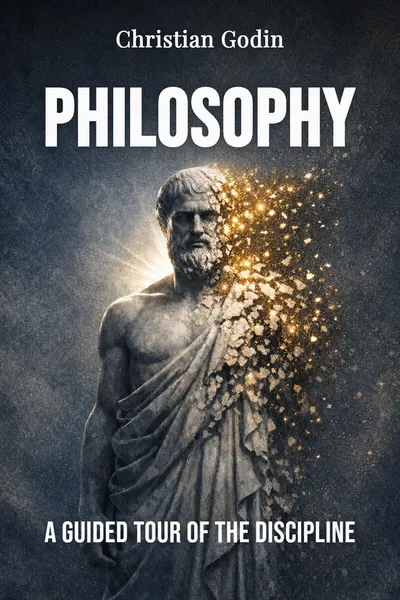
Philosophy
A guided tour of the discipline
Description
At some point, usually late, usually tired, we all ask the kind of question that has no obvious address. Not "what time is it" but "what is time." Not "did I do the right thing" but "what makes an act right in the first place." These questions arrive uninvited, they refuse to stay answered, and they have a name that most of us learned to mistrust somewhere around a dull high-school textbook. The name is philosophy, and in his compact survey of the discipline, the French philosopher Christian Godin sets out to do something unfashionable with it: take it seriously, and make it legible, without draining the life out of it.
Godin's wager is that philosophy is not a museum of dead opinions, nor a private game for specialists who enjoy arguing about whether the table is really there. It is, in his telling, a living activity with a shape — a set of regions, each with its own terrain, its own great questions, its own history of brilliant failures. Metaphysics, ethics, logic, aesthetics, political philosophy: these are not random drawers in an old cabinet. They are the places where the human mind keeps running into the same walls, in every century, in every language, and keeps deciding the walls are worth examining.
What Godin offers is closer to a guided tour than a grand theory. He walks the reader through the country rather than selling a single map of it, and he resists the two easy temptations: turning philosophy into a self-help kit, or embalming it as intellectual history. The result is a book that treats the reader as an adult who has never been shown around, and who might, once shown, start seeing the questions everywhere.
The question we’re asking : What exactly is philosophy doing when it refuses to give a final answer, and why has it survived two and a half millennia of doing so?What we’ll see : A walk through the discipline's main regions, its core questions, and the stubborn reason they never quite close.
Table of contents
01 Chapter 1 — The itch nobody can scratch
Godin starts where the word itself starts. Philosophia, in Greek, means the love of wisdom — not its possession. The distinction matters more than it looks. A sage, in the old sense, would be someone who had arrived; a philosopher is someone still on the road, and content to be. The posture is one of pursuit rather than mastery, which is why Socrates, who claimed to know only that he knew nothing, became the discipline's founding figure rather than an embarrassment to it.
That pursuit has a specific flavor. Philosophy, Godin notes, tends to begin not with the exotic but with the ordinary — the things we assume we understand precisely because we never stop to look. We use the word "time" fluently all day and go silent the moment someone asks what it is. We know a just act when we see one and can't say what justice is. Philosophy is the move of stopping on the familiar word, the one everyone walks past, and asking it to account for itself.

02 Chapter 2 — The map of a single country
If philosophy is one activity, it is nonetheless spread across distinct territories, and Godin spends much of the book sketching them. The oldest and most vertiginous is metaphysics — the inquiry into what fundamentally exists. Behind the appearances of the world, is there a deeper reality? Is being one thing or many? What is substance, cause, identity, nothingness? Aristotle called it "first philosophy" because every other question seems to lean on it, and Godin treats it as the discipline's load-bearing wall, however often people have declared it condemned.
Branching off metaphysics is the philosophy of nature and, later, the philosophy of mind — the question of what we are. Are we bodies, souls, some uneasy combination, or a word for a process? Descartes split mind from matter and bequeathed a problem nobody has cleanly solved since: how a thought can move an arm. Godin shows how this ancient puzzle quietly feeds into the most contemporary debates, from neuroscience to artificial intelligence, without ever being dissolved by them.
03 Chapter 3 — Logic, ethics, and the problem of knowing
Underneath every region runs a common requirement: thinking well about the thinking itself. This is logic, which Godin presents less as a dry technical appendix than as philosophy's conscience. Logic studies the forms a valid argument can take — what follows from what, independent of whether the premises happen to be true. Aristotle gave it its first systematic shape with the syllogism; the twentieth century rebuilt it with mathematical precision. Its job is modest and indispensable: to keep an argument honest, to catch the move where a conclusion is smuggled in rather than earned.
Ethics is where philosophy touches the nerve of daily life most directly, and Godin lays out the great rival answers rather than choosing between them. There is the line that judges an act by its consequences, measuring good by the happiness it produces. There is Kant's opposing insistence that some duties bind us regardless of outcome, that a person must never be treated merely as a means. And there is the older tradition, running from Aristotle, that asks less about rules than about character — what virtues make a human life flourish. These positions genuinely conflict, and Godin's point is that the conflict is instructive, not embarrassing.
04 Chapter 4 — Why the questions refuse to close
Here is the objection Godin knows is coming, and meets head-on. If philosophy has argued about the same handful of questions for twenty-five centuries without reaching agreement, hasn't it simply failed? Sciences advance, settle, move on; philosophy seems to circle. To a certain cast of mind this looks less like a discipline than a very long, very polite disagreement that never ends.
Godin reverses the charge. The questions philosophy asks are the ones that, by their nature, cannot be closed — and that is not a defect but the definition. A question gets a final answer when it can be handed to a method that decides it: measure, calculate, observe, conclude. But "what is justice" or "what should I do" or "what can I truly know" are not of that kind. They concern the frameworks within which we measure and decide in the first place. Settle them permanently and you would have to stop being a thinking being and become a machine executing a verdict.
05 Conclusion
The tour ends more or less where it began, with the ordinary person stopped on an ordinary word. Godin's book does not hand the reader a philosophy to adopt; it hands them the country and its roads — metaphysics asking what is, ethics asking what to do, logic keeping the argument honest, each province distinct and all of them connected. What the survey makes visible is that the discipline's famous inconclusiveness is not a bug it has failed to fix. It is the shape of questions that live where measurement cannot follow.
Related books