The Age of Absurdity
Why modern life makes us laugh
Description
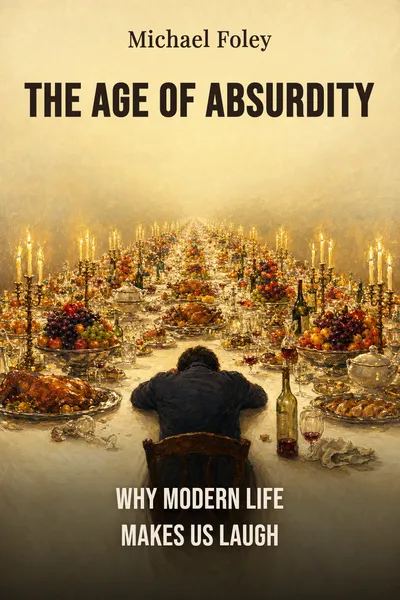
In 2010, an Irish writer and academic named Michael Foley published a book with a title that sounded like a complaint and read like a diagnosis: The Age of Absurdity. Foley had spent decades teaching in London, watching the machinery of modern well-being expand around him — the self-help shelves, the wellness apps, the promise that the right technique could dissolve any discontent. And he noticed something odd. The more elaborate the promise of happiness became, the more elusive happiness itself seemed to get. People had more freedom, more choice, more comfort than any generation in history, and reported feeling roughly no better for it.
His book set out to explain the gap. Not with statistics or a program, but with a long, funny, unusually well-read argument. Foley pulled together neuroscience, Buddhist thought, Stoic philosophy, and the novels of Beckett and Proust to make a single case: the conditions of contemporary life are almost perfectly designed to prevent the very contentment they claim to deliver. Every message we absorb — that we deserve more, that we can have it instantly, that we are unique and entitled — quietly undercuts the disciplines that actually produce a satisfying life.
What could have been a sour lament turns out to be something stranger and warmer. Foley is not scolding. He treats the whole spectacle — the affirmations, the makeovers, the frictionless convenience — as genuinely comic, a farce we are all cast in and mostly cannot see. The absurdity of the title is not an insult. It is closer to a punchline, and Foley delivers it with the air of someone who has decided that the only sane way to survive the joke is to laugh at it.
The question we’re asking : Why does a culture organized around happiness leave so many people feeling cheated of it?What we’ll see : How Foley traces the modern discontent, borrows from old thinkers to name it, and arrives, against expectation, at something like a grin.
Table of contents
01 Chapter 1 — The promise of everything, right now
Foley starts with the sales pitch of modern life, because it is everywhere and almost invisible. The culture we swim in makes a set of standing promises: that we are entitled to fulfilment, that it should arrive quickly, that any obstacle is an injustice, and that the self we happen to have is precious and worth celebrating exactly as it is. These messages come from advertising, from politics, from the entire apparatus of consumer capitalism, and they are relentlessly flattering. Nobody selling anything ever tells us we might be the problem.
The trouble, Foley argues, is that this pitch inverts everything the serious traditions of thought have said about contentment. The old wisdom — Stoic, Buddhist, monastic — held that satisfaction comes from wanting less, accepting limits, and doing difficult things slowly. The modern pitch says the opposite: want more, refuse limits, and expect it without delay. We have built a civilization that systematically trains us in exactly the appetites that make peace of mind impossible.

02 Chapter 2 — What the philosophers already knew
Having named the problem, Foley reaches back for people who saw it coming. His method is that of a well-read friend rather than a scholar: he raids the whole library and drops names the way you would in a good conversation, because the ideas are useful, not because they are authorities. The Stoics turn up first. Epictetus, a former slave, taught that the one thing genuinely in our power is our own judgement, and that misery comes from staking our peace on things — reputation, comfort, other people — that we cannot control. The modern self does the exact reverse, tethering its mood to a thousand external ratings it can never secure.
Buddhism supplies the other pillar. The insight that craving itself is the engine of suffering — that the wanting hurts more than the not-having — maps precisely onto a consumer culture built to keep desire perpetually stoked. Foley is careful not to turn this into a wellness slogan. He respects the difficulty of the practice, the years of attention it demands, precisely because that difficulty is what modern life has trained us to skip.
03 Chapter 3 — The self as full-time project
Foley reserves particular relish for what modern culture has done to the self. Somewhere in the last few decades, the self stopped being something you simply were and became something you had to develop, brand, optimise, and above all express. The result is a peculiar full-time occupation: managing, monitoring, and marketing a personality as though it were a small business that must never post a loss. Foley finds this exhausting to watch and, he suspects, exhausting to be.
The cult of self-esteem is his prime exhibit. We are told to love ourselves unconditionally, to affirm our worth regardless of what we do, to treat any self-criticism as a kind of injury. This sounds kind. Foley thinks it is quietly disastrous, because self-respect that is not earned by actual effort or achievement floats free of reality and needs constant external topping-up. Unconditional self-esteem produces not calm confidence but a fragile, hungry ego that reads every slight as an outrage.
04 Chapter 4 — Laughing at the trap we built
What lifts The Age of Absurdity above the ordinary lament is where Foley finally lands. He could have ended in gloom, or in a program — ten steps to reclaim your attention. He does neither. Instead he steps back and asks what kind of situation this really is, and decides it is not a tragedy but a farce. The gap between what our culture promises and what a human mind can actually sustain is not a bug to be patched. It is permanent, structural, built into the collision between infinite appetite and finite life. And the honest response to a permanent absurdity is not despair. It is comedy.
This is why Beckett matters so much to him. Beckett's characters go on, absurdly, hopelessly, and somehow the going-on is funny rather than merely bleak. Foley wants us to see our own predicament the same way — the affirmations, the life-hacks, the frictionless self-improvement that improves nothing — as a spectacle grand enough to be enjoyed. Seeing the joke does not exempt us from it. But it does grant a small, precious distance, and distance is the one thing the culture of constant self-involvement will not give us.
05 Conclusion
Foley never pretends to have solved anything. The pressures he describes — the relentless flattery, the instant everything, the self as permanent project — are not going away, and he offers no technique to escape them, which is precisely his point. The traditions he admires all agree that contentment is slow, effortful, and reconciled to limits, and modern life is organized to make each of those qualities feel like a failure. Naming the gap does not close it. But it does change how we stand inside it.
Related books