The Future of Human Nature
Biotechnology meets moral limits
Description
Around the turn of the millennium, as the human genome was being mapped and the first serious talk of designer embryos moved from science fiction into bioethics journals, a German philosopher better known for theories of democracy and communication turned his attention to something more intimate. Jürgen Habermas, then in his early seventies, had spent decades arguing that modern societies should stay neutral about what makes a good life — that the state has no business telling anyone how to live. In a short, dense book published in German in 2001 and in English in 2003, he found a place where that neutrality cracked.
The occasion was the debate over preimplantation genetic diagnosis and the more distant prospect of positive genetic engineering — not screening out disease, but enhancing traits, choosing in advance what a future child would be. Most of the argument around it was familiar: safety, consent, the risk of a new eugenics. Habermas wanted something harder to pin down. He suspected that letting one generation program the genetic makeup of the next would quietly alter something we rarely name — the way we understand ourselves as free, equal persons who author our own lives.
That suspicion is awkward for a thinker who had built a career defending the right of individuals to define the good for themselves. If people are free to choose, why not let parents choose their children's traits? Habermas's answer runs against his own liberal instincts, and he knows it. The book is the record of a careful mind deciding that, on this one question, staying neutral is not an option.
The question we’re asking : Can a society committed to leaving the good life to private choice say anything binding about parents redesigning their children?What we’ll see : How a philosopher of neutrality came to argue that one kind of freedom, pushed far enough, undoes the ground freedom stands on.
Table of contents
01 Chapter 1 — A question philosophy had managed to avoid
For most of the twentieth century, liberal philosophy worked hard to keep two things apart. On one side sat questions of justice — the rules we owe each other, the rights that let us coexist. On the other sat questions of the good life — what makes an existence worth living, which Habermas and others insisted should be left to each person's own conscience. The achievement of modern pluralism, on this view, was precisely that it stopped legislating meaning. A secular state does not tell its citizens whether to marry, pray, or chase ambition. It sets the terms of fair cooperation and otherwise steps back.
Habermas had been one of the sharpest defenders of this arrangement. His whole project rested on the idea that legitimacy comes from procedures we can all accept, not from some shared vision of human flourishing we no longer have. So when he looked at genetic enhancement, the expected move would have been to shrug: another private choice, another domain where the state keeps quiet. Many liberal bioethicists made exactly that move, arguing that reproductive liberty simply extends to the genome.

02 Chapter 2 — The difference between growing and being made
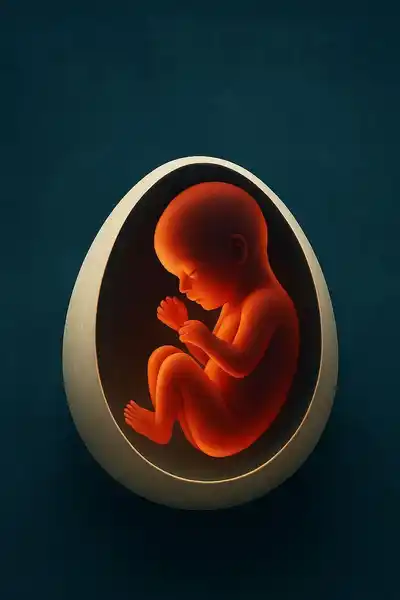
The heart of Habermas's argument is a distinction that sounds almost too simple: there is a difference between something that grows and something that is made. A person who grows up is shaped by countless influences — parents, teachers, accidents, their own choices — but no single author stands behind the shape they take. A made thing, by contrast, carries the intention of its maker. It exists because someone decided it should, and decided what it should be.
Until now, Habermas says, every human being has belonged firmly on the side of the grown. Your genetic endowment was nobody's decision. Your parents raised you, pressured you, loved you badly or well, but they did not design you from the ground up. Even the most controlling upbringing leaves open the possibility of revolt, reinterpretation, starting over — you can revise the story your parents told about you. The genome was the one thing that stood outside this whole negotiable field of influence, a contingency shared by everyone equally.
03 Chapter 3 — When a programmer enters the picture
What does that asymmetry do to the person who results? This is where Habermas presses hardest. Our sense of ourselves as free agents, he argues, rests partly on a kind of fiction we never examine — the assumption that we are the undivided authors of our own lives, that nothing in us was dictated by a foreign will. We know, of course, that genes and upbringing shaped us. But those causes were anonymous. No one meant them. A designed person would know something different: that a specific other person, with specific purposes, authored a part of who they are, and did so before they could object.
Habermas calls this a disturbance in the symmetry between persons. Ordinarily, when adults stand before each other, they meet as equals — nobody is the acknowledged source of anyone else's being. Parent and child eventually arrive at that equality; the child grows up and the authority relationship dissolves into mutual recognition. But between a designed person and their designer, that equality can never fully arrive. The programmer remains, in a literal sense, behind the other's existence, and the designed person remains downstream of a decision they had no part in. The relationship cannot be reversed or outgrown.
04 Chapter 4 — The ethics of the species itself
Step back, and the deeper move in Habermas's book becomes visible. He is arguing that liberal neutrality, which he spent a lifetime defending, cannot be total. There is at least one background condition the liberal order quietly depends on and must therefore protect: the shared sense that all persons are, in their natural origins, equal and self-authoring. Strip that away and the moral architecture of equality loses its footing. We grant each other recognition as free and equal partly because none of us was made to another's specification. Begin making people, and the premise erodes — not for the individual alone, but for how the whole species understands what a person is.
This is why he frames it as an ethics of the species rather than a question of individual rights. Rights-talk assumes stable persons who can claim them. What is at stake with genetic programming is prior to that: the very self-understanding that lets us see ourselves as rights-bearers in the first place. Habermas is reaching for something he admits philosophy has rarely needed to articulate — a defense of the human as a form of life whose members meet as equals because they are all, in the same way, grown rather than engineered.
05 Conclusion
The book ends where it began, with a thinker reluctantly abandoning his own neutrality. Habermas had spent decades insisting that modern societies should not legislate the good life. Here he argues that one apparent extension of private freedom — parents authoring their children's traits — would corrode the shared condition that makes freedom and equality intelligible at all. The grown and the made are not just two categories of thing; they mark the difference between a person who can regard their life as their own and one who must reckon with another's design behind it.
Related books