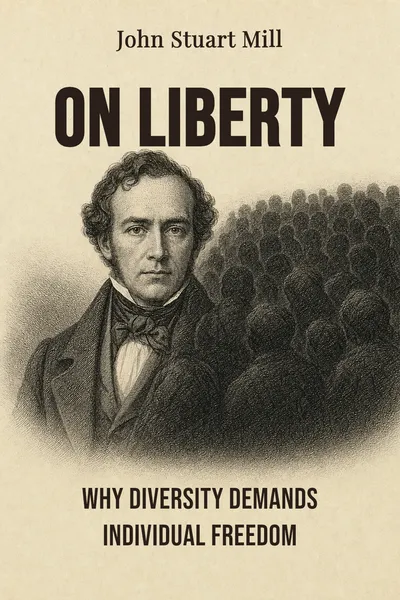
On Liberty
Why diversity demands individual freedom
Description
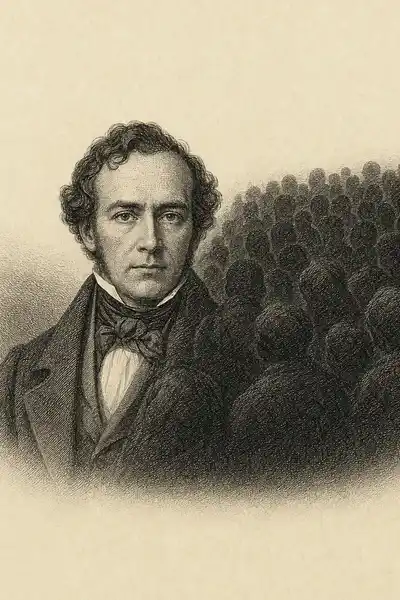
In 1859, a fifty-two-year-old Englishman named John Stuart Mill published a short book that ran barely a hundred and fifty pages. He had been a strange child — taught Greek at three, reading Plato in the original by eight, marched through an education so intense his father designed it as an experiment in producing a reasoning machine. Mill had also, in his early twenties, suffered a breakdown that left him doubting whether a life built entirely on logic was worth living. On Liberty carries the weight of both experiences: the trained analyst and the man who nearly broke under the training.
The book was written in close collaboration with Harriet Taylor, whom Mill had loved for two decades and married in 1851, and who died in 1858, the year before publication. Mill dedicated it to her memory in terms that embarrassed his Victorian readers. The subject was deceptively narrow: how much power should society have over the individual? Not the state alone — Mill was more worried about something quieter, the pressure of opinion, the way a community makes everyone resemble everyone else without ever passing a law.
That worry has not aged. Mill was writing before mass media, before the algorithms that now sort us into agreement, and yet he named the mechanism precisely. He argued that the greatest threat to a free society was not the tyrant but the majority — and that what a society sacrifices when it enforces conformity is the very thing that lets it improve.
The question we’re asking : How much power should a society hold over the person who simply refuses to be like everyone else?What we’ll see : How Mill draws the line between the self that belongs to us and the actions that touch others — and why he stakes human progress on defending it.
Table of contents
01 Chapter 1 — The tyranny that wears no crown
Most people in 1859 understood liberty as a contest between rulers and ruled. You limited the king, you extended the vote, and freedom followed. Mill thought this picture was a generation out of date. Once a people governs itself, he pointed out, the ruler and the ruled become the same body — and a new danger appears, one that constitutional checks do nothing to catch. The majority can oppress the minority just as thoroughly as any monarch, and it needs no throne to do it.
What Mill feared most was not law but opinion. A society, he wrote, can issue its own mandates, and when those mandates are wrong they penetrate far deeper into life than any statute. The law reaches your conduct; social pressure reaches your soul. It shapes what you dare to think, what you admit to wanting, which parts of yourself you quietly amputate so as not to stand out. He called this the tyranny of the prevailing feeling — a despotism of custom that leaves no room for anything it has not already approved.

02 Chapter 2 — One idea against the whole world
Mill's boldest claim concerns opinion, and he states it without softening. If all humankind minus one were of a single mind, and only one person held the contrary view, silencing that one person would be as wrong as it would be for that one person, holding power, to silence everyone else. The number of people who agree changes nothing. Truth is not settled by counting heads, and the act of suppression is an injury whether the sufferer is a multitude or a single voice.
Why so absolute? Because, Mill argues, we can never be certain we are right. Every age has held beliefs that later ages found not merely false but grotesque, and every age was as sure of itself as we are. To silence an opinion is to assume our own infallibility — to declare the question closed on the strength of the very confidence that history keeps proving unreliable. The dissenter we suppress may be carrying the correction we most need.
03 Chapter 3 — The single reason to interfere
Having defended the freedom to think, Mill turns to the harder territory: the freedom to act. Here he is careful, because action can hurt people in ways that opinion rarely does. His line holds, but it needs sharpening. Conduct divides in two. There is the part that concerns only ourselves, and there is the part that affects others — and only the second part is society's business at all. Over the first, individuality has an absolute claim.
The distinction is easy to state and endlessly argued over, because almost anything we do touches someone somehow. Mill anticipates the objection. A man who ruins himself with drink may grieve his family and disappoint his friends — but grief and disappointment are not the kind of harm that licenses coercion, or nothing would be left free at all. The harm that justifies interference is a definite injury to the definite interests of others: a broken contract, an act of violence, a duty abandoned. Being pained by how someone else chooses to live is not an injury. It is the price of living among free people.
04 Chapter 4 — Character, or the person who never happens
Behind the whole argument sits a conviction that most defenses of freedom leave unspoken: that individuality is not a private indulgence but a public good. Mill did not want tolerance for eccentrics because he pitied them. He wanted it because he believed a society that lets people develop in different directions is a society that keeps discovering what human beings can be. The person who plans their own life, chooses their own path, makes their own mistakes, is exercising faculties that the person who merely conforms never uses at all — and those faculties, Mill thought, are the whole of what makes us more than machines.
His metaphor is a tree. Human nature, he wrote, is not something built to a design like a machine, but something that grows like a living thing, needing to develop itself on all sides according to its own inward force. A person who lets custom choose their life for them needs no faculty but imitation. They may stay out of trouble, but they never become anyone in particular. Mill's word for what such a life lacks is character — and a society of people without it, however orderly, has quietly stopped producing the variety it depends on.
05 Conclusion
Mill died in 1873, in Avignon, near the grave of the woman with whom he had written the book. On Liberty was never the most technical thing he produced, nor the longest, but it became the one that outlived the rest. It is still assigned, still argued with, still quoted by people on every side of every fight over what may be said and how others may live. Its central line — that power over another may be justified only to prevent harm — remains the closest thing liberal societies have to a shared first principle.
Related books