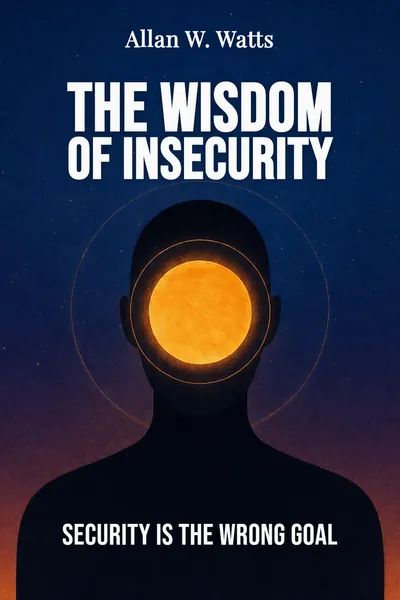
The Wisdom of Insecurity
Security is the wrong goal
Description
In 1951, an English-born writer living in the United States published a slim book with a title that reads almost like a dare: The Wisdom of Insecurity. Alan Watts was then in his mid-thirties, a former Episcopal priest who had left the church and was busy becoming the most readable interpreter of Eastern thought for a Western audience. The book arrived in a particular mood. The war was over, the bomb existed, religion no longer held the authority it once had, and science had explained a great deal without explaining why any of it should feel like enough. People had more comfort than any generation before them, and they were, by Watts's account, more anxious than ever.
His diagnosis was blunt. We spend our lives chasing security — a stable income, a settled belief, a guarantee that tomorrow will hold — and the chase itself is what makes us miserable. The more tightly we grip, the more we feel the thing slipping. Watts wasn't offering a technique to grip better. He was suggesting the whole project was built on a misreading of how reality works, and that the cure for anxiety was not more certainty but a different relationship with uncertainty altogether.
It's an uncomfortable claim, because it asks us to give up the one thing we assume we're all working toward. Most self-improvement runs in the opposite direction — reduce the risk, lock down the future, feel safe. Watts spent a short, strange book arguing that safety, in the sense we usually mean it, does not exist, and that our refusal to accept this is the source of the trouble.
The question we’re asking : If the search for security is what makes us anxious, what are we supposed to reach for instead?What we’ll see : How Watts takes apart our instinct to secure the future and arrives, by a route that runs through the mind, time, and the self, at a case for the present moment.
Table of contents
01 Chapter 1 — The age of anxiety and the broken promise
Watts opens with a paradox he found everywhere around him. By the middle of the twentieth century, people in the industrialized West had more physical security than almost anyone in history — plumbing, medicine, savings, insurance against a dozen kinds of disaster. And yet the mood of the time was unmistakably anxious. The comfort hadn't bought peace of mind. If anything, the more carefully life was padded against risk, the more sharply people seemed to feel the risks that remained.
Part of this, he argued, came from what had quietly collapsed underneath. For centuries, religious belief had given people a sense that the universe was underwritten — that behind the mess of daily life there was a plan, a judge, a destination. Science had steadily eroded those beliefs without putting anything equally comforting in their place. People found themselves living in a cosmos that was vast, old, and indifferent, and they could no longer quite believe the stories that used to make it feel like home.

02 Chapter 2 — The belief that split us in two
Why do we keep reaching for a security that can't exist? Watts locates the root in a particular habit of mind — one so deep we mistake it for reality itself. We think of ourselves as a self, an "I," standing somehow apart from our own experience. There is the thinker and there are the thoughts; the feeler and the feelings; the knower and the known. This splitting feels completely natural, and Watts argues it's an illusion that generates most of our suffering.
When I believe I am separate from my experience, I can treat experience as something to be managed — grasped when pleasant, pushed away when not. The pleasant moment becomes something I want to seize and keep, so I'm already bracing against its passing while it's happening. The painful moment becomes something I resist, which only sharpens it. In both cases I'm never simply in the experience; I'm standing at a slight distance, trying to control a river I'm actually part of.
03 Chapter 3 — The experiment of the naked present
Having taken apart the problem, Watts turns to something closer to an experiment than a doctrine. He asks us to actually look at where we are. The past exists only as memory, a present trace. The future exists only as anticipation, also a present trace. The only place anything ever happens is now — and yet "now" is precisely where the anxious mind refuses to stay, busy using this moment to manage the next one.
So he invites a simple move: stop trying to grasp the present and just attend to it. Not to analyze it or extract a lesson — just to be fully in it. When you taste food, taste it. When you hear a sound, let it fill your awareness. This isn't a relaxation trick; it's a different way of standing in reality, where you stop treating each experience as a means to some future payoff.
04 Chapter 4 — What it means to trust the moment
Step back from the individual advice and what Watts is really doing is challenging an idea so basic we rarely notice holding it: that we are solid, separate selves moving through time, trying to secure our position. The search for security isn't just a strategy that happens to fail. It's a symptom of a mistake about what a self actually is. We experience ourselves as nouns — fixed things with edges — when we are closer to verbs, ongoing processes inseparable from everything around us. A wave isn't a thing the ocean has; it's something the ocean is doing. Watts suggests a person is like that too.
Seen this way, insecurity stops being a defect to be eliminated and becomes the honest texture of being alive. To be alive is to be changing, and to change is to let go, at every moment, of what you just were. The demand for security is really a demand to be exempt from change — a demand not to be alive but to merely persist. The anxious person is quietly asking to be a rock, and suffering because they are a flame.
05 Conclusion
Watts set out to explain why an age of unprecedented comfort was also an age of anxiety, and his answer turned the usual logic inside out. We are anxious not because we lack security but because we want it, and the wanting puts us permanently at odds with a world that offers nothing fixed to hold. The clenched fist that tries to keep water is the posture of the modern striver, and the water runs out all the same.
Related books