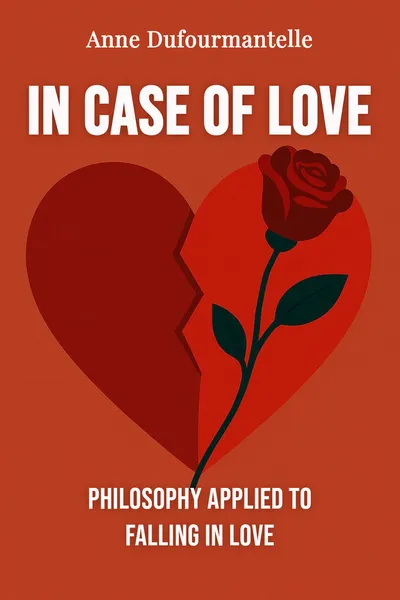
In Case of Love
Philosophy applied to falling in love
Description
When something goes wrong in love, we tend to reach for the same vocabulary. Attachment style, childhood wound, red flag, the right or wrong partner, the work we still have to do. It is the language of repair — the assumption that love is a function that sometimes malfunctions, and that with enough self-knowledge we can get it running smoothly again. Anne Dufourmantelle, a French philosopher and psychoanalyst who died in 2017, spent a career arguing against exactly that reflex. In her small, dense book "In Case of Love," she treats love not as a problem to be solved but as a philosophical event to be thought — something closer to an encounter with the unknown than to a skill we can master.
The difference matters more than it sounds. Psychology asks what is wrong with us and how to fix it. Philosophy, in Dufourmantelle's hands, asks a stranger question: what actually happens to a person when another person arrives in their life and will not leave their mind? She draws on the analysts she worked among and the philosophers she read closely — among them Emmanuel Levinas, whose idea of hospitality runs under the whole book — but she never cites them as proof. She writes the way someone thinks while living, circling the thing rather than diagnosing it.
The result is a book that refuses the one thing we most want from books about love, which is instructions. There is no five-step method here, no typology, no promise that understanding will make it hurt less. What there is instead is an invitation to look at falling in love as the moment our carefully guarded self is breached by someone we did not plan for — and to ask whether that breach is the accident, or the point.
The question we’re asking : What changes when we read falling in love as a philosophical event rather than a psychological malfunction?What we’ll see : A philosopher's case for love as an encounter with the unknown — and for welcome as the gesture it quietly asks of us.
Table of contents
01 Chapter 1 — The symptom we mistook for a problem
Dufourmantelle opens by noticing how thoroughly we have medicalized the heart. We speak of toxic relationships, of healing, of doing the work, of partners who are good or bad for us the way foods are. The vocabulary is therapeutic, and it carries a quiet promise: that love is a malfunction in principle correctable, and that the goal is a calmer, safer version of it. Love that hurts is love gone wrong. Love done right should, eventually, stop costing us anything.
Against this she sets a flat observation. Love has always unsettled people, in every era and under every theory of the self, and the unsettling is not a bug that better self-management would remove. It is what love is. To fall for someone is to lose a measure of sovereignty over your own life — your attention, your plans, your sense of where you end. Trying to engineer that loss away does not produce better love. It produces something smaller that we agree to call love because it is easier to live with.

02 Chapter 2 — What happens when another arrives
If love is not a malfunction, what is it? Dufourmantelle's answer begins with a scene we all know but rarely examine: the arrival of the other. Before love there is a self that feels more or less complete, running on its habits, defended by its routines. Then someone appears, and that completeness turns out to have been provisional. The other arrives not as an addition to a full life but as a disruption of it — a presence that reorganizes the furniture of a mind without asking permission.
She insists on the word unknown. The person we fall for is never the person we construct in our head; the image we fall for and the actual human rarely coincide. What we love, at first, is partly a stranger we have decorated with our own longing. The vertigo of early love comes from this gap — from sensing that there is a whole interior life on the other side that we do not and cannot fully reach. Love is, among other things, the experience of being in constant relation to something we do not possess.
03 Chapter 3 — Loving as a form of knowing
One of the book's quieter claims is that love is a way of knowing, not merely of feeling. We tend to split the two: reason over here, emotion over there, with love filed under the second and therefore treated as something that clouds judgment. Dufourmantelle reverses the arrangement. To love someone attentively is to come to know them in a register that detached observation cannot reach — to perceive the gesture, the hesitation, the particular way a person is in the world. There is an intelligence in love, even if it is not the kind that produces propositions.
But this knowing is strange, because its object keeps moving. The beloved is not a fixed text we eventually finish reading. They change, and we change in relation to them, so that loving well requires a continual willingness to be surprised by someone we thought we had understood. The failures of long relationships, in her account, often come not from knowing too little but from deciding we already know everything — from freezing the other into a version of themselves we can predict and therefore stop attending to. Contempt, she suggests, begins where curiosity ends.
04 Chapter 4 — The stranger we agree to keep
Step back from the individual love story and a larger gesture comes into view, the one Dufourmantelle had thought about for years: hospitality. Welcoming a stranger into your home means letting someone you do not control cross your threshold and change the order of your house. You cannot fully vet them in advance; genuine welcome always carries a risk, because a guest who could do no harm is not really a guest, just a visitor you have secured. The host is exposed by the act of opening the door. This, for her, is the deep structure of love.
To let someone into your life as a lover is to practice hospitality at its most intimate. You admit a stranger — because the beloved always remains, in part, a stranger — into the space you had built to keep yourself safe. You hand over some of your sovereignty. You accept that you will be altered, and that you cannot know in advance into what. Read this way, love is not primarily about compatibility or matching or finding the one who fits your requirements. It is about the capacity to welcome what you did not design and cannot command.
05 Conclusion
The book ends more or less where it began, with a refusal to treat love as a thing we master. Dufourmantelle leaves us without a method, which is itself the argument: there is no technique for welcoming a stranger, only the decision to open the door and the willingness to be changed by whoever comes through it. Falling in love, read philosophically, is the moment our self-sufficiency is revealed as a story we were telling ourselves — and love is what we do with that revelation once we can no longer pretend otherwise.
Related books