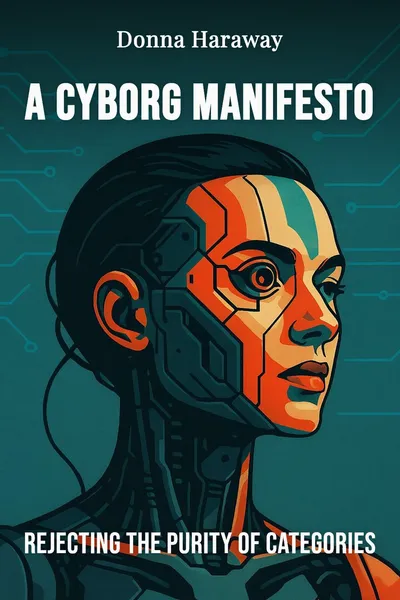
A Cyborg Manifesto
Rejecting the purity of categories
Description
In 1985, a biologist-turned-historian of science named Donna Haraway published an essay in the Socialist Review with a title that sounded like science fiction and read like a provocation: "A Manifesto for Cyborgs." She was writing for the American left, for socialist feminists specifically, at a moment when that movement was fracturing over a hard question — who counts as "women," and what, if anything, do all women share. Instead of answering it, Haraway reached for the cyborg: a creature half-organism, half-machine, a figure she borrowed from military research and cheap paperbacks and turned into something nobody expected. A tool for thinking about politics.
The move was strange on purpose. Feminism in the early 1980s often grounded itself in nature — in women's bodies, women's experience, a shared female essence that patriarchy had buried and that liberation would recover. Haraway found that ground treacherous. Every time a movement declares what women naturally are, it quietly decides who doesn't qualify. The cyborg has no such origin story. It was never innocent, never whole, never expelled from a garden it could dream of returning to. It is a hybrid, and it is fine with that.
That is the wager of the essay, later just called "A Cyborg Manifesto": a myth built not on purity but on its refusal. It arrived as organisms were becoming code and machines were becoming lively, and it refused the comfort of saying which side we are really on. The question underneath it is less about robots than about belonging — and about what feminism loses when it insists on a clean, natural self to speak for.
The question we’re asking : What does feminism gain by abandoning the idea of a pure, natural identity, and why would anyone choose a half-machine as the figure to carry it?What we’ll see : How a strange myth, assembled from military hardware and leftist infighting, became an argument against the politics of essence.
Table of contents
01 Chapter 1 — A socialist feminist loses patience with purity
Haraway came to the humanities from the lab. She had trained in biology, earned a doctorate at Yale, and spent her early career thinking about how scientific descriptions of nature are never just neutral readings — they carry the politics of whoever is doing the describing. By the time she was teaching in the History of Consciousness program at the University of California, Santa Cruz, she had a reputation for taking science seriously as culture. Not as lies to be debunked, but as stories we live inside.
The manifesto grew out of a specific tension on the American left. Socialist feminism in the 1980s was trying to hold two things together: a Marxist account of labor and class, and a feminist account of gender and the body. Both traditions leaned hard on the idea of a natural subject — the worker, the woman — whose authentic nature had been distorted by capitalism or patriarchy and could be recovered. Liberation, on that model, meant getting back to something true underneath the damage.

02 Chapter 2 — The cyborg, and the three boundaries it breaks
The cyborg does its work by breaking down distinctions we treat as natural and permanent. Haraway names three boundaries that were already leaking by the 1980s, and she argues the cyborg is what we become once we stop pretending they hold. The breakdowns are not predictions of a sci-fi future. They are descriptions of a present we were already living in without a figure to name it.
The first boundary is between human and animal. By the late twentieth century, biology had quietly dismantled the wall. Language, tool use, social complexity — the traits we had reserved for ourselves kept turning up in other species. The line separating people from the rest of the living world had become, in Haraway's phrase, thoroughly breached, and the old comfort of human uniqueness no longer had much to stand on.
03 Chapter 3 — Against the dream of a common language
Much of feminism, Haraway observed, carried a quiet dream: that beneath our differences lay a common language, a shared women's standpoint that could unite the movement and ground its truths. Find the authentic voice buried under patriarchy, speak it together, and the fractures would heal. It is a beautiful dream, and she treats it as a trap. The search for one true language is the search for one true identity, and that search always ends by policing its own borders.
The cyborg wants the opposite. It is committed, she writes, to partiality, irony, intimacy and perversity — to being made of incompatible parts that never resolve into a whole. It does not look for the single story that explains everything. It is suspicious of totality, of the grand theory that would name our shared oppression once and for all, because every such theory has to flatten the people who don't fit its plot.
04 Chapter 4 — Affinity instead of identity
Step back from the hardware and the irony, and the manifesto is making one steady argument: that a liberation grounded in natural, pure categories keeps betraying the people it claims to free. Whenever a movement announces what its members essentially are, it draws a border, and someone always ends up on the wrong side of it — too mixed, too compromised, too unlike the ideal type to be fully counted. Haraway's cyborg is the figure that lets feminism stop drawing that border.
What she offers in its place is affinity rather than identity. You do not belong to a political coalition because you share a nature with its members; you belong because you choose to, because your situations connect, because you build the kinship deliberately out of partial, overlapping stakes. She borrowed the word from Chicana feminists writing about "women of color" — not a biological fact but a constructed, oppositional solidarity, a unity made rather than discovered. Coalition becomes an act of construction, not a recognition of sameness.
05 Conclusion
The essay that began in a leftist magazine in 1985 outgrew its occasion almost immediately. Haraway had written it for socialist feminists arguing about the limits of their own category, and within a decade the cyborg had become one of the most cited figures in the study of gender, science and technology — read by people who had never followed the quarrel that produced it. The strange myth, built from astronaut research and pulp fiction and the exhaustion of identity politics, kept doing work its author could not have scripted.
Related books