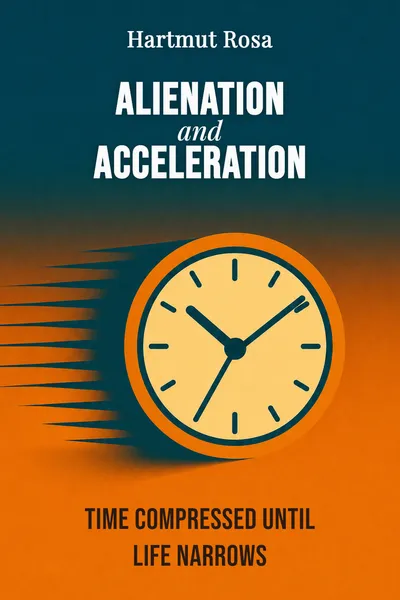
Alienation and Acceleration
Time compressed until life narrows
Description
Here is a small, familiar scene. We reach the end of a week, look back, and cannot quite account for where it went. The days were full — meetings, messages, errands, a dozen small optimizations — and yet nothing in them feels like it stuck. We did more than our grandparents could have imagined doing, and we feel, somehow, that we lived less. The German sociologist Hartmut Rosa, who teaches at Jena and has spent two decades building a theory of modern time, takes this sensation seriously. In his short, dense book Alienation and Acceleration, drawn from lectures he gave in the Netherlands, he argues that the feeling is not a personal failing. It is the signature of the age.
Rosa's claim is that modern society is defined by one master process: acceleration. Not just of technology — though our machines are faster — but of social change itself, and of the rhythm of daily life. Fashions, jobs, relationships, political certainties all turn over faster than they used to. And paradoxically, the time-saving devices we built to free ourselves have left us feeling more rushed than any humans before us. Something in the arithmetic does not add up, and Rosa wants to know why.
His bigger target, though, is not speed for its own sake. It is what speed does to our relationship with the world — with our own bodies, with the people around us, with the things we make and touch. He borrows an old word for this damage, alienation, and gives it a modern engine. The book is both a diagnosis and, in its final pages, an attempt at a cure.
The question we’re asking : Why does a society that saves more time than ever leave us feeling we have less of it — and what is that doing to how we live?What we’ll see : How Rosa builds his theory of acceleration from the ground up, where it bites hardest, and the quieter concept he offers against it.
Table of contents
01 Chapter 1 — The engine with three gears
Rosa starts by refusing a vague complaint. Everyone senses that life has sped up, but a sociologist needs to say what, exactly, is accelerating. He separates the process into three distinct kinds, and the distinction is what makes the whole argument work. The first is technological acceleration — transport, communication, production. A letter that once took weeks now takes a second; a journey that took days takes hours. This is the obvious one, the kind we can measure in megabytes and miles per hour.
The second kind is subtler: the acceleration of social change itself. Rosa means the rate at which the structures around us turn over. How long does a given job last, a given neighborhood stay the same, a given technology remain current, a given relationship hold? He borrows a useful image from the philosopher Hermann Lübbe — the shrinking of the present. The present is the stretch of time over which our experience of the past and our expectations of the future roughly match. In a slow society, that stretch is wide; what you learned as a child still applies when you are old. In a fast one, it narrows, until the ground keeps shifting under your assumptions.

02 Chapter 2 — The treadmill nobody can step off
If acceleration were simply the sum of our individual choices, we could choose to slow down. Rosa's unsettling point is that we mostly can't, because the pressure to keep up has stopped being a choice and become a condition. He describes it with the old metaphor of the slipping slope: to stand still in a fast society is not to hold your position, it is to fall behind. The person who declines to answer email quickly, update their skills, or move for the better job does not stay level — they lose ground relative to everyone who didn't decline.
This is why the usual explanations feel incomplete. We tend to blame capitalism, or culture, or our own weak willpower. Rosa accepts that competition is the deep driver — a market society rewards whoever moves faster — but he adds that the logic has by now escaped its origins. It no longer needs a capitalist cracking a whip. It is built into the structure of the institutions we live inside, so that even people with no particular ambition find themselves running simply to remain in place.
03 Chapter 3 — When speed becomes alienation
Here the book shifts from diagnosis to its real charge. Acceleration would be a neutral fact — maybe even a thrilling one — if it did not damage something. Rosa argues that it does, and he reaches for an old concept to name the damage: alienation. Marx used the word for the worker cut off from the product of his labor. Rosa widens it. Alienation, in his version, is a relationship to the world that has gone cold — a state in which we act without really being touched by what we do, where things and people and places stay mute to us even as we move among them.
He walks through the forms this takes. We become alienated from space: we pass through places so fast, by car and plane and screen, that we no longer dwell in them or let them matter. We become alienated from things: the objects around us are disposable, upgraded, swapped out before we form any attachment, so the world of stuff becomes a flow rather than a home. We become alienated from our own actions — doing things we don't want to do, saying yes to invitations we dread, scrolling through content that leaves no trace. And most painfully, we become alienated from time itself, and from other people, and finally from ourselves.
04 Chapter 4 — Resonance, the exit Rosa points to
In the book's closing move, Rosa names what he thinks acceleration has been crowding out, and the word he chooses is resonance. The opposite of alienation, he argues, is not rest and not slowness — it is a particular mode of relating to the world in which something out there actually reaches us, moves us, and in which we answer back. A piece of music that genuinely grips us; a landscape that stops us; a conversation in which we are changed by what the other person says. In these moments the world is not mute. It speaks, and we respond, and neither of us is quite the same afterward.
Resonance, in Rosa's definition, cannot be forced or scheduled, and this is the deep problem acceleration poses. Resonant experiences are unpredictable; they take their own time; they refuse to be optimized. You cannot guarantee that a book will move you by reading it faster, and you cannot manufacture connection by allotting it a slot. A society organized around speed and control is, by its nature, hostile to the one thing that makes life feel alive. We keep trying to secure resonance by accumulating resources — more money, more options, more reach — on the theory that a wider menu raises the odds. But a wider menu is not the same as a deeper encounter, and the accumulating tends to eat the very time the encounter needs.
05 Conclusion
We began with the lost week, the days that were full and left nothing behind. Rosa's achievement is to show that this is not a quirk of our personality or a sign we are doing modern life wrong. It is the predictable product of a system built to accelerate, one whose three gears keep driving each other forward with no hand on the wheel. The time we save does not become ours; it is reinvested the instant we save it, and the world we move through fast stays mute as we pass.
Related books