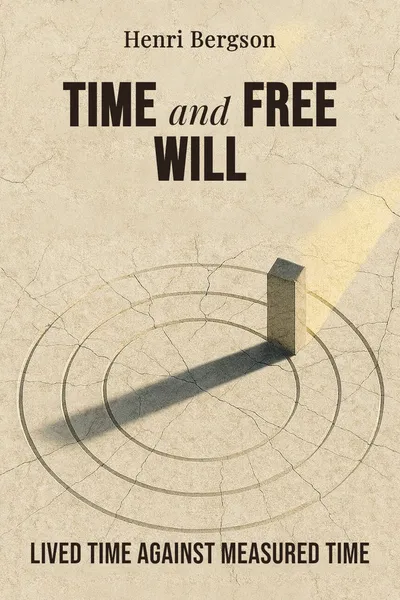
Time and Free Will
Lived time against measured time
Description
In 1889, a twenty-nine-year-old philosophy teacher at a lycée in Clermont-Ferrand submitted a doctoral thesis to the Sorbonne. Its French title was Essai sur les données immédiates de la conscience, and when it reached English readers it was renamed Time and Free Will. The man was Henri Bergson, and the book was small, patient, and oddly beautiful for a work of academic philosophy. It did not announce a revolution. It began with something that sounds almost trivial: the claim that we have been thinking about time with the wrong tools, and that nearly everything following from that mistake is also wrong.
The wrong tool, for Bergson, was space. We picture time as a line, a series of instants laid out side by side like beads on a string, each external to the next, all countable. That is the time of clocks and calendars, of physics and railway schedules — and it works perfectly for those purposes. The trouble starts when we assume this is what time actually is, then try to understand our inner lives by the same measure. Bergson's wager was that lived time, the time we feel passing, has nothing in common with the time we count.
From this single distinction a second, larger question opens. If the self that lives in real time is not a chain of separable states but a flowing, indivisible whole, then the old debate about whether our choices are free or determined may rest on a confusion rather than a genuine disagreement. Bergson thought the determinists and their opponents had both been arguing about the wrong thing.
The question we’re asking : What does it change to say that the time we live is nothing like the time we measure — and what happens to the question of freedom once we take that seriously?What we’ll see : How a quiet distinction between lived and measured time quietly unmakes one of philosophy's oldest arguments.
Table of contents
01 Chapter 1 — The watch tells a lie we agreed to
Bergson starts with a confession we rarely notice ourselves making. Ask someone what time is, and they will glance at a clock — a dial, a number, a sequence, a quantity. Time, in this everyday sense, is something you can have more or less of, divide into equal parts, something that behaves exactly like a length of road. Two hours is twice one hour the way two meters is twice one meter. This feels like a fact about the world rather than a choice we have made.
But look at what the clock actually gives us. The hands move through positions in space. When we say an hour has passed, we have counted the distance the hands traveled, or the oscillations of a pendulum, or the ticks of a mechanism. We have not measured time; we have measured motion through space and called the result time. The clock translates duration into something spatial so we can count it — and the translation is so useful that we forget it was ever a translation.

02 Chapter 2 — What happens when we stop counting
To name the time we actually live, Bergson reaches for a word: durée, usually rendered as duration. Duration is time as consciousness undergoes it — continuous, flowing, with no gaps and no detachable parts. The past does not vanish behind us; it accumulates, pressing forward into the present and coloring everything we feel. A melody is his favorite illustration. We do not hear a tune as isolated notes, each wiped clean before the next arrives. We hear each note swollen with the ones before, the whole phrase present in the single note now sounding. Chop the melody into separate notes and you have arithmetic, not music.
Our inner states behave the same way. The person who feels joy this morning is not the person who felt it yesterday, because yesterday's joy is now part of the ground from which today's rises. States do not succeed one another like soldiers in a line; they interpenetrate, melt together, grow out of each other. This is why Bergson insists duration is a qualitative multiplicity rather than a quantitative one — varied, rich, many-colored, but not countable, because counting requires things to stay separate and identical, and lived states refuse both.
03 Chapter 3 — Why the determinists got the wrong self
Here is the classic problem as the nineteenth century posed it. Either our actions are caused by prior states — character, motives, the conditions of the moment — in which case they are determined and we are not free; or they spring from nowhere, uncaused, in which case they are random and not really ours. Freedom is squeezed out from both sides. The determinist leans on science: if every physical event has a cause and we are physical beings, our choices are links in an unbroken chain. The defender of free will struggles to find room for a self that could have done otherwise.
Bergson's move is not to pick a side but to show that both sides picture the self as a thing laid out in space — a collection of distinct states and motives sitting beside one another, like forces on a diagram, from which an action is supposed to result. The determinist imagines motives as fixed quantities pushing the self toward an outcome. The libertarian imagines the self at a fork in the road. But a fork in the road is a spatial picture, assuming two paths coexist, fully laid out, with the self hovering between them.
04 Chapter 4 — Freedom was never a problem, only a mistranslation
Step back from the particular quarrel and a wider pattern comes into view. Bergson's real target is a habit of mind so deep we scarcely feel it: the habit of settling questions about inner life with a ruler borrowed from the outer world. We reach for space whenever we want to count, compare, predict, or explain — and space is the right tool for matter. The mistake is forgetting it is a tool at all, and applying it to the one domain, duration, defined by refusing to be divided. Nearly every tangle Bergson touches turns out to be this same mistranslation wearing a different costume.
The debate over free will is the costume he cares about most, because the stakes are human rather than merely logical. When we accept the spatialized self — states in a row, decisions as resultants of forces — determinism follows almost by grammar, and with it a quiet fatalism about what we can be. Bergson's answer is not to out-argue the determinist on his own ground but to deny him the ground. Freedom, in Time and Free Will, is not a special power intervening against causation. It is simply what action looks like when it flows from the whole living self, undivided, rather than from the diagram we construct after the fact.
05 Conclusion
Bergson set out to defend an immediate datum of consciousness — the plain fact that we feel time flowing, continuous and unrepeatable — against a philosophy that kept translating that fact into numbers and losing it. The clock was never the enemy. The error was believing it told the whole truth, and then trying to find our freedom inside its measured intervals, where it could not be found. The whole book is an effort to return us to the time we actually live before we count it.
Related books