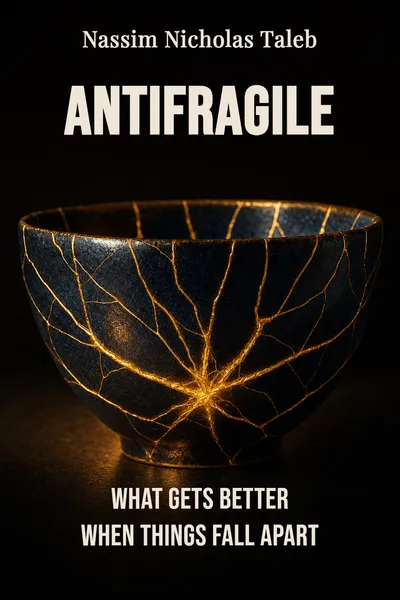
Antifragile
What gets better when things fall apart
Description
In 2012, a former options trader named Nassim Nicholas Taleb published a book built around a word he had to invent, because the language didn't have one. We have a word for things that break under stress — fragile. We have words for things that resist it — robust, resilient, solid. But Taleb noticed there was no single word for the opposite of fragile. Not something that merely survives a shock, but something that actively gets better because of it. He called it antifragile, and spent four hundred pages arguing that this missing category is everywhere once you have the name for it.
His point starts with a complaint about how we package things. Write "fragile" on a box and a clerk handles it with care; the contents have a downside from being shaken and no upside. The opposite box wouldn't say "robust" — robust means the shaking doesn't matter either way. The truly opposite box would say: please mishandle me, I improve when dropped. That box sounds absurd. Yet Taleb's claim is that living things, certain businesses, good ideas, and entire careers behave exactly like that box, and that we keep mistaking them for the fragile kind and protecting them to death.
Taleb wrote Antifragile in the wake of the 2008 financial crisis, which he had partly anticipated in his earlier book on improbable events, The Black Swan. But this one is less about predicting disasters and more about how to be positioned so that disasters, when they inevitably arrive, help rather than ruin us. It is sharp, opinionated, and frequently rude about economists and bankers. Underneath the provocations sits one genuinely useful reversal of how to think about an unpredictable world.
The question we’re asking : What does it mean for something to gain from disorder, and why does Taleb think we keep building the opposite?What we’ll see : How a single missing word reorganizes the way we think about stress, error, and the things we try hardest to protect.
Table of contents
01 Chapter 1 — A word that didn't exist
The whole book hangs on a distinction Taleb insists most people blur. Fragile, robust, antifragile — three categories, not two. The fragile thing fears volatility and loses from it: a teacup, a tightly scheduled airline, a heavily indebted company. The robust thing is indifferent: a rock takes the same beating and stays a rock. The antifragile thing is the strange third case — it needs the shocks to thrive, and starves without them. Taleb's complaint is that we have collapsed the third category into the second, calling everything that doesn't break "resilient," and so we never notice the things that were supposed to be fed disorder.
His favorite illustration comes from Greek mythology, reorganized into a small system of his own. The fragile is Damocles, dining under a sword hung by a single thread — one disturbance and it's over. The robust is the Phoenix, which burns and rises again, unchanged, back to where it started. The antifragile is the Hydra: cut off one head and two grow back. The Hydra doesn't merely survive the attack. It is improved by it. That, Taleb says, is the category we've been missing, and the one that actually describes how the most important systems around us behave.

02 Chapter 2 — The package the post office should fear
If antifragility is a property worth having, the next question is what kills it. Taleb's answer is counterintuitive: the thing that most reliably destroys antifragility is our own well-meaning effort to remove volatility. We smooth things out, we stabilize, we suppress the small fluctuations — and in doing so we starve the system of exactly the stressors it needed, while quietly storing up one enormous shock for later. He calls the modern tendency to do this naive interventionism, and he sees it everywhere from medicine to economics to parenting.
The forest fire is his standard image. Suppress every small fire and the underbrush accumulates, unburned, year after year. The forest looks healthy and calm. Then a fire eventually comes that nobody can stop, because there is now decades of fuel waiting for it. The small fires were not the danger; they were the system clearing its own risk in manageable doses. By preventing them, the well-intentioned fire manager guarantees the catastrophic one. Taleb maps this directly onto economies: every recession prevented by intervention, he argues, builds toward a larger crisis that the prevention made inevitable.
03 Chapter 3 — Why the turkey never sees Wednesday coming
Behind all of this sits Taleb's older obsession: our hopeless overconfidence about predicting the future. A turkey is fed every day by the butcher. Each feeding strengthens its belief that humans are benevolent and that tomorrow will look like today. Its confidence peaks the day before Thanksgiving — the exact moment it is most wrong. The turkey's mistake is to read a thousand peaceful days as evidence of safety, when those days were in fact the setup for the one day that mattered. We are, Taleb argues, almost all turkeys about the things that will eventually hurt us most.
His point is not that we should predict better. It is that for a whole class of events — the rare, the consequential, the genuinely unprecedented — prediction is structurally impossible, and the energy poured into forecasting them is worse than wasted. It produces false confidence, which makes us take on more risk than we would if we admitted our blindness. The forecasters who confidently missed 2008 paid no price for being wrong, kept their jobs, and went on forecasting. Taleb's quarrel is less with their errors than with the fact that they faced no consequences for them.
04 Chapter 4 — The barbell, and skin in the game
Step back from the examples and Antifragile is really an argument about how to live and build in a world you cannot forecast. Taleb's central practical tool is the barbell: instead of taking moderate risk in the middle, you combine extreme caution on one side with aggressive risk on the other, and nothing in between. Keep the bulk of what you have in something very safe, then place small, capped bets on wildly uncertain things. You are protected against ruin on one end and exposed to enormous upside on the other. What you avoid is the deceptively reasonable middle, where a single bad surprise can wipe you out because you thought you were being sensible.
The barbell is a way of becoming antifragile on purpose: you cap your downside so that disorder can only help you. A novelist with a steady, dull day job and a wild manuscript is barbelled. So is the investor with most assets in cash and a sliver in speculative ventures. The shape recurs because it solves the same problem everywhere — how to stay exposed to good surprises while making bad ones survivable. It is the opposite of the leveraged, all-in arrangement that looks efficient right up until it doesn't.
05 Conclusion
Taleb began with a missing word and a box that asks to be mishandled, and the book is really an extended argument that the box exists — that some things genuinely improve when shaken, and that we have spent enormous effort protecting them from the one input they needed. The Hydra grows heads, the bone grows dense, the tinkerer stumbles onto the discovery, the small fire keeps the big one away. What looks like care is often slow harm; what looks like chaos is often the system doing its work.
Related books