From Enhanced Human to Posthuman
Where enhancement stops being medicine
Description
A child born with a cleft palate gets surgery, and no one hesitates. A healthy adult asks a surgeon to make his jaw more symmetrical, and suddenly everyone has an opinion. Same scalpel, same skill, roughly the same risk — yet one feels like care and the other feels like vanity, or worse. Bernard Baertschi, a Swiss philosopher who spent his career on bioethics, takes this ordinary intuition and refuses to let it sit undisturbed. His book opens on the gap we all feel between fixing a body and improving it, and then asks the uncomfortable question: can anyone actually say where one ends and the other begins?
The stakes are not academic. Growth hormone, cognitive stimulants, mood drugs, gene editing, neural implants — each of these sits astride the same fault line. We reach for them to repair, and then we notice they could just as easily enhance. The pill that helps a man with attention disorders also sharpens a healthy student before an exam. The therapy and the upgrade turn out to be the same molecule, pointed in two directions. Baertschi's wager is that the medicine-versus-enhancement distinction, which carries enormous moral weight in how we regulate and judge these interventions, is far shakier than it looks.
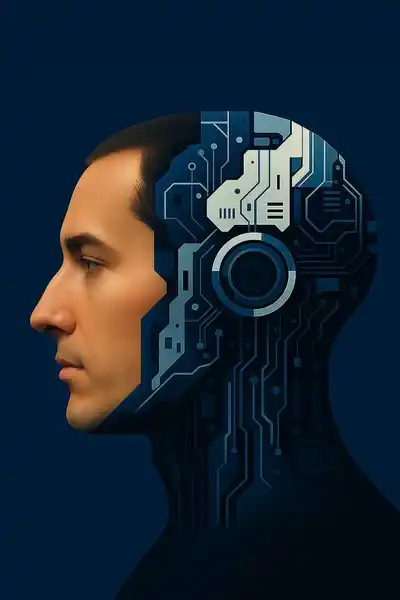
And beyond enhancement waits a stranger idea: that we might not merely improve humans but change what a human is. The posthuman is no longer only a figure from science fiction; it has become a serious position in philosophy, defended by thinkers who argue our species is an unfinished draft. Baertschi walks the whole road, from the uncontroversial clinic to the contested frontier, and keeps his eye on the one seam that holds the argument together — or fails to.
The question we’re asking : When a technology stops healing a body and starts upgrading it, can we still tell the difference — and does the difference carry the moral weight we give it?What we’ll see : We follow Baertschi along the road from the ordinary clinic to the posthuman frontier, testing the line between therapy and enhancement until it starts to give way.
Table of contents
01 Chapter 1 — The line that used to be obvious
Medicine, for most of its history, had a comfortable self-understanding: it restores. Something has gone wrong — an infection, a broken bone, a failing heart — and the doctor brings the body back toward how it is supposed to work. On this picture, there is a baseline called health, and illness is a fall below it. Therapy lifts you back up. It does not lift you past. Baertschi notes how deeply this restorative model is built into our moral reflexes. We feel entitled to be cured; we do not feel entitled to be improved, and we are suspicious of those who try.
The trouble starts the moment you ask what the baseline actually is. Health, it turns out, is not a fixed number written into our biology. The idea of a 'normal' human function leans on statistics, on what is typical for a species at a given age — and the typical is not the same as the ideal. Being nearsighted is extremely common, yet we correct it without calling glasses an enhancement. Being short is normal, yet growth hormone for a child of ordinary height is treated as crossing a line. The baseline bends depending on what we have decided counts as a deficiency worth fixing.

02 Chapter 2 — What the body was never meant to do
Push past repair and you reach enhancement proper: interventions meant not to restore a function but to extend it beyond the species norm. Baertschi sorts them into the familiar families. Physical enhancement, like the endurance a doped athlete gains. Cognitive enhancement, the stimulants and future drugs that sharpen memory or attention in already-healthy brains. Mood and emotional enhancement, where a substance does not treat depression but simply makes an untroubled person feel better. And moral enhancement — the most startling idea — where we would use biology to make people more empathetic or less aggressive.
The objections arrive quickly, and Baertschi takes them seriously rather than dismissing them. One is about authenticity: a self improved by a pill, the worry goes, is no longer quite your self; the achievement is the drug's, not yours. Another is about fairness: if enhancement is expensive, it widens the gap between those who can afford a better brain and those who cannot. A third is older and vaguer — the sense that we are overstepping, playing at being more than human, reaching for what some would call hubris.
03 Chapter 3 — The posthuman on the horizon
Enhancement improves humans. The posthuman is something else: a being that no longer counts as human at all, because the improvements have gone far enough to change the kind of thing it is. Baertschi takes the idea seriously as philosophy, not spectacle. Transhumanist thinkers — Nick Bostrom and Julian Savulescu among the most cited — argue that nothing sacred attaches to our current biology, and that a creature with vastly longer life, far greater intelligence, or emotional range we can barely imagine would not be a monster but a successor worth welcoming.
The leap raises a question enhancement alone never forced: what makes someone a person, and does it survive the transformation? Baertschi's answer leans on continuity of mind rather than of body. If a being remembers being you, pursues the projects you cared about, and relates to others as a moral agent, the fact that its substrate has been radically altered may not break the thread of identity. On this view the posthuman is not the end of us but a continuation under new conditions — the way an adult is continuous with the child who no longer exists.
04 Chapter 4 — When the whole species is the patient
Step back from any single drug or implant and look at the line itself — therapy on one side, enhancement on the other — and notice how it keeps moving. What counted as enhancement a generation ago often counts as ordinary care now. Vaccination once looked like meddling with nature's design; today refusing it looks like negligence. Correcting vision, managing cholesterol, fertility treatment — each migrated from the suspect column to the routine one. Baertschi's deeper point is that the boundary is not a fact we discover but a decision we keep renegotiating, usually without noticing we are deciding.
This matters because the line is doing heavy institutional work. Insurers use it to decide what they will pay for. Regulators use it to decide what is medicine and what is lifestyle. Ethicists use it to sort the permitted from the frowned-upon. All of that machinery rests on a distinction that, pressed hard enough, turns out to track our evolving judgments about what a good human life requires — not a stable fact about bodies. When the therapy-enhancement line moves, it is because we moved it, often in response to what has simply become available.
05 Conclusion
Return to the two patients on the operating table — the child with the cleft palate and the adult after a sharper jaw. Baertschi's road from the clinic to the posthuman shows that our instinct to separate them was never resting on the firm biological ground we assumed. Health is partly a statistical convention and partly a moral one; the baseline bends; the vocabulary of disease smuggles in values while claiming to report facts. The line between healing and improving is real enough to use, but not solid enough to settle an argument on its own.
Related books