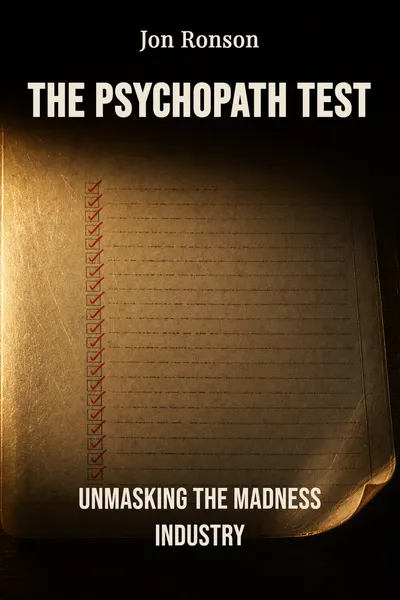
The Psychopath Test
Unmasking the madness industry
Description
It starts with a book that makes no sense. In 2006, an academic named Deborah showed the journalist Jon Ronson a strange, beautifully made object called Being or Nothingness — cryptic pages, cut-out words, no clear message — that had been mailed, apparently at some expense, to neurologists and academics all over the world. Nobody knew who sent it or why. Ronson, a writer with a nose for the odd corners of human behaviour, took the case as a small mystery to solve: who would go to such trouble to unsettle the world's most rational people?
The trail did not stay small. Chasing the sender pulled Ronson toward a bigger, stranger territory — the loose federation of psychiatrists, psychologists, drug companies, TV producers and criminal-justice officials who make their living deciding who is sane and who is not. He came to call it the madness industry. Somewhere in there, he met a Scottish psychologist convinced that a startling number of the people running companies and countries were, clinically speaking, psychopaths. And that with the right training, anyone could learn to spot them.
So Ronson got trained. He learned a checklist, a set of telltale tics, a way of reading charm and coldness as symptoms. Then he went looking — in a maximum-security hospital, in a corporate boardroom, in the archives of daytime television. What he found was not a clean answer but a queasier one, about the tool itself and the people wielding it.
The question we’re asking : When we go hunting for madness with a checklist in hand, what do we actually catch — and who gets to decide?What we’ll see : A hoax that opens onto the whole apparatus of diagnosing the human mind, and the unsettling thing that happens once we learn to see symptoms everywhere.
Table of contents
01 Chapter 1 — A puzzle mailed to neurologists
The mystery of Being or Nothingness is the kind of thing Ronson loves: a small anomaly that itches. Serious, credentialed people had received this handmade book and been genuinely rattled by it. Was it a code? A prank? The work of someone unwell, or someone very clever pretending to be? Ronson does the legwork — tracing paper stock, cross-referencing recipients — and eventually finds the author, a Swedish academic named Petter Nordlund, whose explanation is both underwhelming and oddly touching. The grand conspiracy dissolves into one person's private obsession.
But the chase leaves a residue. Ronson notices how quickly he had assumed there must be something pathological behind the puzzle — some disordered mind pulling strings. The instinct to diagnose, to file strangeness under a clinical heading, turns out to be his own reflex too, not just the establishment's. That reflex is what the rest of the book will interrogate.

02 Chapter 2 — Twenty items and a checklist
The lens has a name: the Hare Psychopathy Checklist, or PCL-R, devised by the Canadian psychologist Robert Hare. Twenty items — glib superficial charm, grandiose self-worth, cunning and manipulativeness, lack of remorse, shallow affect, failure to accept responsibility, and so on — each scored zero, one or two. A high total marks someone out as a psychopath, a person Hare describes as a kind of predator among us, wired without the ordinary brakes of empathy and conscience. Ronson attends a training course and comes away buzzing, newly convinced he can read the coldness behind a smile.
This is the seductive part, and Ronson is honest about the seduction. The checklist gives him a superpower. Suddenly conversations rearrange themselves; every charming boast, every flicker of callousness, becomes evidence. He starts diagnosing people at dinner parties. The tool that was meant to sharpen his judgement begins, quietly, to warp it — he is now primed to find psychopaths, and a mind primed to find something usually does.
03 Chapter 3 — Into the corridors of power
First stop is Coxsackie, New York, where Ronson meets Toto Constant, a former Haitian death-squad leader now incarcerated, improbably, for mortgage fraud. Constant is charming, self-justifying, apparently untroubled by the atrocities attributed to his militia. He decorates his cell, poses for photos, spins his story. Ronson runs him through the checklist in his head and the items keep lighting up. Here, at least, the tool seems to fit its object almost too neatly.
Then comes the harder case: Al Dunlap, the American CEO nicknamed Chainsaw for the ferocity of his layoffs, a man the press had already floated as a possible psychopath. Ronson visits his mansion, full of sculptures of predators — lions, hawks, birds of prey — and interviews him with the checklist as his secret guide. And here the tool starts to slip. Dunlap cheerfully reinterprets its items as virtues. Grandiose sense of self-worth? Self-confidence. Manipulativeness? Leadership. Lack of remorse? Not carrying baggage. Every symptom flips into a business-school buzzword, and Ronson watches his diagnosis melt into ordinary corporate swagger.
04 Chapter 4 — The maddest edges win
Step back from the individual portraits and the book's real subject comes into focus: not psychopaths but the industry that lives off spotting them. Ronson keeps noticing that everyone in the machinery — the checklist's defenders, the drug marketers, the TV producers who cast troubled guests, and Ronson himself — is drawn to the extreme. A person becomes interesting, fundable, broadcastable, diagnosable precisely at their maddest edge. The ordinary middle of a human being, the ninety per cent that is dull and mixed and unremarkable, gets edited out.
This is the disturbing symmetry Ronson lands on. The people at the helm of the madness industry — obsessive, driven, certain of their instruments, hungry to find the pathology they're looking for — are in their own way as gripped as the subjects they study. Hare's certainty, the TV producer's appetite for a breakdown, a marketer's talent for turning shyness into 'social anxiety disorder': these are drives too, and they shape reality rather than merely observing it. The looker's obsession leaks into what gets seen.
05 Conclusion
The hoax gets solved — Petter Nordlund, a private obsession, no conspiracy. But by the time Ronson closes that loop, the puzzle has become almost beside the point. What began as a detective story about a strange book ends as a portrait of the whole enterprise that decides who among us is broken, and how easily that enterprise mistakes a person's sharpest edge for their entire shape.
Related books