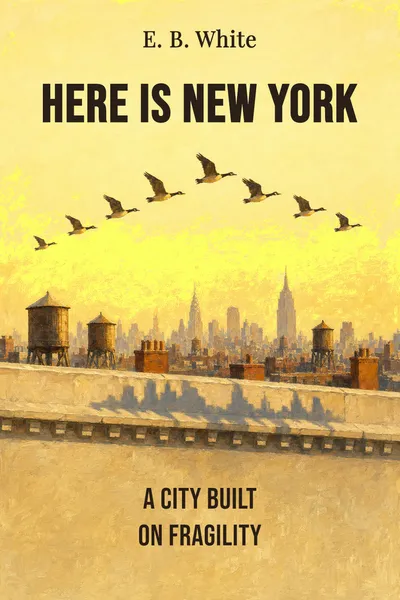
Here is New York
A city built on fragility
Description
In the summer of 1948, a magazine editor asked E. B. White to write something about New York City. White, who had left the city and moved to a farm in Maine, came back to Manhattan for a few days in the middle of a heat wave, took a room in a stifling midtown hotel, and wrote a long essay from there. The result ran about 7,500 words and appeared first in Holiday magazine, then as a slim book called Here Is New York. It is barely the length of a short story. It has outlived almost everything published alongside it.
Most of the essay is what you would expect from a man who wrote for the New Yorker for decades: precise, affectionate, a little wry. White walks the reader through the three New Yorks — the one belonging to those born there, the one belonging to the commuter, the one belonging to the person who came from somewhere else and made the city their own. He notices the deli on the corner, the tempo of the streets, the strange privacy a person can keep inside eight million neighbors. And then, near the end, in a few sentences, the whole tone shifts.
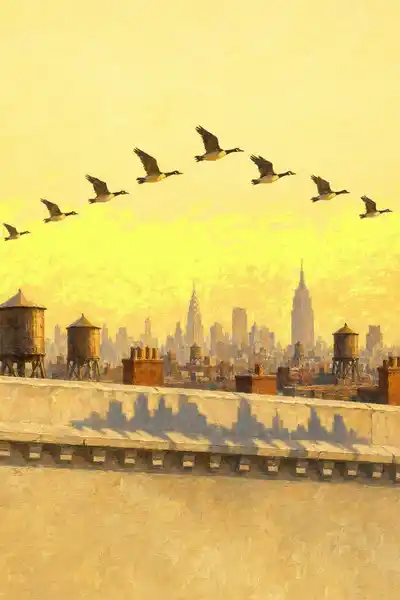
White writes that a single flight of planes, no bigger than a wedge of geese, could end the island fantasy — burn the towers, crumble the bridges, cremate the millions. He wrote that in 1948, before jets, before the towers he seems to describe were built. The sentence has been read a great many ways since. What makes it worth returning to is not that it sounds like a prophecy. It is what White does with the fragility once he has named it.
The question we’re asking : Why does a short 1948 essay about walking around Manhattan end by imagining the city's destruction — and call that the reason it matters?What we’ll see : How White turns an affectionate portrait of a summer city into an argument about concentration, exposure, and the quiet gamble that keeps a place alive.
Table of contents
01Chapter 1 — The essayist and the summer hotel
Elwyn Brooks White was not, by 1948, a man with anything to prove about New York. He had come down from Cornell in the early 1920s, knocked around the city as a young writer, and joined the New Yorker not long after Harold Ross founded it. For twenty-odd years he wrote the magazine's opening Notes and Comment pages, the short unsigned paragraphs that set its tone. By the time Holiday commissioned the piece, White had already decamped to a saltwater farm in Maine, where he kept geese and wrote the essays that would make his other reputation. He came back to the city as a visitor, which is exactly the vantage the essay needs.
The physical circumstances matter more than they usually do. New York was in the grip of a heat wave, and White took a room in a hotel a few blocks from a building where, he notes, he had once worked. He could not sleep. The room was airless. And so much of the essay's texture — the sweat, the noise coming up from the street, the sense of a huge machine running just outside the window — comes from a man writing in genuine discomfort, half a tourist in a city he had loved for a quarter of a century.

02Chapter 2 — A city that works by not colliding
The heart of the essay, before the turn, is White's attempt to explain something that ought not to work at all. Millions of people are packed onto a narrow island. Every one of them is a stranger to nearly every other. The density is absurd — more people in a single block than in whole towns White knew in Maine. And yet the thing functions. Water arrives. Food arrives. The mail comes. People get to work and home again. The city, he writes, is like a poem: it compresses all life into a small island and adds music and the accompaniment of internal engines.
What holds it together, in his account, is not administration but a kind of tacit cooperation, a willingness among strangers to leave each other alone. New York bestows the gift of loneliness and the gift of privacy, White says, and that privacy is not a failure of community but its precondition. Eight million people manage to occupy the same small space precisely because they agree, mostly without thinking, not to press too hard on one another. The city runs on restraint as much as on electricity.
03Chapter 3 — The passage nobody rereads calmly
Then, in the final pages, White writes the sentences that have followed the essay ever since. The city, he says, has never been so worth saving, and never so vulnerable. A single flight of planes no bigger than a wedge of geese can quickly end this island fantasy, burn the towers, crumble the bridges, turn the underground passages into lethal chambers, cremate the millions. He is writing in 1948, in the first years of the atomic age, three years after Hiroshima. The fear is nuclear, and it is new, and he lets it sit on the page without softening it.
What is striking is how little the passage behaves like a warning. White does not build to it with alarm, and he does not moralize after it. He states the vulnerability the way he stated the delicatessen and the water tunnels — as another fact about the city, the last one in a long list. The destruction he imagines is continuous with the density he admired a few pages earlier. The towers are worth burning, in the grim logic of a bomber, for the same reason they are worth loving: because so much life is gathered in so little space.
04Chapter 4 — The luck of the improbable
Step back from the specific fear, and what White has written is a meditation on concentration itself. Civilization, in his telling, advances by gathering — by pulling people, ideas, money, and machinery into ever-tighter proximity until a small island can hold more life than a country once did. That gathering is the source of everything the city achieves: the music, the noise, the searchers who come from elsewhere and burn brightest. But the gathering is also, by the same stroke, the source of its exposure. The more a place concentrates, the more of it can be lost at once, and the more it depends on the fragile agreement that nobody will choose to end it.
This is why White's essay does not read as a period piece about the bomb. The particular weapon dates it; the structure of the insight does not. Any great concentration — of population, of infrastructure, of the invisible systems a modern life runs on — is a wager. It bets that the cooperation will hold, that the machinery will not fail, that the wedge of geese will stay geese. New York simply makes the wager visible, because it concentrates further than almost anywhere else and hides the wager less well.
05Conclusion
White left Manhattan and went back to Maine, to the geese and the farm and the essays about them. Here Is New York was a commission he almost turned down, written fast in an uncomfortable room, and it became the most enduring short thing he wrote about the city. Near the end he notes an old willow tree in a courtyard he can see from his window, a battered survivor of the city's growth, and says that if he had to choose one thing standing for the whole of New York, he would choose that tree — the living proof that the improbable holds on.
Related books