Silicon Valley
Why that place, not another
Description
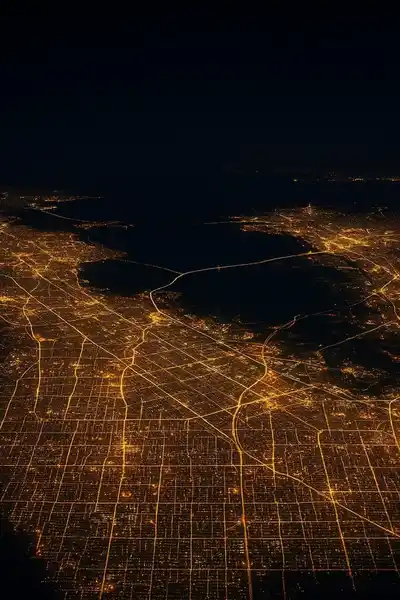
The stretch of northern California that runs roughly from San Francisco down to San Jose is now the most concentrated technology region in the world. Palo Alto, Mountain View, Cupertino, Menlo Park, and half a dozen other towns are home to Apple, Google, Meta, Nvidia, Intel, and most of the rest of the American tech industry. The region is roughly 50 miles long. It contains something like half a trillion dollars of venture capital deployed, two of the top ten engineering universities in the United States, and the offices of almost every large tech company that has existed since 1960.
In 1955, this area was apricot orchards. The region was known as the Valley of Heart's Delight and was a major producer of canned fruit. There was no computer industry there. The transistor had been invented at Bell Labs in New Jersey. The major electronics firms — RCA, GE, Raytheon — were all on the East Coast. The military research money was flowing through MIT and Lincoln Labs. If anyone in 1955 had been asked to predict where the American computer industry would consolidate, Boston would have been the obvious answer. Nobody would have said Palo Alto.
The transformation from farms to tech capital didn't happen by accident. It can be traced to one university dean's policy, one famous engineer's decision about where to put his laboratory, and one mass resignation in the fall of 1957. Each of these was contingent — they could easily have gone differently. Together they produced the conditions for a regional industry that has compounded across seven decades. Understanding how Silicon Valley actually formed is useful for anyone trying to replicate it, which, despite many attempts, almost nobody has succeeded at doing.
● The question we're asking: how did an area of apricot orchards in 1955 become the most concentrated technology region in the world, and why has no other place been able to replicate the pattern?
● What we'll see: Frederick Terman's university-industry ecosystem, Shockley's decision to move to Mountain View, the 1957 resignation that produced Fairchild Semiconductor, and the Fairchildren network that spawned the modern tech industry.
Table of contents
01 Terman's ecosystem
The first architect was Frederick Terman, a Stanford engineering professor who became dean of the School of Engineering in 1944. Terman had grown up in Palo Alto — his father was a Stanford psychologist who had popularized the term IQ — and he was frustrated that Stanford's best engineering graduates kept leaving California for jobs at East Coast firms. He began making it his project to build an electronics industry on the West Coast that could employ Stanford graduates locally.
In the 1930s, Terman had personally persuaded two of his graduate students, William Hewlett and David Packard, to start their own company rather than take jobs on the East Coast. He helped them find financing and introduced them to their first customers. Hewlett-Packard was founded in a Palo Alto garage in 1939, making audio oscillators. The garage is now a California historical landmark. By the 1950s, HP was one of the largest electronics firms in the region and had become the prototype for what Terman wanted more of.

02 Shockley and the Traitorous Eight
William Shockley was one of the three Bell Labs scientists credited with inventing the transistor in 1947 (the others being John Bardeen and Walter Brattain). He had ambitions well beyond laboratory research. In 1955, at age 45, Shockley decided to leave Bell Labs and found his own semiconductor company. The location he chose was Mountain View, California — partly because his elderly mother lived in Palo Alto and he wanted to be near her. Shockley Semiconductor Laboratory opened in 1956.
The decision to locate in Mountain View rather than near Bell Labs in New Jersey was consequential in a way Shockley probably didn't fully anticipate. It placed the cutting-edge semiconductor research of the era adjacent to Terman's Stanford ecosystem. Shockley recruited a remarkable group of young engineers and physicists, most of whom moved across the country to work with him. The laboratory's intellectual output was immediately significant. Shockley himself won the Nobel Prize in physics in 1956 for the transistor work he had done earlier at Bell Labs.
03 Fairchild and the children it produced
The eight engineers needed funding. Eugene Kleiner's father-in-law was a banker at Hayden, Stone and Company in New York, and Kleiner wrote to the firm asking for investment suggestions. The letter was passed to Arthur Rock, a young banker at the firm. Rock flew out to meet the engineers and became convinced. He helped them find Sherman Fairchild — the camera-and-instrument industrialist, unrelated to the Bell Labs Sherman Fairchild — who agreed to finance them through his existing company Fairchild Camera and Instrument.
Fairchild Semiconductor was incorporated on October 1, 1957. Over the following decade, it became the most technically important semiconductor company in the world. Jean Hoerni developed the planar process — a manufacturing technique that allowed transistors to be reliably produced on silicon wafers. Robert Noyce, building on Hoerni's work, invented the integrated circuit, the technical breakthrough that made microprocessors possible. By the mid-1960s, Fairchild was the benchmark for the semiconductor industry globally, and most of the engineering talent in the field had passed through it.
04 Why the pattern is so hard to copy
What's notable about this history is how contingent it was. Terman could have stayed a regular engineering professor. Shockley could have moved to New Jersey instead of Mountain View. The Traitorous Eight could have stayed at Shockley's lab and endured. Fairchild could have collapsed before its alumni multiplied. Each of these decisions, at the time, was made by individuals responding to local circumstances. None of them was aimed at building a regional tech industry. The regional tech industry emerged as a byproduct.
Silicon Valley has since become an object of study for economists, urban planners, and governments who want to replicate it. There have been many serious attempts — Route 128 around Boston, Research Triangle in North Carolina, Silicon Alley in New York, Silicon Wadi in Israel, Zhongguancun in Beijing, Silicon Fen in Cambridge, and dozens of others. A few have succeeded on smaller scales, mostly through proximity to existing research universities. None has come close to reproducing the full Silicon Valley model of mass industry generation from a single regional cluster.
05 Conclusion
Frederick Terman wanted his Stanford graduates to stay in California. William Shockley wanted to live near his mother. Eight engineers walked out on Shockley in 1957. Fairchild Semiconductor produced Intel, AMD, Kleiner Perkins, and the model that generated the next seventy years of tech companies. Those are the actual turning points.
Related books