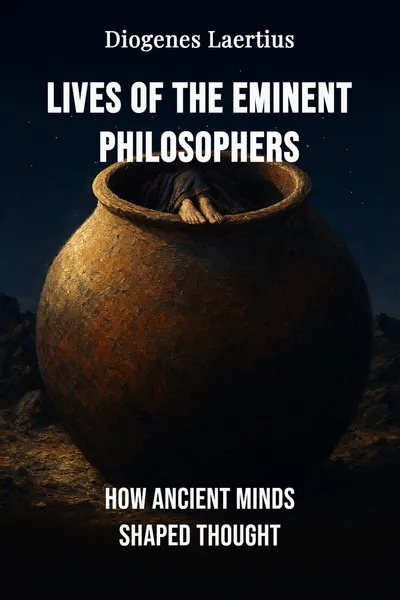
Lives of the Eminent Philosophers
How ancient minds shaped thought
Description
Somewhere in the third century, a writer named Diogenes Laertius sat down to do something no one before him had quite managed: catalogue the entire tradition of Greek philosophy, thinker by thinker, from the legendary sages to the schools still teaching in his own day. We know almost nothing about him — not his city with any certainty, not his dates, not even which philosophical camp, if any, he belonged to. What survives is the work itself, ten books that run from Thales staring at the heavens to Epicurus writing letters about pleasure and death. He called it, roughly, Lives and Opinions of Eminent Philosophers.
The result is one of the strangest classics we have. It is not a treatise. It does not argue for a system or defend a position. It is closer to a biographical encyclopedia stitched together from older sources, packed with birthplaces and death scenes, teacher-and-pupil lineages, jokes, quarrels, wills, and the occasional recipe for how a philosopher chose to die. Alongside the doctrines sit the anecdotes — Diogenes the Cynic living in a jar, Thales falling down a well while watching the stars, Aristotle's alleged habits at dinner.
For centuries this was how Europe met the ancient thinkers: not through their lost books, but through Laertius's crowded gallery of portraits. Much of what we casually know about who these people were traces back, whether we realize it or not, to this one compiler working from a library we no longer have.
The question we’re asking : What kind of history of philosophy does a book built from anecdotes and death scenes actually give us?What we’ll see : How Laertius assembled his gallery, why he trusted the story over the system, and what that method saved.
Table of contents
01Chapter 1 — A librarian collecting the dead
Laertius organizes his cast into two grand lines of descent, an Ionian tradition running from Thales through Socrates and Plato down to the later schools, and an Italian tradition beginning with Pythagoras. It is a family tree of ideas, mapped by who taught whom. This lineage logic matters more to him than chronology or geography: philosophy, in his telling, is transmitted like an inheritance, master to disciple, across generations. Each thinker arrives already placed within a genealogy, his significance measured partly by where he sits in the line.
For every philosopher he tends to follow the same rough sequence. Where the man came from, who his parents were, whom he studied under. Then the anecdotes that fixed his reputation — the retort that silenced a rival, the eccentric habit, the political entanglement. Then a compressed digest of doctrines, sometimes a few lines, sometimes many pages. Then the death, often rendered with grim relish, and frequently a short poem Laertius himself wrote to mark the occasion, plus notes on wills, namesakes, and the exact spelling of a name he wants to get right.

02Chapter 2 — The anecdote as argument
The anecdotes are the part everyone remembers, and Laertius knew it. Diogenes the Cynic asking Alexander the Great to stop blocking his sunlight. Thales so lost in the stars that he tumbles into a well and gets mocked by a servant girl. Solon's counsel to call no man happy until he is dead. These are the fragments that outlived the arguments, and the book treats them not as decoration but as evidence — a philosopher's character, for Laertius, is itself a kind of doctrine.
This is a genuine editorial stance, even if he never states it as one. A Cynic who preached self-sufficiency is best shown living in a jar and owning nothing. A Stoic who taught indifference to fortune is best shown meeting ruin without flinching. The life is offered as proof that the teaching was lived, or, occasionally, as quiet evidence that it wasn't. When Laertius reports that a philosopher of moderation kept a lavish table, the contradiction is left hanging for us to notice. The stories do work the summaries can't: they show us whether a man could stand behind the position he sold to his students.
03Chapter 3 — The schools, sorted and settled
Underneath the gossip, Laertius is running a serious taxonomy. He wants to sort the whole tradition into its schools and show how each descended from the one before. The Academy from Plato, the Lyceum from Aristotle, the Stoa from Zeno of Citium, the Garden from Epicurus, the Cynics from Antisthenes, the Skeptics from Pyrrho — each gets its founder, its succession of leaders, and a summary of what held its members together.
Some of these summaries are the most valuable thing in the book, because the originals are gone. His account of the Stoics preserves distinctions about logic, physics, and ethics that we would otherwise know only in scraps. His treatment of Epicurus is the standout: he hands over three long letters and a set of principal doctrines more or less whole, on physics, on weather, on how to live. For Epicurean thought, Laertius is not a summarizer at all but very nearly the primary source, the reason the philosophy of the Garden reaches us as a coherent system rather than a rumor.
04Chapter 4 — What a gossip preserved
Step back from the individual portraits and the book reveals itself as an act of salvage. Laertius was writing at the tail end of a tradition, with centuries of philosophical literature already crumbling behind him. He worked from books we will never see, and by copying their contents — even carelessly, even credulously — he became a lifeboat for material that would otherwise have sunk without trace. A great deal of what we know about the Presocratics, the minor Socratics, and the early Stoics reaches us through him and almost nowhere else.
That gives the book a peculiar double status. As philosophy it is thin; Laertius rarely thinks hard about the ideas he transmits, and he sometimes garbles them. As a container it is priceless. The scholarship that reconstructs ancient thought spends much of its energy sifting his pages, separating the reliable citation from the tall tale, cross-checking his quotations against the few other survivals. He is unavoidable precisely because so little else made it through, which means his taste — for the vivid story, the memorable death, the quotable line — has quietly shaped the canon he thought he was only recording.
05Conclusion
We began with a writer about whom we know almost nothing, and that emptiness is fitting. Diogenes Laertius spent his book fixing other men in memory — their birthplaces, their retorts, their deaths — while leaving no reliable trace of his own. The compiler vanished; the compilation survived. Ten books of borrowed portraits outlasted both their author and most of the library he plundered to make them.
Related books