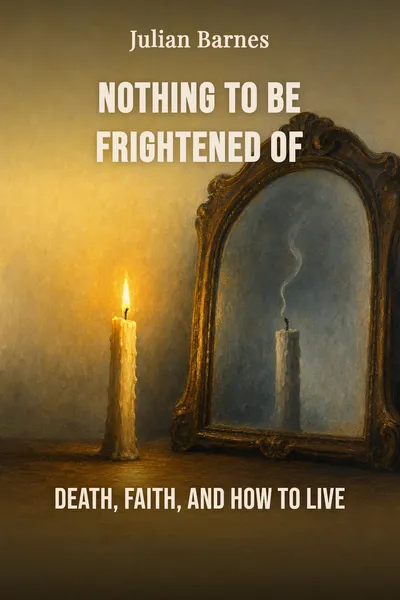
Nothing to Be Frightened Of
Death, faith, and how to live
Description
The book opens with a sentence that Julian Barnes must have known he could never top: "I don't believe in God, but I miss him." It is the kind of line a writer spends a career waiting for, and it holds the whole project in eight words. Barnes was in his early sixties when he wrote it, having buried both parents and watched the ordinary machinery of a life run down. He had been an outright atheist at twenty. By sixty he had softened into agnosticism, which is not a warmer position so much as a more honest one — the admission that he does not know, and that not knowing changes nothing about the ending.
What he is actually writing about is fear. Not a poetic dread, not a literary pose, but the specific animal terror of ceasing to exist — the thing that, in his account, can wake a person at four in the morning and leave them staring at the shape of their own extinction. His brother, a philosopher, finds this fear irrational and says so. Barnes disagrees, and calls the fear of death "the most rational thing in the world." The two positions never reconcile, which is part of the point. This is a book built out of disagreements that stay unresolved.
So it is a memoir, though it refuses the tidy arc a memoir usually promises. It moves between his parents and grandparents, his sceptical brother, the God he cannot believe in but cannot quite let go of, and a large cast of the dead — writers, composers, doctors, unbelievers — who faced the same fact before him. What emerges is not consolation. Barnes is too clear-eyed for that, and too funny. It is closer to a way of keeping company with the unbearable.
The question we’re asking : If the fear of death is the most rational thing in the world, how does a non-believer live alongside it?What we’ll see : How one writer contends with his own extinction — through faith he lacks, a family he can no longer read, and a company of the dead who went before him.
Table of contents
01 Chapter 1 — Not God, but missing him
The missing is the strange part. Barnes has no faith and expects none to arrive, yet he registers the absence of God as a genuine loss — the loss of a structure, a witness, a reason for the whole arrangement to mean something rather than nothing. He is clear that wishing a thing were true has no bearing on whether it is. He would like there to be a God, roughly the way he would like a great many impossible things, and the liking does not move him an inch toward belief. What it does is keep the question open when a colder atheism would have closed it.
He distinguishes his position carefully from his brother's. The philosopher treats religion as a category error, a set of claims that are simply false and therefore not worth the emotional weather. Barnes cannot manage that briskness. He grew up inside a culture soaked in Christianity, its cathedrals and requiems and moral vocabulary, and he suspects that much of what he values was built by people who believed. To dismiss God entirely is, in a sense, to dismiss the scaffolding that produced Mozart's Requiem and the paintings he loves.

02 Chapter 2 — The fear that wakes you at four in the morning
The fear is the engine of the book, and Barnes describes it with an exactness that most people spend their lives avoiding. It is not fear of dying — not the pain, the indignity, the medical particulars, though those come too. It is fear of the state of being dead: of non-existence, of the world continuing without the smallest trace of the self that watched it. He can conjure this at will, or worse, it conjures itself, arriving in the small hours as a clean flat terror that no argument dissolves.
His brother offers the classic philosophical dismissal, the one that runs back to Epicurus: where death is, you are not, and where you are, death is not, so there is nothing to fear. Barnes finds this logically neat and emotionally useless. The Epicurean move assumes that what frightens us is the experience of being dead, which of course there will be none of. But that is precisely the horror — not an experience, but the total cancellation of all future experience, the fact that this consciousness reading this sentence will one day and forever not be. Logic does not touch it because the fear was never a logical mistake.
03 Chapter 3 — The family archive that won't cohere
After his parents died, Barnes became, as he puts it, the archivist of his bloodline — the one left holding the drawer of mementos, the photographs, the objects that were supposed to add up to a family and somehow do not. He turns them over and finds them oddly mute. A medal, a letter, a face he half-recognises: the artefacts survive, but the people have gone out of them, and no amount of handling restores the connection they were meant to preserve. Memory, he discovers, is not a filing system but an unreliable narrator with its own agenda.
The unreliability becomes sharper when he compares notes with his brother. The two of them grew up in the same house with the same parents, and yet their memories diverge on basic facts — what was said, what happened, what their mother and father were even like. The philosopher, professionally sceptical of memory, treats his own recollections as reconstructions rather than recordings, and is unbothered when they contradict Julian's. Barnes finds this both bracing and unsettling. If two brothers cannot agree on the shared past, what confidence can anyone have that the dead are remembered as they were?
04 Chapter 4 — The dead French companions
The largest cast in the book is not living at all. Barnes surrounds himself with the dead — writers "most of them dead, and quite a few of them French" — and treats them as daily companions rather than authorities to be cited. Jules Renard, Montaigne, Flaubert, Stendhal, the Goncourt brothers move through the pages alongside composers like Shostakovich and Stravinsky and a supporting cast of theologians and scientists. They are there not to settle the argument but to have thought about the same thing before him, and to have left a record of how they managed.
This is Barnes's real method, and it is more than a stylistic tic. Unable to believe in God and unwilling to pretend the fear away, he assembles a kind of secular communion of the dead: people who faced extinction and wrote it down. Renard's journals, quoted throughout, become a running voice — sardonic, unillusioned, human. The point is not that any of them found the answer. None did. The point is that the conversation about death is itself the closest thing to consolation on offer, and that a writer's peculiar privilege is to keep talking to the dead as though they might still reply.
05 Conclusion
The title turns out to be a small joke, or at least a double one. "Nothing to be frightened of" is the reassurance offered to a frightened child, and Barnes means us to hear it that way — the empty comfort of a phrase that solves nothing. But it also means exactly what it says: that what awaits is nothing, and that nothing, the pure absence of everything, is precisely the thing to be frightened of. He never lets the reader settle on which reading wins. Both are true, and the book lives in the space between them, moving from his parents' drawer of mementos back to the God he misses and the fear that still arrives at four in the morning.
Related books