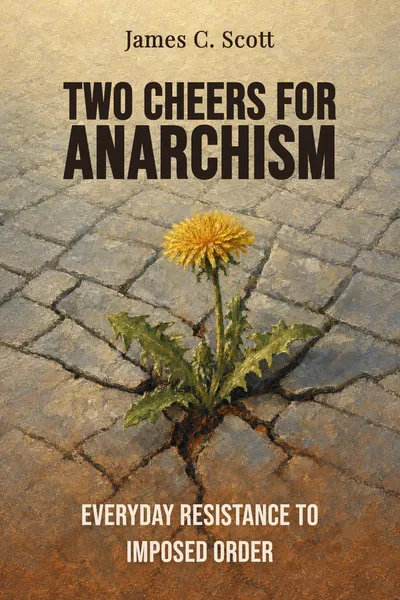
Two Cheers for Anarchism
Everyday resistance to imposed order
Description
James C. Scott spent most of his career as a political scientist at Yale studying how states see, and how the people they govern quietly see back. Somewhere in that long study he collected a habit he calls, half-joking, an "anarchist squint" — the reflex of looking at any grand plan, any official map, any tidy scheme of improvement, and asking what it flattened to get there. In 2012 he gathered the fragments into a short book, Two Cheers for Anarchism, and the count in the title is deliberate. Not three cheers, not the full salute. Two.
The reservation is honest. Scott is not calling for the abolition of the state, and he says so plainly. He likes clean water, vaccines, the rule of law when it protects the weak. What he distrusts is the certainty that order must always come from above, delivered by experts, stamped onto a population that is presumed to be waiting for instructions. Against that certainty he lines up something smaller and more stubborn: the improvised, unrecorded, often illegal ways ordinary people arrange their own lives — and resist when the arrangement is taken from them.
It is a book made of episodes rather than a system, which suits the argument. A crowd crossing against the light. A German garden dug against the rules. A peasant who never files a complaint but plows a little further into the landlord's field each season. Scott's wager is that these tiny acts, beneath the notice of history, add up to something political — and that we have trained ourselves not to see it.
The question we’re asking : What does the mess of everyday disobedience actually accomplish, and why does a book by a self-described anarchist stop at two cheers?What we’ll see : How informal order and small refusals quietly govern more of life than the official version admits — and what we lose when we let that muscle go slack.
Table of contents
01 Chapter 1 — The jaywalker knows something the planner doesn't
Scott opens with a scene almost too ordinary to notice. A pedestrian stands at a crossing in the small hours, no cars in sight, and the light is red. In much of the world she crosses anyway. In a few places — he singles out the disciplined obedience he observed in parts of Germany — she waits, dutifully, for a machine to grant permission an empty street has already granted. He is not scolding either one. He is asking what the waiting costs, and what the crossing preserves.
What the crossing preserves, in his reading, is a small exercise of judgment. The jaywalker weighs the actual situation — no traffic, clear sightlines — against a rule written for the average case, and decides the rule doesn't fit this moment. That act of assessment, repeated across a life, keeps a capacity alive. It says the person, not the signal, is the final authority on whether crossing is safe. Scott calls this kind of thing "anarchist calisthenics": breaking a trivial, pointless law now and then to stay in shape for the day a law worth breaking comes along.

02 Chapter 2 — The gardener who read the world before he burned it
To show how official order gets things wrong, Scott returns to a story he had told at length in earlier work: the invention of scientific forestry in Prussia and Saxony in the late eighteenth century. Foresters wanted a woodland they could measure and predict, so they cleared the tangled old forest — with its undergrowth, its mixed species, its birds and fungi and fallen wood — and replanted rows of a single tree, evenly spaced. On a ledger it was a triumph. The state could finally count its timber.
The first generation of these plantations grew beautifully, drawing on centuries of fertility the old forest had banked in the soil. The second generation faltered. Stripped of the mess that had sustained it — the pests eaten by vanished birds, the nutrients cycled by vanished undergrowth — the monoculture began to sicken. The Germans coined a word for the result, Waldsterben, forest death. What the planners had removed as clutter turned out to be the working machinery of the thing they wanted.
03 Chapter 3 — A world scrubbed of the improvised
Having established that informal knowledge holds systems together, Scott turns to what resistance looks like when it comes from people with no power to refuse openly. His answer, drawn from years of fieldwork among peasants in Southeast Asia, is that most resistance never announces itself at all. It is quiet, deniable, and cumulative — what he famously named the weapons of the weak.
The list is unglamorous by design. Foot-dragging. Feigned ignorance. Pilfering a little of the harvest. Poaching. Slowing the pace of work until it barely moves. Squatting on land and simply not leaving. None of it produces a manifesto or a martyr; that is the point. A peasant who openly rebels against a landlord or a state gets crushed. A thousand peasants who each shave a little off their rent, each plow a foot further into contested ground, each develop a convenient inability to understand an order — they cannot all be crushed, and often they cannot even be identified. The resistance is dispersed into the ordinary until it becomes invisible to the very authorities it drains.
04 Chapter 4 — The muscle that democracy forgets to use
Step back from the jaywalker and the peasant and the dying forest, and Scott's fragments point to one uncomfortable claim about modern life. We have handed nearly all our political agency to institutions — parties, elections, agencies, courts — and told ourselves that this is what maturity looks like. Vote, and then wait. But Scott notices how thin that inheritance can be. Most of the rights we now take for granted, he argues, were not granted from above at all. They were seized from below, often illegally, by people who broke the existing order first and were vindicated only later.
The eight-hour day, the end of legal segregation, the vote for those long denied it — these arrived through strikes that were illegal when called, sit-ins that were trespass, marches that defied the permit. Orderly petition rarely moved the immovable. What moved it was disruption serious enough that the authorities preferred concession to continued disorder. If that is how the deepest changes actually happened, then a citizenry that has forgotten how to disobey has misplaced the very tool that won it everything worth having.
05 Conclusion
We began with a woman at an empty crossing, deciding for herself. Scott's book is a long argument that her small, unnoticed judgment belongs to the same family as the peasant's quiet foot-dragging and the strike that was illegal until it won. Each is a way of keeping a margin of self-government against a world that would prefer everyone wait for the light. He never pretends this is enough. Disorder does not lay pipe, teach children, or settle disputes fairly; for those we still need the institutions he refuses to burn down. Hence the reservation baked into the title, the cheer he deliberately withholds.
Related books