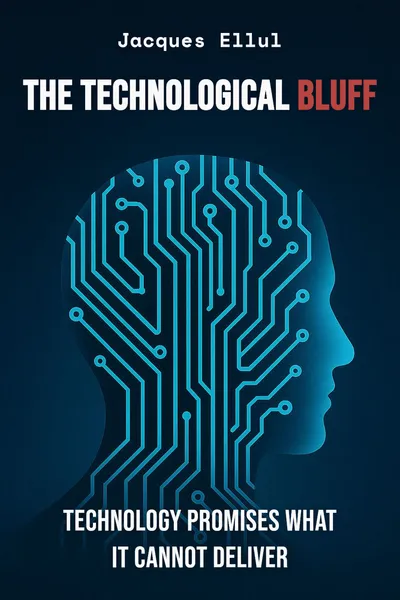
The Technological Bluff
Technology promises what it cannot deliver
Description
In 1988, Jacques Ellul published a book with a title that read like an accusation: Le Bluff technologique. Ellul was then in his mid-seventies, a sociologist and historian of law at Bordeaux who had spent four decades arguing that technique — the whole apparatus of efficient means that modern societies build around themselves — had quietly become their master rather than their tool. He had written about it since the 1950s, often against the grain, and by the late 1980s the mood had turned against him. Personal computers were arriving, biotechnology was in the papers, and the word everywhere was promise. Ellul wrote to say that the promise was, in large part, a bluff.
He meant something precise by the word. Not that the machines don't work — they obviously do, often spectacularly. The bluff is the discourse that surrounds them: the ceaseless talk that technology will solve the problems it has created, liberate our time, heal the planet, make us freer and richer and wiser, any day now. That talk, Ellul argued, is accepted on faith, repeated by experts and advertisers and politicians alike, and almost never checked against what technology actually delivers. We are dazzled by what technology can do, and that dazzle does the work of silencing the question of what it costs.
Three decades later the vocabulary has changed and the structure has not. Every new tool arrives wrapped in the same assurances. Ellul's book is less a prediction than a diagnosis of a habit of mind — and the habit has only deepened. It is worth sitting with what he actually said, before deciding whether he was a pessimist or simply someone keeping the receipts.
The question we’re asking : When technology promises to fix everything and keeps arriving, who is still asking what it actually delivers — and what it quietly takes?What we’ll see : How Ellul took apart the discourse of progress itself, separating what machines do from what we are told to believe about them.
Table of contents
01 Chapter 1 — The fascination, not the machine
Ellul's first move is to clear up a misunderstanding that followed him for most of his life. He was not against machines, and he did not think technology failed. He used it, studied it, admired its ingenuity. His quarrel was with the attitude we bring to it — a condition he called fascination. We no longer look at a given tool and weigh it. We look at technology as such and feel something closer to awe, the way earlier societies felt about the sacred.
That fascination, he argued, has become the common religion of the modern world. It crosses every political line. The liberal who wants markets and the socialist who wants planning both assume that more technique is the road forward; they disagree only about who steers. The environmentalist and the industrialist both reach for technological fixes. Whatever the problem, the reflex is identical — and the reflex itself goes unexamined, because to question it feels like questioning reason, or the future, or progress itself.

02 Chapter 2 — The discourse that promises everything
The bluff, in Ellul's sense, lives in language before it lives in fact. It is the vast, cheerful discourse that accompanies every innovation — the press releases, the futurist forecasts, the advertising, the ministerial speeches. This discourse makes a characteristic promise: that technology will deliver more leisure, more freedom, more communication, more abundance, cleaner air, better health, and a solution to whatever the last wave of technology broke. The promises are generous, continuous, and strikingly resistant to disappointment.
What struck Ellul was the immunity of the promise to its own track record. The computer was going to free us from paperwork; paperwork multiplied. New tools were going to give us time; the pace of life accelerated. Each failed forecast was not retracted but simply overwritten by the next one, aimed at the next machine. The discourse never pauses to reconcile. It is always future-facing, always about the marvel that has not quite arrived, which is precisely why it can never be falsified — tomorrow is forever out of reach of the audit.
03 Chapter 3 — The costs the ledger never shows
Against the discourse, Ellul sets the other column of the ledger — the one the promise never mentions. His central argument here is that technical progress always has a price, that the price is rarely visible at the moment of adoption, and that it tends to be paid later, elsewhere, by someone who did not choose. Every solution generates its own fresh set of problems, which then require new technologies to address, which in turn generate further problems. Progress is not a staircase but a loop that keeps raising the stakes.
He catalogued the forms this takes. There are the unforeseeable effects — the ones no one could have predicted, which surface only once a technology is woven into daily life and too embedded to remove. There are the side effects that were foreseeable but ignored because they fell outside the promise. And there is the way a technical system, once in place, imposes its own demands on everything around it: a society organized for the car must rebuild itself around the car, and then is no longer free to do without it.
04 Chapter 4 — What the bluff does to our judgment
Step back from Ellul's particular examples and a larger worry comes into focus — one that outlives any specific technology he was writing about. The deepest effect of the bluff is not that it oversells this device or that one. It is what it does to our capacity to judge. A society trained to greet every innovation with faith has, by that very training, retired the faculty that might have governed technology in the first place. Belief and judgment are not the same thing, and the bluff substitutes the first for the second so smoothly that we rarely notice the trade.
Ellul's point was never that we should reject technology — he thought that was neither possible nor desirable. His point was that we should be able to approach it as free people, which means being able to weigh, to refuse, to set limits, to ask of any given tool what it is for and what it will take. The bluff disarms exactly this. By making progress feel inevitable and criticism feel reactionary, it removes the question from the table before anyone can raise it. What looks like freedom — all these choices, all these new powers — can coexist with a deep unfreedom at the level that matters: the level of saying no.
05 Conclusion
Ellul died in 1994, a few years after the book appeared, having spent his life slightly out of step with his moment and largely at peace with it. The Technological Bluff was not a call to smash machines or flee to the hills. It was a request to keep both columns of the ledger open — to set the discourse of promise beside the record of delivery, and to notice how rarely the two are ever placed side by side. The bluff works, he argued, precisely because we do not insist on that comparison.
Related books