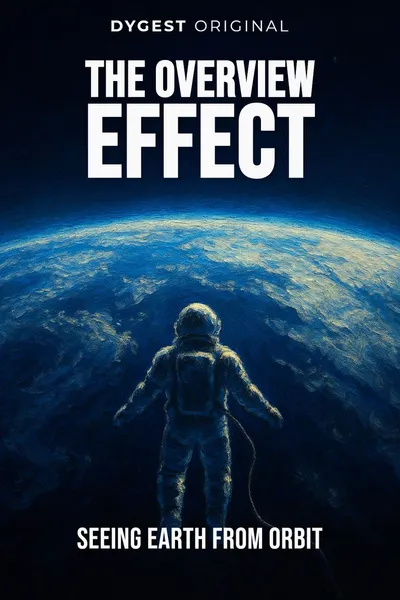
The Overview Effect
Seeing Earth from orbit
Description
On Christmas Eve 1968, the three astronauts of Apollo 8 became the first humans to orbit the Moon. On the fourth pass around the far side, as their capsule swung back toward the near side, Earth climbed over the lunar horizon — blue, white, small, suspended against total black. Bill Anders grabbed a camera and shot the photograph that would be called Earthrise. None of them had planned for it. The flight plan said nothing about looking at home. They had come to study the Moon, and instead the thing that stopped them cold was the planet they had left behind.
Anders said later that they had traveled all that way to explore the Moon, and what they really discovered was the Earth. Variations of that sentence have been repeated by dozens of people who have since gone to orbit, in languages and from spacecraft their predecessors never imagined. The specifics differ — some describe awe, some describe grief, some describe a sudden tenderness toward strangers — but the shape of the experience recurs with a consistency that is hard to dismiss as coincidence. Something about the view itself seems to do the work.
Decades later a writer gave the thing a name, and a handful of researchers started asking whether a shift reported by people in extraordinary circumstances could be studied like any other psychological event. The view is rare — fewer than seven hundred people have ever had it. The claim attached to it is not.
The question we’re asking : What exactly happens in the mind of someone who sees Earth whole from space, and does the shift travel beyond the few who feel it?What we’ll see : How a single view became a named phenomenon, what astronauts consistently report, what might explain it, and where the intuition runs into the hard edges of politics.
Table of contents
01 Chapter 1 — A word coined on a plane in 1987
The phrase "overview effect" belongs to a writer named Frank White, who settled on it in the mid-1980s. The story he tells is almost too neat: he was on a commercial flight, looking down at the ground from his window seat, when it struck him that people in cities below were arguing over borders and property lines they could not even see from this modest height. Multiply the altitude, he reasoned, and you would multiply the shift. He began interviewing astronauts, and in 1987 published a book that gave the experience its lasting label.
White was not reporting something new. He was collecting something scattered. Astronauts had been describing versions of the same feeling since the earliest flights, but they tended to do it privately, or in memoirs, or in the kind of language that doesn't survive a press conference. Test pilots are not, as a group, trained to narrate their inner lives. What White did was notice that the accounts rhymed, and insist that the rhyme meant something worth a name.

02 Chapter 2 — The border that disappears from orbit
What astronauts describe is not a single emotion but a cluster, and the cluster is remarkably stable across very different people. The most reliable element is awe — the specific, slightly overwhelming sense of encountering something vast that doesn't fit your existing frame. Edgar Mitchell, who walked on the Moon with Apollo 14, described a feeling on the way home that he struggled to put into words for the rest of his life, something between euphoria and a profound sense of connection to everything he was looking at.
Alongside the awe comes a second, stranger element: a sense of unity, and often a surge of protectiveness. The planet looks alive and looks exposed at the same time. Astronauts from rival nations have described, almost word for word, a sudden inability to care about the rivalries that defined the ground they came from. Ron Garan, who flew on both the Space Shuttle and a Soyuz, has spoken about looking down at a conflict zone and finding the fight unintelligible from where he sat — not resolved, just suddenly impossible to hold in mind.
03 Chapter 3 — Why a view rewires the mind
For a long time the overview effect lived in testimony, which made scientists wary of it. Testimony is vivid and unverifiable; people who have spent fortunes and risked their lives to reach orbit have every reason to describe the view as life-changing. So a group of psychologists set out to ask whether the shift had a recognizable structure, and whether it resembled anything already understood.
The most useful bridge turned out to be the research on awe. Over the past two decades, psychologists — Dacher Keltner and Jonathan Haidt among the early ones — have argued that awe is a distinct emotion with its own job. It arises when we meet something vast enough to require that we update our mental models, and its characteristic effect is to shrink the self. In experiments, people made to feel awe become less focused on their own concerns, more generous, more willing to describe themselves as part of something larger. The overview effect looks like awe delivered at maximum dose: the vastest possible object, seen in a context stripped of every familiar reference.
04 Chapter 4 — The politics of a planet without lines
The claim that follows the overview effect everywhere is political, even when nobody states it outright. If seeing Earth whole dissolves the salience of borders and expands the unit of concern to the species, then the view is an argument — a bodily, pre-rational case for thinking about the planet as one shared system rather than a patchwork of competing claims. Collins wanted leaders to see it for exactly this reason. The hope was that a perception strong enough to override an astronaut's nationality might override everyone's.
That hope has a real historical echo. Earthrise and the later "Blue Marble" photograph from Apollo 17 arrived in the years the modern environmental movement was taking shape, and the first Earth Day followed Earthrise by sixteen months. Those images gave a diffuse concern a single icon: a finite planet with no visible exits. It is genuinely hard to picture the environmental imagination of the 1970s without the photograph of the whole Earth hanging over it, standing in for everything the movement was trying to say about limits and fragility.
05 Conclusion
Edgar Mitchell spent the decades after Apollo 14 trying to understand what had happened to him on the way back from the Moon, founding an institute to study consciousness and returning again and again to that moment of looking at Earth and feeling, as he put it, that the molecules in his body and the molecules in the spacecraft and the molecules in the planet below were all part of one thing. He never fully pinned it down. Few of the people who have had the experience do. What they share is the conviction that something real shifted, and the frustration of carrying a perception that doesn't quite fit into words made on the ground.
Related books