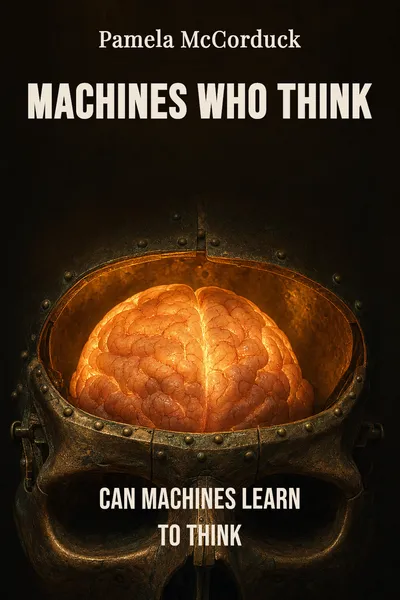
Machines Who Think
Can machines learn to think
Description
When Pamela McCorduck sat down in the early 1970s to interview the people trying to build thinking machines, the field she was documenting barely had a settled name and almost no history anyone had bothered to write. Machines Who Think, published in 1979, was the first attempt to tell that story as a story — not a technical manual, not a prophecy, but a record of a very old human wish finally colliding with real hardware. She talked to the founders while they were still arguing at the whiteboard, and the book carries the heat of a field convinced it was on the edge of something.
Her argument runs against the grain of how we usually date artificial intelligence. The impulse, she insists, is ancient. Long before transistors, humans built talking statues, imagined bronze servants, dreamed of golems and automata that could reason on their behalf. The digital computer did not invent the ambition; it simply gave a form to a fantasy that shows up in Greek myth, medieval workshops and the private notebooks of mathematicians. What changed in the middle of the twentieth century was that the dream became a research program with funding, rivalries and a name.
McCorduck treats this as an inquiry too important to leave to the specialists. To ask whether a machine can think is, unavoidably, to ask what thinking is — and that is a question about us, not only about circuitry. She writes as a witness who found the people building these systems more interesting, and more revealing, than the systems themselves. The book is less a status report on the technology than an invitation to sit at the table where a species tries to duplicate its own most prized possession.
The question we’re asking : Can a machine be built to think — and what does the attempt tell us about our own minds?What we’ll see : How an ancient wish became a modern science, and why the effort to copy intelligence keeps sending us back to define our own.
Table of contents
01 Chapter 1 — A dream older than the machines
McCorduck's opening move is to refuse the tidy origin story. Artificial intelligence, in the popular telling, begins with vacuum tubes and men in short-sleeved shirts. She pushes the starting line back by millennia. The wish to make an artificial mind, she argues, is one of the oldest things humans have wished for, and it recurs across cultures with a persistence that suggests it answers something deep in us. We keep imagining beings we have made that can think as we do.
She gathers the evidence like a collector. There is Hephaestus in Homer, forging golden handmaidens with sense and voice. There are the medieval legends of the brazen head that could answer questions, attached to figures like Roger Bacon and Albertus Magnus. There is the Jewish golem of Prague, animated clay shaped into a servant. There is the eighteenth-century craze for mechanical automata — Vaucanson's digesting duck, the writing boy that dipped its own pen — machines built to blur the line between clockwork and life.

02 Chapter 2 — Dartmouth, 1956 — the field gets a name
The book's center of gravity is a summer workshop at Dartmouth College in 1956, where the phrase "artificial intelligence" was coined and a discipline effectively announced itself. John McCarthy, then a young mathematician, chose the term partly to distinguish the effort from cybernetics and its established figures. He, Marvin Minsky, Nathaniel Rochester and Claude Shannon drafted a proposal whose confidence still startles: they believed a serious summer's work could make real progress on getting machines to use language, form concepts and solve problems reserved for humans.
McCorduck's gift is that she knew these people and lets them talk. The field she describes is small enough to fit in a few rooms, and fiercely opinionated. Herbert Simon and Allen Newell arrived from Carnegie with something the others did not yet have: a working program. Their Logic Theorist could prove theorems from Whitehead and Russell's Principia Mathematica, in one case finding a proof more elegant than the original. Simon reportedly told a class that they had invented a thinking machine — a claim that captured both the exhilaration and the trouble the field would carry for decades.
03 Chapter 3 — The long argument about what thinking is
Once machines began doing things previously called thinking, a stubborn argument opened, and McCorduck stations herself right inside it. Alan Turing had already reframed the question in 1950: instead of asking whether machines can think — a word he found too vague to settle — he proposed a test of behavior. If a machine could converse well enough that a human judge could not reliably tell it from a person, on what grounds would we deny it thought? The move shifted the debate from metaphysics toward performance, and it has never fully closed.
The critics arrived quickly and did not soften. The philosopher Hubert Dreyfus argued that human intelligence rests on embodiment, context and a background of common sense that symbol-manipulating programs could not capture — a critique the AI community treated with open hostility, which McCorduck records with some amusement and some sympathy for both sides. Later, John Searle's Chinese Room would press the point differently: a system might produce the right outputs while understanding nothing at all. Every advance provoked a retort that the machine was only simulating, never really doing.
04 Chapter 4 — What the pursuit reveals about us
Step back from the programs and the personalities, and McCorduck's deeper claim comes into focus: artificial intelligence is a mirror. The attempt to build a mind in an artifact keeps forcing us to specify what a mind is, and every time we try, we discover the specification is thinner than we assumed. The project she chronicles is at least as much an inquiry into human intelligence as into machine intelligence. We learn about ourselves by watching what is hard to copy.
This is why she insists the subject belongs to everyone, not just the researchers. To duplicate intelligence in an artifact is to touch what she calls our most important property — the capacity we point to when we explain why we matter. A civilization that seriously tries to reproduce that capacity is running an experiment on its own self-image. The stakes are not only technical. They reach into how we understand memory, creativity, judgment, even the sense that there is something it is like to be us.
05 Conclusion
McCorduck ends where she began, with the sense that this is one long story and not a recent invention. The people she interviewed at Stanford and MIT and Carnegie were carrying forward an impulse that runs through Homer, through the medieval brazen heads, through the golem and the clockwork duck. What was new was not the wish but the workshop: for the first time, the wish had a machine equal to its literal pursuit, and a generation confident enough to try.
Related books