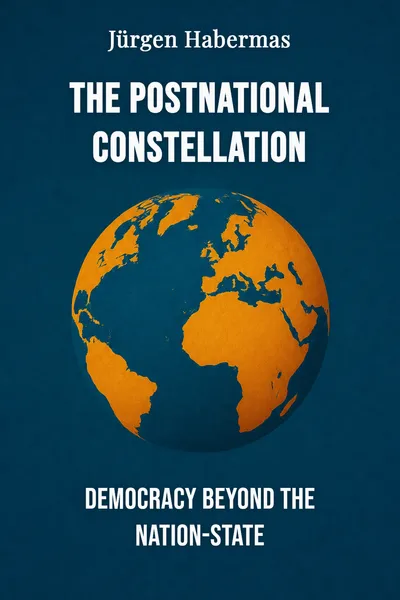
The Postnational Constellation
Democracy beyond the nation-state
Description
Around the turn of the millennium, Jürgen Habermas — by then the most prominent living German philosopher, a man who had spent decades arguing that democracy lives or dies by public argument — published a short, dense collection of essays called The Postnational Constellation. The title sounds abstract, and the prose does nothing to soften it. But the worry underneath is concrete, and it was already in the air in the late 1990s: markets had gone global, capital moved at the speed of a keystroke, and the political community that was supposed to govern all this — the nation-state — was suddenly looking too small for the job.
Habermas is not nostalgic about the nation. He spends a good part of the book reminding us that the nation-state was itself an invention, a relatively recent one, built to solve problems that older forms of rule could not. It welded together a people, a territory, and a set of rights, and for roughly two centuries it did something remarkable: it made democratic self-government possible at scale, and it made strangers feel responsible for one another. That achievement, he argues, is exactly what globalization now quietly erodes.
So the book is less a lament than a question posed with unusual seriousness. If the decisions that shape our lives — trade, finance, climate, migration — are increasingly made above or beyond the state, and if democracy still means that those affected by a decision get a say in it, then something has to give. Either we accept that large zones of modern life simply escape democratic control, or we try to imagine political community rebuilt at a larger scale. Habermas, writing from a Europe in the middle of building exactly such a thing, refuses the first option.
The question we’re asking : When the decisions that govern our lives outgrow the nation-state, where does democratic legitimacy go?What we’ll see : How Habermas reads the quiet dismantling of the nation-state, and why he thinks the answer has to be built, not mourned.
Table of contents
01 Chapter 1 — The nation-state did a job we forgot to name
To understand what Habermas fears losing, it helps to see what he thinks the nation-state actually accomplished. We tend to treat it as natural, almost eternal — a people, a flag, a border that was simply always there. Habermas insists it was none of those things. The nation, in the modern sense, is an eighteenth- and nineteenth-century construction, assembled out of shared language, print culture, schooling, conscription, and a story a population told about itself. It had to be built, often deliberately, and often against older loyalties of region, faith, and clan.
What made the construction worth the effort was the work it did. The nation-state fused two things that had no natural reason to go together: a legal order that guaranteed individual rights, and a thick sense of belonging that made people willing to share burdens with strangers they would never meet. This is the trick at the center of the book — call it solidarity among strangers. A tax system, a welfare state, a military draft all depend on citizens accepting that the person two hundred miles away, whom they will never know, counts as one of us.

02 Chapter 2 — What globalization takes apart
Globalization, in Habermas's account, is not one thing but a bundle of processes that share a single effect: they pull the economy out of the national container while leaving politics behind. Capital markets integrate; goods and services flow across frontiers; firms relocate production to wherever conditions are best for them. The economy stops coinciding with the territory. And a government that still answers to a national electorate finds that the forces most shaping its citizens' lives are precisely the ones it can no longer command.
The consequence he dwells on most is the squeeze on the welfare state. For decades, prosperous democracies taxed capital and labor to fund pensions, health care, and insurance against misfortune — the material side of solidarity among strangers. But when capital can exit, governments compete to keep it, and the easiest currency in that competition is lower taxes and thinner protections. No single state is doing anything irrational; each is responding to the others. The collective result is a slow erosion of the state's capacity to do the redistributive work that underwrote its legitimacy in the first place.
03 Chapter 3 — Solidarity among strangers, round two
If the old solidarity rested on a shared nation, and the nation is losing its grip, the tempting conclusion is that solidarity above the national level is simply impossible. Habermas refuses this. His counter-move is to point out that national solidarity was itself an artificial, learned achievement — people once could not imagine feeling bound to a stranger in the next province, and then, through institutions and argument and time, they did. If belonging could be stretched from the village to the nation, there is no law of nature saying it cannot be stretched again.
What would have to carry it, though, is different. Habermas does not think a European or global identity can be built on the old materials — a shared ethnic descent, a single language, a common mythic past. Those never existed at the larger scale and never will. Instead he reaches for what he calls constitutional patriotism: an attachment not to blood or soil but to the principles of a political order — rights, democratic procedure, the commitment to settle disagreement by public reason rather than force. Loyalty to a constitution, not to a tribe.
04 Chapter 4 — The legitimacy gap, and who closes it
Step back and the book is really about one recurring structure, visible far beyond this particular moment. Whenever the scale of decision-making grows faster than the community that authorizes it, a gap opens. Decisions get made that bind people who had no hand in making them. That gap is what we mean, precisely, by a crisis of legitimacy — not that governments are corrupt or incompetent, but that the reach of power has outrun the reach of consent. Habermas's achievement is to name this as the defining political problem of a globalized age, and to insist it has only two kinds of answer.
The first is to shrink the power back down to the community — the instinct behind every call to take back control, to reassert the border, to make the nation sovereign again. Habermas treats this as understandable and ultimately futile. The forces in question are structurally transnational; a single state cannot re-nationalize a global capital market by wishing it. Worse, the attempt tends to substitute the warm fiction of ethnic unity for the hard work of shared self-government, trading legitimacy for identity. The second answer is to grow the community up to the power — to build democratic institutions at the scale where decisions are actually taken.
05 Conclusion
The Postnational Constellation came out of a particular moment — a Europe adopting a shared currency, a decade giddy about globalization — but the predicament it describes has only sharpened since. Financial crises, pandemics, climate, migration: the decisive pressures on ordinary lives keep arriving from a level above the state, while the vote we cast still stops at the border. Habermas gave that mismatch a name and traced it back to what made the nation-state work in the first place — the lucky alignment of economy, identity, and democracy that globalization pulls apart.
Related books