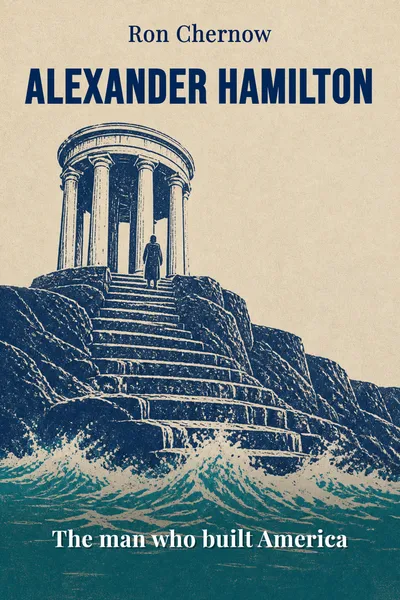
Alexander Hamilton
The man who built America
Description
He came ashore in a country that did not yet exist. Sometime around 1772, a teenager from the Caribbean island of Nevis stepped off a ship into the port of New York, carrying almost nothing but a talent for words. He was illegitimate, orphaned, and broke — his father had abandoned the family, his mother had died beside him of fever when he was thirteen. What got him off the island was a letter: he had written a description of a hurricane so vivid that local merchants pooled money to send the boy to the mainland to be educated. Ron Chernow's biography opens on this improbable arrival and never quite lets go of its strangeness.
Within twenty years, that penniless immigrant would draft the financial system of the United States, argue its constitution into ratification, and found the institutions that let a bankrupt collection of former colonies borrow, tax, and pay its debts. He was George Washington's indispensable aide, the first Treasury Secretary, and the intellectual engine behind most of what the early federal government actually did. And then, at forty-nine, he was shot dead in a duel by a sitting Vice President of the country he had helped assemble.
Chernow's eight-hundred-page life, published in 2004, set out to rescue Hamilton from the footnotes — the man on the ten-dollar bill whom most Americans could not place. The book became a bestseller and, a decade later, the seed of one of the most successful musicals ever staged. Behind the story of a founder lies a stranger, more useful question about who actually builds a country.
The question we’re asking : How did an orphaned immigrant with no money and no name end up designing the machinery of the United States — and why was he nearly forgotten?What we’ll see : An improbable ascent, the words that made a nation, the institutions built almost from nothing, and the fall that froze the legend in place.
Table of contents
01 Chapter 1 — The orphan who read his way out
Chernow spends real time on the island childhood because everything after it depends on it. Hamilton was born on Nevis, probably in 1755, to a woman who was not married to his father. When the father left, and the mother died, the boy and his brother were passed among relatives, one of whom promptly killed himself. There was no inheritance, no schooling, no obvious future. At around fourteen, Hamilton was clerking for a trading house on St. Croix, keeping the books, tracking cargo, handling correspondence — an accidental apprenticeship in the mechanics of money and credit that would matter enormously later.
What separated him from every other clever clerk was ferocious self-education and a prose style that could stop people in their tracks. The hurricane letter of 1772 is the hinge of the whole biography: a description of a storm so charged with feeling and force that the men who read it decided this boy could not stay on a small island. They raised a subscription and shipped him to New York to study. He arrived barely literate in Latin, crammed himself through preparatory work, and enrolled at King's College — now Columbia — where he began writing political pamphlets before he had finished his degree.

02 Chapter 2 — The pen that argued a nation into being
The war ended, and the peace revealed the deeper problem. Under the Articles of Confederation, the United States was barely a country — thirteen jealous states, a Congress with no power to tax, a national debt it could not service, and creditors abroad who had stopped believing the whole thing would survive. Hamilton had seen this from inside the army. He became one of the loudest voices calling for a stronger federal structure, and he was a delegate to the 1787 convention in Philadelphia that produced the Constitution, though his own proposals there were too centralizing to win support.
His decisive contribution came after the drafting, during the fight to get the document ratified. Ratification was not guaranteed; New York in particular was hostile. Hamilton conceived a campaign of newspaper essays defending the Constitution clause by clause, recruited James Madison and John Jay, and then wrote the overwhelming majority of them himself — fifty-one of the eighty-five essays now known as the Federalist Papers, produced at a pace that Chernow describes as almost physically implausible. They remain the single most cited explanation of what the Constitution was meant to do.
03 Chapter 3 — Building a machine no one had seen
As the first Secretary of the Treasury, Hamilton inherited a government with enormous debts and no reliable way to pay them. His response was a set of reports to Congress that read, in Chernow's telling, like the blueprints of a modern economy drawn by someone working almost from memory and first principles. He proposed that the federal government assume the war debts of the individual states, fund them fully, and honor them at face value — a controversial move that turned scattered IOUs into a stable national credit and gave wealthy holders a direct stake in the survival of the union.
He went further. He established a national bank, modeled loosely on the Bank of England, to hold public funds, issue currency, and lend to the government — an institution Jefferson and Madison attacked as unconstitutional and dangerous. Hamilton's defense of it introduced the doctrine of implied powers: the argument that the Constitution granted not only its explicit authorities but whatever means were necessary to carry them out. That reasoning would shape the reach of federal power for the next two centuries. He also built a customs service, a coast guard, and a system of excise taxes to fund the whole apparatus.
04 Chapter 4 — The duel, and the country he left running
The end, when it came, was almost gratuitous. Hamilton had spent years feuding with Aaron Burr, a man he regarded as brilliant and unprincipled, ambitious without conviction. When Burr ran for governor of New York in 1804 and lost, he blamed remarks Hamilton had reportedly made about his character, and demanded satisfaction. On the morning of July 11, 1804, the two men crossed the Hudson to Weehawken, New Jersey, to duel. Chernow examines the evidence that Hamilton intended to throw away his shot; whatever his intent, Burr's bullet struck him in the abdomen. He died the next day.
What survived him was not the man but the system. And here Chernow's larger argument comes into focus. The founders most Americans revere are the authors of ideals — Jefferson's eloquence about liberty, the ringing language of the Declaration. Hamilton is the founder of instruments: the bank, the debt structure, the customs house, the doctrine that let the government act. Ideals are memorable; plumbing is not. The country ran on Hamilton's plumbing for two centuries while crediting the plumbing to almost no one.
05 Conclusion
The orphan who arrived on a New York dock with a letter and no prospects ended as the architect of a functioning state, shot dead by the sitting Vice President before he turned fifty. Chernow's eight hundred pages track that arc without romanticizing it: Hamilton was abrasive, indiscreet, and often reckless with his own reputation, and he was also the most consequential builder among a generation of builders. The debt he funded, the bank he founded, the powers he argued into existence — these outlasted the parties, the feuds, and the man himself.
Related books