Simone de Beauvoir
The Second Sex and a life
Description
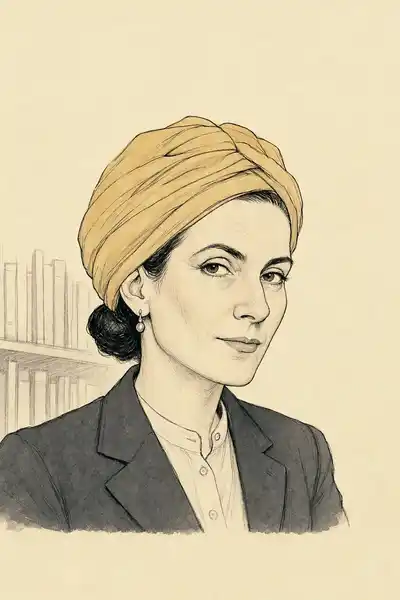
In the summer of 1949, a Parisian publisher put out the second volume of a long, dense book by a forty-one-year-old philosopher and novelist named Simone de Beauvoir. It was called Le Deuxième Sexe. Within a week it had sold some twenty-two thousand copies, and it had also earned its author a place on the Vatican's Index of forbidden books. The novelist François Mauriac wrote to a literary review that he now knew everything about the vagina of his colleague. Albert Camus, a friend, complained that she had made the French male look ridiculous. The reception was loud, personal, and mostly furious.
What Beauvoir had written was not a manifesto. It was an eight-hundred-page inquiry, half philosophy and half reportage, into a single deceptively simple question: what does it mean to be a woman? She had assumed the answer would be quick. It became the largest project of her life. The book braided biology, history, myth, psychoanalysis and dozens of ordinary lives into one argument, and its most famous sentence — one is not born, but rather becomes, a woman — would outlive nearly everything else written that decade.
Beauvoir spent the rest of her life as one of the most photographed intellectuals in France, forever paired in the public mind with Jean-Paul Sartre, sometimes read as his footnote. The pairing hid what she had actually done. The philosophy she is famous for popularizing was, in several respects, more rigorously her own than his, and the book that scandalized Paris turned out to rest on an idea that reaches far past the question of women.
The question we’re asking : How did an eight-hundred-page philosophy book become the founding text of modern feminism, and what idea was really holding it up?What we’ll see : A scandalous book, a life lived on its own terms, and the quiet philosophical claim underneath both.
Table of contents
01 Chapter 1 — A book that scandalized Paris
Beauvoir did not set out to write about women. In her memoirs she recalls wanting to write about herself, and noticing, when she tried, that the first thing to say was: I am a woman. That observation stopped her. A man would never begin an account of himself that way — he is simply a person, the default, the neutral. She realized that being a woman was a condition she had never examined, and that nobody around her had examined it either. The book grew out of that pause.
She worked at the Café de Flore and in the archives, reading biology, anthropology, Hegel, Freud, and the historians. The first volume, on facts and myths, traced how women had been imagined across cultures and centuries — always in relation to men, always as the exception to a male standard. The second volume, on lived experience, followed a woman from childhood through marriage, motherhood and old age, drawing on letters, case studies and confidences. It was this second volume, with its frank pages on female sexuality, that detonated.

02 Chapter 2 — One is not born a woman
The sentence that opens the second volume is deceptively plain: one is not born, but rather becomes, a woman. In it Beauvoir separates two things that her era treated as one — the biological female, and the social role of the woman. A body is a fact. Femininity, the whole apparatus of what a woman is supposed to be, want and do, is a construction, assembled over a lifetime by families, schools, advertising, and expectation. No destiny is written in anatomy.
This is the distinction later thinkers would formalize as sex versus gender, though Beauvoir never used that vocabulary. Her claim was that the little girl is not naturally coy, nurturing or self-effacing; she is trained toward it, taught to see herself through the eyes of others, to make herself an object to be chosen rather than a subject who chooses. The result is not a lesser human but a diverted one.
03 Chapter 3 — The philosophy underneath the polemic
It is tempting to read The Second Sex as sociology with a grievance, but it is built on a philosophy, and that philosophy is existentialist. Beauvoir had spent the 1940s working out the ethical stakes of a world without God or fixed human nature — a world in which, as the phrase went, existence precedes essence. We are not born with a purpose; we make ourselves through our choices. Her 1947 essay The Ethics of Ambiguity laid the groundwork, and it is more coherent on freedom than anything Sartre wrote on the subject.
From that foundation, the woman question becomes urgent. If a human being is defined by the freedom to choose and to project herself into the future, then any condition that systematically blocks that projection is not merely unfair — it is a kind of mutilation of the human. Beauvoir called the woman confined to immanence, to the endless repetition of housework and caretaking, someone denied transcendence, the movement outward toward projects and the world. The wrong done to women was, in her terms, metaphysical before it was political.
04 Chapter 4 — Freedom, and the situation we start from
If one idea survives Beauvoir beyond the feminist canon, it is the situation. She never claimed we are free in a vacuum. We are free, always, but from somewhere — a body, a class, a century, a set of expectations we did not select. Freedom is real, and it is also exercised against a weight. To be a woman in 1949 France was to begin from a particular position, with particular doors already shut, and no amount of inner resolve dissolved the walls of the room. Yet the walls did not abolish the freedom either.
This double claim is more demanding than either of its halves alone. It refuses the comfort of determinism — you are not simply produced by your conditions, off the hook for what you become. And it refuses the fantasy of the sovereign will that pretends conditions do not exist. Between the two, Beauvoir asks something harder: that we recognize our situation clearly, and then act inside it, knowing the odds and choosing anyway. She held herself to it, living without marriage or children, keeping her own name and her own work, in an arrangement with Sartre that scandalized as much as her book did.
05 Conclusion
Beauvoir kept writing until her death in 1986 — novels, memoirs, a long, unsparing account of her mother's dying, essays on old age. She was buried beside Sartre at Montparnasse, the pairing intact to the end, though by then the reflex of reading her through him had begun, slowly, to loosen. The book that had put her on the Vatican's Index was on university syllabi across the world, and the sentence about becoming a woman had passed into ordinary speech.
Related books