
Nike
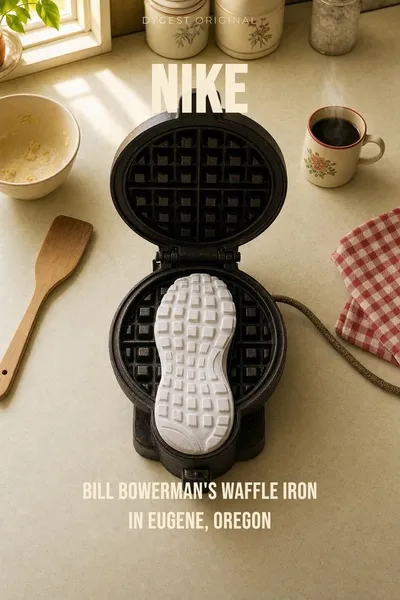
Bill Bowerman’s waffle iron in Eugene, Oregon
Description
In the summer of 1971, a fifty-nine-year-old track coach named Bill Bowerman was sitting at the kitchen table of his home in Eugene, Oregon, looking at his wife’s waffle iron. Bowerman had been the head track coach at the University of Oregon for twenty-three years. He had trained Olympic medalists. He had been obsessed for at least a decade with the problem of running-shoe traction, particularly on the synthetic surfaces that were beginning to replace cinder tracks in American athletics. The waffle iron, which his wife Barbara used to make the family’s Sunday breakfast, had a square waffle pattern that Bowerman thought looked like the kind of sole he had been trying to design. He took the waffle iron out to his garage workshop, filled it with liquid urethane rubber, and clamped it shut. The rubber bonded permanently to the iron, ruining the appliance and giving Bowerman the first prototype of what would become one of the most consequential product designs in the history of footwear.
The shoe that emerged from the waffle-iron experiment, the Nike Waffle Trainer, would launch in 1974 and would become the founding product of what was then a small Pacific Northwest shoe distributor called Blue Ribbon Sports. The company would rename itself Nike a few years later and would, over the following five decades, become one of the most valuable brands in the world, with revenues exceeding fifty billion dollars annually and a global presence that includes manufacturing in dozens of countries, marketing partnerships with most major sports leagues, and a sponsorship roster that runs from Tiger Woods to Serena Williams to LeBron James to Cristiano Ronaldo. The trajectory from Bowerman’s kitchen to that scale is one of the more documented business successes of the postwar American period.
What is less documented is the specific way the company has operated, what made it different from the running-shoe businesses that competed with it in the 1970s, and what the structural choices of its founders produced over the following half-century. Nike was not, in its early years, an obvious winner. It competed against Adidas and Puma, which had decades of European technical credibility, and against domestic American shoe brands that had more capital and broader distribution. The combination of factors that allowed the small Oregon operation to overtake the established competition, and then to redefine what athletic apparel as a category could be, is the part of the story worth examining beyond the founding anecdote.
The question we’re asking: what did Bowerman and Phil Knight actually build at Nike, what made the company different from its competitors, and what does the half-century trajectory reveal about how brand-driven business works?
What we’ll see: the founding partnership, the Waffle Trainer and the early products, the marketing innovation that made the brand, and the global expansion.
Table of contents
01 A coach and his accountant student
The Nike origin story has two main characters. Bill Bowerman was the coach. Phil Knight was the accountant. They had met in 1957, when Knight was a middle-distance runner on the Oregon track team Bowerman coached. After Knight finished his undergraduate degree, he went to Stanford Business School, where he wrote a 1962 master’s thesis on whether Japanese running shoes could compete with the German imports that dominated the American market.
The thesis was the seed of what would become Nike. Knight argued that Japanese manufacturing was producing high-quality running shoes at substantially lower cost than the German producers, and that an American distributor could undercut the competition while maintaining margins. After graduation, Knight traveled to Japan, met with the manufacturers of Onitsuka Tiger (later Asics), and pitched himself as their American distributor. Onitsuka agreed.

02 The Waffle Trainer and the founding of the brand
The Waffle Trainer launched in 1974, three years after the waffle-iron incident, after a series of refinements that turned the original ruined kitchen appliance into a manufacturable shoe sole. The product had two features that distinguished it from the competition. The first was the waffle pattern itself, which provided substantially better traction on synthetic tracks and grass than the smooth or lightly textured soles of competing shoes. The second was its weight: the urethane construction was lighter than the leather and rubber alternatives that the European brands were producing, and the lighter weight translated directly into better marathon times for the athletes who used the shoe.
The shoe sold well almost immediately. The 1970s running boom, which would peak around 1979, had been driven by a combination of public-health enthusiasm for aerobic exercise, the example of Frank Shorter’s 1972 Olympic marathon gold, and the broader cultural emphasis on personal fitness that the period produced. Blue Ribbon Sports, which had renamed itself Nike in 1971 after the Greek goddess of victory, was well-positioned to serve this expanding market. The company had a technically superior product, a direct relationship with serious athletes through Bowerman’s coaching network, and the operating focus of a startup that had been built specifically for the running market.
03 “Just do it” and the marketing transformation
The Nike that the rest of the world knows is largely the Nike that emerged in the late 1980s, after the company had recovered from a period of relative decline in the mid-1980s when Reebok had briefly overtaken it in the American athletic-shoe market. The recovery had two main components. The first was the launch of the Air Jordan line in 1985, the basketball-shoe partnership with Michael Jordan that would become one of the most successful athlete endorsement deals in the history of consumer products. The second was the launch of the “Just Do It” campaign in 1988, which would become the brand’s defining marketing statement.
The Air Jordan partnership had unusual structural features. Jordan, drafted by the Chicago Bulls in 1984, signed a five-year contract with Nike for $2.5 million plus royalties on shoes bearing his name. Nike had not previously made basketball shoes a major product line. The bet was that Jordan would be sufficiently telegenic to drive demand for shoes branded around him. The bet paid off. Air Jordan revenue exceeded $100 million in the first year. The shoes were banned by the NBA for being non-uniform; the ban became part of the marketing. The partnership has continued to generate substantial revenue for forty years.
04 What survives, half a century on
Nike today is a company of substantially different scale and structure from the operation Bowerman and Knight built in the 1970s. Annual revenues are in the high tens of billions of dollars. The athlete-endorsement portfolio runs into the hundreds. The product range extends from running shoes to basketball shoes to apparel to digital fitness applications. The manufacturing operations are distributed across dozens of countries. The company is one of the most valuable consumer brands in the world by most standard metrics.
The structural choices that allowed this scale are clearer in retrospect than they were at the time. The early decision to build the company around athletic credibility to make the shoes good enough that serious athletes would use them gave Nike a kind of cultural authority that competitors built on broader product lines could not match. The decision to pair the credibility with marketing aimed at non-athletes allowed the brand to capture the much larger consumer market without losing the credibility that justified the premium pricing. The combination serious credibility, mass marketing has remained the operating template of athletic apparel as a category. The competitors who have come closest to matching Nike’s position, particularly Adidas, have done so by adopting versions of the same template rather than by developing an alternative.
05 Conclusion
Bill Bowerman died in 1999 in Eugene, having spent his retirement coaching, gardening, and tinkering with running-shoe designs he passed to Nike’s product team. Phil Knight stepped down as CEO in 2004 and as chairman in 2016. The brand identity and operating template Bowerman and Knight built in the 1970s remain largely intact.
Related books