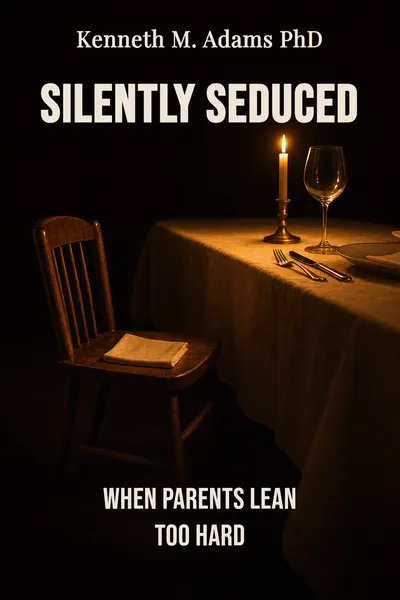
Silently Seduced
When parents lean too hard
Description
A mother tells her nine-year-old son he's the only one who really understands her. A father confides in his daughter about the marriage falling apart, the money worries, the loneliness he can't name to anyone else. The child feels chosen. Special. More grown-up than the other kids, closer to a parent than any sibling. There's no abuse in the way we usually mean it — no touch that crosses a line, nothing anyone would report. From the outside it can even look like a beautiful bond, the kind other parents envy. And that, in the clinical work of psychotherapist Kenneth M. Adams, is precisely the problem.
In his book Silently Seduced, Adams gives this dynamic a name that most people flinch at: covert incest, or emotional incest. The word incest usually points at a physical act. Adams uses it deliberately for something quieter — a parent who turns to a child to meet the emotional needs that belong to an adult partner. The child becomes the confidant, the emotional caretaker, the substitute spouse in everything but body. No line is visibly crossed. Which is exactly why it goes unnamed for decades, why the grown child struggles to explain what went wrong, and why the damage is so hard to trace back to its source.
Adams didn't arrive at this from theory. He built it from years of sitting with adults who couldn't understand why intimacy kept collapsing on them — why they felt guilty leaving a parent, why closeness felt like a trap, why they chased and fled love in the same breath. The pattern kept pointing back to a childhood that had looked, on paper, unusually warm.
The question we’re asking : What happens to a child who is loved not as a child but as a stand-in for a missing adult partner?What we’ll see : How this quiet betrayal takes shape, the role a child is quietly cast into, and the mark it leaves on the way we love as adults.
Table of contents
01 Chapter 1 — The parent who needs too much
The setup Adams describes rarely begins with cruelty. It begins with a hole. A marriage that's gone cold, a partner who's absent or emotionally unavailable, a divorce, an addiction, a death — some rupture that leaves an adult carrying more loneliness than they can hold. Instead of turning to another adult, or to therapy, or to the hard work of the marriage itself, the parent turns to the nearest available source of unconditional attachment: their own child. Children are, after all, wired to love their parents and desperate to be needed by them. They make willing recipients.
What flows toward the child isn't age-appropriate warmth. It's adult emotional weight. The parent shares grievances about the other parent, leans on the child for reassurance, treats the child as a peer and companion. Adams is careful to distinguish this from ordinary closeness. A parent who enjoys a child's company is healthy. A parent who depends on a child for their own emotional survival has inverted the relationship — the child is now serving the parent's needs rather than the other way around.

02 Chapter 2 — The child who becomes a spouse
Once cast in the role, the child begins to organize their entire self around it. Adams describes how the emotionally enmeshed child develops a hyper-attunement to the parent's moods — reading the room before entering it, managing the parent's disappointment, learning to soothe before being asked. The child becomes an emotional caretaker, and caretaking becomes identity. Their own needs, feelings, and developmental tasks get shelved, because there's no room for them. The parent's inner weather takes up all the space.
This is where the covert nature does its deepest work. In overt abuse, the child at least knows something wrong has happened, even if they can't say it. In emotional incest, there's nothing to point to. The child feels loved, chosen, important. Any resentment or suffocation that surfaces gets buried under guilt — how can you resent a parent who so clearly adores you, who tells you you're their whole world? The result, Adams finds, is a child who splits: outwardly devoted and dutiful, inwardly angry and trapped, with no permission to feel the second part.
03 Chapter 3 — The bill comes due in adulthood
The adults who eventually find their way to Adams's office rarely arrive complaining about their childhoods. They arrive because their relationships keep failing in ways they can't explain. A common pattern: they're drawn to partners, then feel smothered by the very intimacy they sought, then pull away, then feel guilty, then chase again. Closeness triggers the old feeling of being consumed, so they flee; distance triggers the old fear of abandoning someone, so they return. They are, Adams writes, replaying the enmeshment and running from it at the same time.
Sexual difficulties are frequent, and they surprise people who expect trauma to look dramatic. Because intimacy in childhood was fused with obligation and a parent's need, adult sexuality can feel loaded, shameful, or oddly deadened. Some struggle with commitment entirely, unable to fully arrive in a relationship without feeling trapped. Others swing to the opposite pole and merge completely, recreating the enmeshment because it's the only version of love that feels familiar. Either way, the childhood template is running the show.
04 Chapter 4 — What enmeshment asks us to rethink about love
Step back from the specific dynamic and Silently Seduced points at something larger and uncomfortable: the gap between being needed and being loved. We tend to treat them as the same thing, or to assume the first proves the second. Adams's clinical picture pulls them apart. A child in an emotionally incestuous home is intensely needed and, in a real sense, not loved at all — because love, in its healthy form, wants the other person to grow into their own life, while need wants the other person to stay and fill an emptiness. The tragedy is that the two can feel identical from the inside, especially to a child.
This is why the harm is so hard to see. Our cultural picture of family damage tends toward the visibly bad: the shouting, the neglect, the violence. Adams's work insists that some of the most lasting wounds are inflicted by closeness — by too much of it, aimed in the wrong direction. The favored child, the confidant, the little adult who made everyone proud, can be carrying an injury precisely because nothing looked wrong. Enmeshment hides inside our most flattering ideas about devotion.
05 Conclusion
The child who felt chosen grows into an adult who cannot quite explain why love feels dangerous. That's the thread Adams follows from the first page — the special bond, the whispered confidences, the sense of being someone's whole world — to the office where a grown person sits trying to understand why closeness keeps turning into a trap. What connects the two is a role assigned in childhood and never set down: the parent's confidant, the substitute partner, the little adult who was needed too much and loved too little in the way that would have helped them grow.
Related books