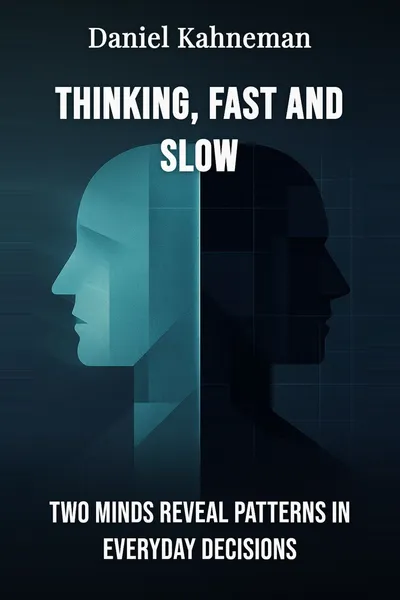
Thinking, Fast and Slow
Two minds reveal patterns in everyday decisions
Description
In the early 1970s, two psychologists at the Hebrew University of Jerusalem started asking colleagues deceptively simple questions. Daniel Kahneman and Amos Tversky would pose a little puzzle — about a hospital, a coin, a quiet woman named Linda — and watch even trained statisticians get it confidently wrong. Not lazily wrong, not sloppily wrong. Wrong in the same direction, again and again, in a way you could predict before they opened their mouths. The two men spent the next decade and a half turning those errors into a science. The work eventually earned Kahneman a Nobel Prize in economics in 2002, a year after a discipline he had reshaped from the outside finally claimed him.
Decades later, in 2011, Kahneman gathered all of it into one book, written after Tversky had died and could not share the recognition. He called it Thinking, Fast and Slow. The premise is almost embarrassingly simple: there are two ways the mind comes to a conclusion. One is fast, automatic, the answer that arrives before you've decided to look for it. The other is slow, effortful, the one you have to sit down and actually do. Most of the time the fast one runs the show, and most of the time that's fine. The trouble starts when it runs the show on a problem it was never built to handle.
What makes the book stick is that the errors aren't random. They have shapes, names, and a logic — which means they can be studied, reproduced, and, occasionally, caught in the act. Kahneman isn't trying to make us feel foolish. He's mapping how a perfectly good machine produces the same predictable mistakes, and why knowing that barely helps.
The question we’re asking : If our intuitions are this systematically off, why do they feel so reliable from the inside?What we’ll see : How two modes of thought share the work, where the fast one quietly takes over, and what that does to the choices we treat as our own.
Table of contents
01 Chapter 1 — The two characters in our head
Kahneman asks us to picture the mind as two characters, which he names without ceremony: System 1 and System 2. System 1 is fast. It runs constantly, with no sense of effort, and it produces impressions, feelings, and answers you didn't ask for. Show someone the face of an angry man and they read the anger instantly — no deliberation, no choice. Tell them two plus two and the number four appears unbidden. System 1 is where the world arrives already interpreted.
System 2 is the slow one. It's the part of us we tend to identify with, the deliberate self that reasons, checks, and concentrates. Multiply 17 by 24 and you can feel System 2 wake up: your pupils dilate, you stop walking, you lose track of the conversation. It's powerful but lazy in a specific way — it costs energy, so it stays out of the way as long as System 1 seems to have things handled. Most of the time it just signs off on whatever System 1 proposes.

02 Chapter 2 — The shortcuts that read the world for us
The reason System 1 is so quick is that it doesn't actually solve the problem in front of it. It answers an easier one and substitutes the result. Kahneman calls these substitutions heuristics, and the book is partly a catalog of them. Asked how likely something is, the mind quietly checks how easily examples come to mind. This is the availability heuristic, and it explains why we overestimate the risks that make the news — plane crashes, shark attacks — and underestimate the dull, common ones that kill far more people.
Then there's anchoring, maybe the eeriest of the lot. Throw out a number, any number, before someone makes an estimate, and their guess drifts toward it — even when the number is plainly irrelevant. In one demonstration, spinning a wheel of fortune before asking people what percentage of African nations sit in the UN visibly shifted their answers. They knew the wheel was random. It moved them anyway. System 1 reaches for whatever's nearby, and a meaningless number sitting nearby will do.
03 Chapter 3 — Where the numbers go wrong
Some of the sharpest errors show up when money and odds enter the room — the territory that won Kahneman the economics prize. With Tversky he built what they called prospect theory, and its core finding is blunt: losses hurt roughly twice as much as equivalent gains feel good. Lose fifty dollars and the sting outweighs the pleasure of finding fifty. This loss aversion quietly warps countless decisions, from holding a losing stock too long to refusing a coin-flip bet that's clearly in our favor.
Then comes framing, which shows how much the wording does the deciding. Tell people a surgery has a 90 percent survival rate and they sign up; tell them it has a 10 percent mortality rate and they hesitate. Same fact, opposite reactions. A pure System 2 reasoner would treat the two statements as identical. We aren't pure System 2 reasoners. The emotional pull of "die" versus "survive" reaches us before the arithmetic does, and the arithmetic rarely catches up.
04 Chapter 4 — A flawed agent, not a broken one
Step back from the individual tricks and a bigger claim comes into view, one that quietly dismantles a picture of ourselves we hold dear. The standard model — the one economics ran on for a century — assumes a rational agent who weighs options and chooses what serves them. Kahneman and Tversky didn't argue this agent is occasionally distracted. They showed the deviations are systematic, predictable, and shared. We don't err in scattered, individual ways. We err together, in the same directions, which means the mistakes belong to the design rather than to the person.
That reframing is what makes the book uncomfortable in a useful way. Being smart doesn't help much. Kahneman is disarmingly candid that decades of studying these biases left his own intuitions just as wrong as everyone else's — he still falls for the same illusions, the way you keep seeing a visual illusion even after you've measured the lines. Knowing the lines are equal doesn't make them look equal. Knowing about anchoring doesn't stop you from being anchored.
05 Conclusion
Those puzzles Kahneman and Tversky handed to colleagues in Jerusalem turned out not to be parlor tricks. They were small windows onto the machinery everyone runs on — the fast mind that answers before it's asked, and the slow one that mostly takes its word for it. The book gathers half a century of that work into a single, patient demonstration: the mistakes have names, the names have shapes, and the shapes show up in all of us, expert and novice alike.
Related books