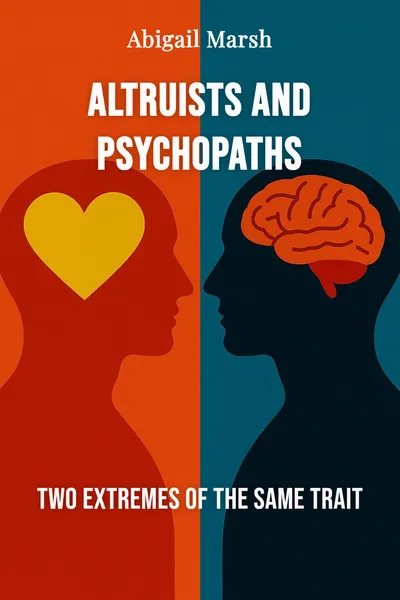
Altruists and Psychopaths
Two extremes of the same trait
Description
In the late 2000s, a neuroscientist named Abigail Marsh found herself trying to explain a group of people most of us would struggle to understand. They were extraordinary altruists — people who had donated a kidney to a complete stranger, someone they would never meet, for no reward and often without telling anyone. From one angle this looked like a small category of eccentrics. From another, it looked like a door into one of the oldest questions we have about ourselves: where does human kindness actually come from, and why do some people have so much more of it than others?
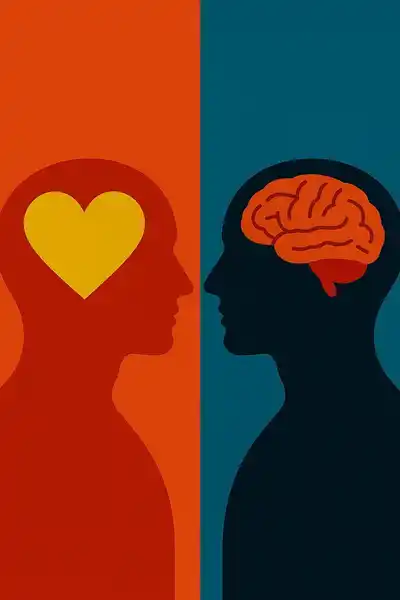
Marsh had spent years on the opposite end of the spectrum, studying psychopaths — people whose defining trait is a flat indifference to the suffering of others. The two groups seemed to have nothing in common. One would cut you off in traffic and feel nothing; the other would hand a kidney to a stranger. And yet, when Marsh put both into a brain scanner and showed them the same thing — a frightened human face — she found that the altruists and the psychopaths differed on exactly the same measure, in exactly opposite directions.
That symmetry is the spine of her book Altruists and Psychopaths. It reframes caring not as a moral achievement or a character flaw but as something closer to a dial, turned up in some people and nearly off in others — and it locates a surprising amount of that dial in how we respond to fear on someone else's face. Marsh's argument pulls kindness out of the realm of sermons and puts it somewhere stranger and more concrete.
The question we’re asking : Where does human kindness come from, and why does the same brain signal seem to explain both the people who give the most and the people who give nothing?What we’ll see : How one neuroscientist followed a frightened face from the brains of kidney donors to the brains of psychopaths, and found caring sitting on a single continuum.
Table of contents
01 Chapter 1 — A stranger gives up a kidney
The people at the center of Abigail Marsh's work are easy to describe and hard to believe. They are altruistic kidney donors — individuals who volunteer to have major surgery to give an organ to a person they have never met and will likely never meet. There is no family bond, no payment, no publicity. In most cases nobody even asks them to do it. By the standard economic logic we apply to behavior, this makes very little sense, and that is precisely what drew Marsh in.
Her own interest in altruism was not abstract. Years earlier, as a young driver, she had swerved to avoid a dog on a dark highway, spun out, and ended up stalled across the fast lane. A man she never identified ran across several lanes of traffic, got her car started, and vanished before she could thank him. He risked his life for a stranger and asked for nothing. She wanted to know what kind of person does that, and whether there was something measurable behind it.

02 Chapter 2 — The amygdala that reads a face
The region that kept surfacing was the amygdala, a small almond-shaped structure deep in each hemisphere of the brain. For a long time it was described mainly as the brain's fear center — the thing that fires when we are threatened. That description turned out to be too narrow. The amygdala is less about feeling fear ourselves than about detecting it, including when it appears on someone else's face. It is a kind of social alarm.
When Marsh scanned her altruistic donors and showed them photographs of frightened expressions, their amygdalae lit up more strongly than those of ordinary volunteers. Their brains were not just registering the faces; they were amplifying the signal of another person's fear. On top of that, their amygdalae were measurably larger than average — around eight percent larger in the right hemisphere. The anatomy matched the behavior. A brain built to notice distress belonged to people who acted on it.
03 Chapter 3 — The amygdala that goes quiet
Before she studied altruists, Marsh studied the other extreme, and the thread that connects her career is this single structure. Psychopathy is often misunderstood as pure aggression or criminality. Clinically it is something more specific: a profound deficit in empathy and remorse, an inability to be moved by the distress of others. Not everyone with these traits is violent, but the core is the same — the suffering of other people simply does not land.
When Marsh and her colleagues scanned people, including young people, with strong psychopathic traits and showed them the same frightened faces, the result was the mirror image of the donors. The amygdala, instead of flaring, stayed quiet. It underreacted. And in some studies the structure was physically smaller. The alarm that rang loudly in the altruists barely sounded in them. Tellingly, these individuals were worse specifically at recognizing fear — not anger, not happiness, but fear.
04 Chapter 4 — The caring continuum
What Marsh's symmetry suggests is that most of us are not standing outside this picture looking in. We are somewhere on the line between the two poles. Caring, in her account, is not a binary that sorts humanity into the good and the broken. It is a continuum, and the altruists and psychopaths mark its far edges, with the vast ordinary middle of us distributed between them — a little more sensitive to fear on some days, a little less on others, better at it with some people than others.
This recasts a question that usually gets answered with sermons. We tend to treat kindness as an achievement, something earned through discipline or belief, and cruelty as a choice someone makes. Marsh's work shifts the ground under both. A good deal of how much we care seems to track something quieter and less flattering to our self-image: how loudly our brain registers that another person is in trouble. The donor who gives a kidney and the bystander who walks past may differ less in their values than in the volume of the same signal.
05 Conclusion
Marsh began with a man who ran across a highway for a stranger and disappeared, and she ended with a measurement. The extraordinary altruists who give an organ to someone they will never meet, and the psychopaths who feel nothing when others suffer, turn out to be reading the same cue in opposite directions — a frightened human face, amplified or muted by the same small structure in the brain. The gap between the most generous people and the most indifferent is not a gap of moral worth. It is, to a surprising degree, a gap in perception.
Related books