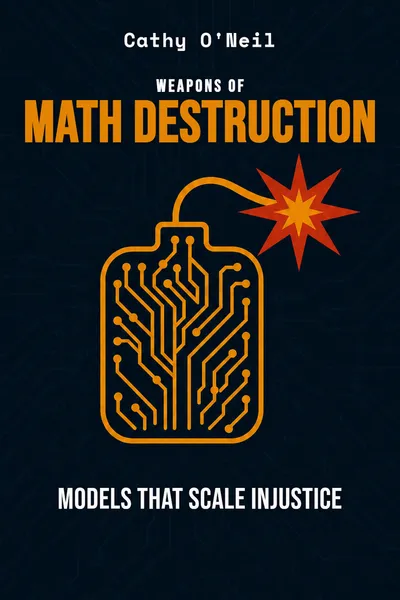
Weapons of Math Destruction
Models that scale injustice
Description
In 2011, a fifth-grade teacher in Washington, D.C., named Sarah Wysocki was told she was one of the best in her school. Parents praised her, her principal rated her highly, colleagues wanted their own children in her class. Then a software system called IMPACT ran her students' test scores through a statistical model and handed down a number. Her score was low. At the end of the year, she and more than two hundred other teachers were fired — not because a human had judged their work, but because a formula had.
Wysocki asked how the number was calculated. Nobody could really tell her. The model was proprietary, built by a consulting firm, and its inner workings were opaque even to the district that used it. There was no clear way to appeal, because there was nothing legible to appeal against. A teaching career ended on the authority of a calculation that its own owners could not fully explain. She later found a job in a wealthier district that didn't use the tool — but the algorithm's verdict stood.
This is the kind of story Cathy O'Neil, a mathematician who left academia for a hedge fund and then for data science, set out to collect. She had watched the same statistical machinery that priced mortgages before the 2008 crash migrate into schools, courtrooms, hiring, policing, and credit. In her 2016 book she gave these systems a name, and argued that the problem wasn't bad math. It was math doing exactly what it was built to do, at a scale nobody was watching.
The question we’re asking : When a mathematical model decides something about a person's life, who gets to see how it works — and what happens when nobody can?What we’ll see : How O'Neil traces the anatomy of a harmful model, the way it quietly turns prediction into punishment, and why the fix is less about better data than about accountability.
Table of contents
01 Chapter 1 — The teacher who got fired by a formula
O'Neil opens with cases like Wysocki's because they strip away the usual glamour around data. We tend to assume that a number is more objective than a person — that a model, unlike a biased manager, treats everyone the same. The teacher-evaluation story turns that assumption inside out. The model that fired Wysocki was trying to measure how much "value" a teacher added to her students over a year, isolating her effect from everything else in their lives. On a class of twenty-five or thirty children, that is a statistically tiny sample. The margin of error was enormous. The system was essentially generating noise and presenting it as judgment.
What made it dangerous wasn't the imprecision alone. Plenty of measurements are imprecise. It was that the imprecision came wrapped in mathematical authority and attached to real consequences. A human evaluator who fired someone on a hunch could at least be questioned, overruled, asked to explain. The model couldn't. Its output was treated as fact precisely because it looked like science, and that veneer of objectivity shut down the conversation rather than opening it.

02 Chapter 2 — Three ingredients of a WMD
Not every algorithm is dangerous, and O'Neil is careful about that. A model that recommends films or routes a delivery truck can be sloppy without wrecking anyone's life. The ones she calls weapons of math destruction share three specific properties, and it's the combination that does the damage. The first is opacity. The model is a black box — its workings hidden from the people it judges, often protected as a trade secret, sometimes not even understood by the organization deploying it. You cannot contest what you cannot see.
The second ingredient is scale. A biased human manager can harm the people in one office. A biased model embedded in hiring software can filter millions of applicants across thousands of companies, applying the same flawed logic everywhere at once. Scale is usually sold as the great virtue of automation — do it once, do it cheaply, do it to everyone. O'Neil's point is that scale is exactly what turns an ordinary mistake into a systemic one. The same efficiency that makes a model attractive is what lets it spread harm.
03 Chapter 3 — The feedback loop that manufactures its own proof
The most insidious mechanism in the book is the feedback loop — the way a model can create the reality it claims merely to predict. O'Neil's clearest example is predictive policing. A department feeds in historical crime data to decide where to send patrols. But historical data reflects where police have already been looking, not where crime actually is. Minor offenses get logged heavily in neighborhoods that were already heavily policed. The model reads that density, flags those areas as high-risk, and sends more officers. More officers find more of the small infractions that are everywhere but only recorded where someone is watching. The new arrests feed back into the data, which confirms the model's original guess.
Nothing in that loop requires malice. Every step looks reasonable on its own. But the system is not discovering crime hotspots — it is manufacturing them, and then citing its own output as evidence that it was right all along. The appearance of accuracy is produced by the model's own actions. This is what separates a WMD from an honest imperfect tool: an honest tool can be checked against reality, while a feedback-loop model rewrites reality so that checking becomes impossible.
04 Chapter 4 — What it would take to open the black box
Step back from the individual cases and O'Neil's larger claim comes into focus: a model is an opinion embedded in code. It looks like neutral mathematics, but every one of its choices — what to measure, which proxy to trust, what to count as success — is a value judgment made by people with interests. The danger isn't that the math is wrong in some technical sense. It's that the math is treated as if it were above judgment, and so the judgments inside it escape scrutiny. We have handed moral decisions to systems we've decided not to examine, and called the result objectivity.
That framing changes what the remedy looks like. If the problem were merely technical, the answer would be cleaner data and smarter algorithms. But O'Neil argues the problem is accountability, and accountability is a political and legal question, not a mathematical one. A model that ranks teachers or sentences defendants is exercising a kind of public power, and in every other domain where institutions exercise power over people's lives, we insist on the right to see the reasoning and to contest it. Algorithms have so far been exempt from that basic expectation, mostly because they are new and because calling something math makes people stop asking questions.
05 Conclusion
Sarah Wysocki never got a straight answer about the number that ended her job in Washington. The model that produced it stayed shut, its logic protected as property, its verdict standing on the strength of looking like science. She was, in O'Neil's telling, one of the lucky ones — she found another teaching position elsewhere. Most people flagged by a scoring system never learn they were scored at all. The loan that was never offered, the application that vanished, the extra months in a sentence: these arrive without a signature, and there is no one to ask.
Related books