The Brain
A working guide to the organ
Description
Hold a ripe grapefruit in one hand and you're holding roughly the weight and heft of the thing reading this sentence. About a kilo and a half, the texture of firm tofu, pinkish-grey, wrinkled like a walnut scaled up. In his book The Brain, the biologist and neuroscientist Bernard Sablonnière starts more or less there — with the object itself, unglamorous, sitting in its bath of fluid inside the skull. We tend to talk about the brain as if it were a metaphor: a computer, a filing cabinet, a muscle. Sablonnière's wager is that the organ is far stranger, and far more interesting, than any of those images, and that you can actually follow how it works without a medical degree.
What makes the guided tour worth taking is that the brain refuses to behave the way our tidy diagrams suggest. The clean textbook picture — this lobe does vision, that one does language, this knob handles fear — turns out to be a useful lie, true enough to pass an exam and wrong enough to mislead. Real brains share the work, improvise, reroute. A region that lost its usual job can be handed another. The map we draw is a snapshot of something that keeps moving.
Sablonnière writes as someone who has spent a career in the lab but still remembers what it's like not to know any of this. He takes the organ apart gently — the gross anatomy, the cells, the electrical and chemical traffic between them — not to reduce it to plumbing, but to show why plumbing this intricate can produce a thought, a memory, a change of mind.
The question we’re asking : What is the brain actually made of, how does it do its work, and why does an organ this physical keep changing shape throughout a life?What we’ll see : A walk through the organ from the outside in — its folded tissue, its talking cells, its deceptive map — and what all of it finally rests on.
Table of contents
01 Chapter 1 — A kilo and a half of folded tissue
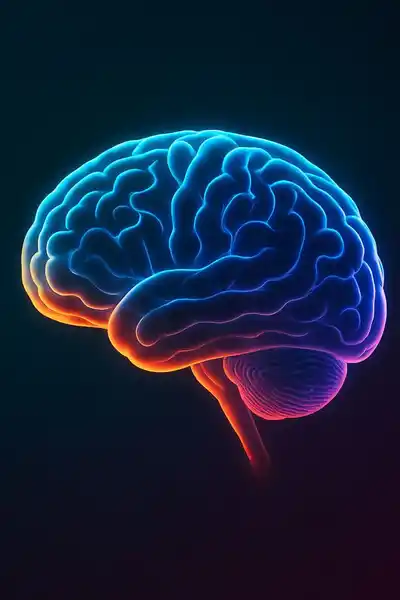
Start with what you'd see if you lifted the top of the skull off. The outer surface is the cortex, a sheet of grey matter only a few millimetres thick, crumpled into ridges and grooves. That crumpling is not decoration. Sablonnière points out that the folding is how evolution packed a large surface area into a container that still had to fit through a birth canal — flatten the human cortex and you'd get something close to the size of a dish towel. The ridges are called gyri, the valleys sulci, and a few deep ones split the whole thing into the familiar lobes.
Underneath the grey sits the white matter, and the colour difference is real, not conventional. White matter is pale because it's mostly bundled fibres wrapped in a fatty sheath that speeds up signals; grey matter is darker because it's where the cell bodies cluster. So the architecture is roughly: a thin computing surface on the outside, and beneath it a dense cabling system carrying messages between regions and down into the body.

02 Chapter 2 — The cells that do the talking
Zoom in and the folded tissue resolves into cells — somewhere in the order of tens of billions of neurons, the exact count revised downward in recent years from the old textbook figure of a hundred billion. A neuron is a strange-looking cell: a central body, a spray of short branches called dendrites that receive signals, and one long fibre, the axon, that sends them. Sablonnière describes it less as a wire than as a tiny decision-maker, constantly tallying the signals arriving on its dendrites and firing only when the sum crosses a threshold.
The firing itself is electrical. A pulse travels down the axon as a brief, self-propagating change in charge — the action potential — all-or-nothing, like a line of dominoes rather than a dimmer switch. But where one neuron meets the next, the electricity usually stops. The two cells don't touch; there's a microscopic gap, the synapse, and the message crosses it chemically.
03 Chapter 3 — The map that isn't a map
Everyone has seen the diagram: the brain painted in zones, each coloured for its job. Vision at the back, movement along a central strip, language camped in two patches on the left. The map isn't invented — those associations are real and were mapped the hard way, often by observing what people lost when a particular region was injured. The patients named Broca and Wernicke studied in the nineteenth century really did reveal that specific language abilities live in specific places.
But Sablonnière's point is that the map flattens something the brain does constantly: it works in networks, not territories. Reading this sentence lights up visual areas, language areas, memory, attention and more, firing together across distances, trading signals through that white-matter cabling. No single spot 'does' reading. A capacity emerges from a conversation between regions, and if you only ever photograph the regions, you miss the conversation.
04 Chapter 4 — A brain that keeps rebuilding itself
If one idea runs underneath the whole guided tour, it's that this organ is not finished. For most of the twentieth century the working assumption was that the brain was built in childhood and fixed by adulthood — you were handed your neurons, wore some out, and that was the hand you played. Sablonnière spends his closing pages dismantling that assumption, because the evidence of the last few decades points the other way. The brain is plastic, meaning it rewires itself in response to what it does.
Plasticity happens mostly at the synapses. Connections that get used repeatedly grow stronger and more numerous; connections left idle weaken and are pruned away. This is the physical face of learning — when you practise an instrument or a language, you are not filling a container, you are reshaping tissue. Sablonnière points to the well-known finding that intensive navigation work physically enlarges the hippocampal region tied to spatial memory. Use carves the organ.
05 Conclusion
Come back to the grapefruit in the hand. It looked, at the start, like a finished object — a thing you could weigh, slice, label. By the end of Sablonnière's tour it looks more like a process that happens to have a shape: billions of cells trading electrical pulses and chemical messages, organised into networks that overlap and share work, running on a greedy, fragile blood supply, and quietly reorganising themselves around everything the body experiences.
Related books