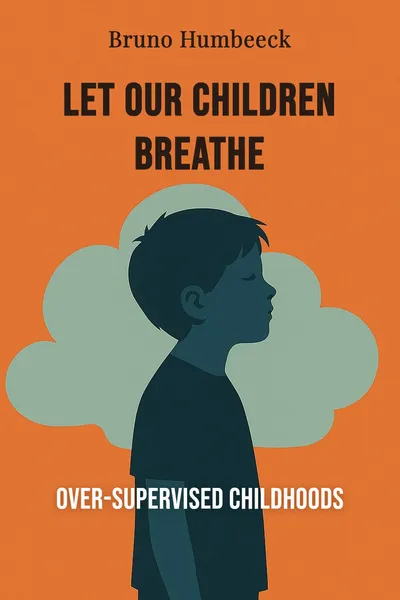
Let Our Children Breathe
Over-supervised childhoods
Description
Picture a Wednesday afternoon that no longer exists: a cul-de-sac, a few kids, a ball, and the understanding that you'd be called home when the streetlights came on. Nobody logged it. No adult refereed the arguments over whose turn it was, no one filmed the first wobbly bike ride, and the long stretches of doing nothing in particular belonged entirely to the children. The Belgian psychopedagogue Bruno Humbeeck opens his book Let Our Children Breathe on roughly this image — not out of nostalgia, but because he thinks something structural has been lost there, and he wants to name it precisely.
What replaced it is familiar to any parent today. The afternoon is booked: music, then sport, then a bit of tutoring, then a playdate that someone scheduled by text. The adult is rarely far — hovering at the edge of the sandbox, narrating the slide, settling the squabble before it becomes a squabble. Humbeeck, who has spent decades working on childhood, schooling and the management of conflict, reads this not as a few overanxious families but as a widespread shift in how we treat the whole terrain of growing up.
His argument runs against a lot of well-meaning instinct. More supervision feels like more care, more enrichment feels like more opportunity, and keeping a child safe and occupied feels unarguable. Humbeeck doesn't dismiss any of that. He asks instead what the child loses when every hour is watched, filled and optimized — and whether the thing we've quietly removed was doing more work than we noticed.
The question we’re asking : What do children actually lose when adults supervise, schedule and optimize every hour of their days?What we’ll see : How a childhood got colonized by adult attention — and what the empty, unwatched hours were quietly teaching all along.
Table of contents
01 Chapter 1 — The playground with no dead time
Humbeeck starts with a shift most of us lived through without registering it. A generation ago, a child's day had holes in it — unstructured stretches with no adult plan and no adult watching. Those holes weren't accidents. They were where the child did the private, unglamorous work of being a child: getting bored, improvising, drifting, inventing a game out of a stick. En vrai, the dead time was the point. It was the only part of the day that belonged to no one but the kid.
That emptiness has been systematically filled. Humbeeck describes the contemporary childhood as a managed calendar, where the adult reflex is to treat any idle hour as a problem to solve — an activity to add, a skill to develop, a screen to monitor. The logic feels generous. A busy child is a stimulated child, and a stimulated child is presumably getting ahead. The trouble, he argues, is that we've mistaken the symptom for the disease. Boredom isn't a void to be plugged; it's the raw material of imagination.

02 Chapter 2 — When adults colonize the sandbox
The deeper move in Humbeeck's book is to show how adult presence changed the nature of play itself. It isn't only that children have fewer free hours; it's that even the free hours are now watched. The parent sits at the edge of the sandbox, commenting, encouraging, mediating. And the moment an adult is watching, the sandbox stops being the children's territory and becomes a stage. The game bends toward the grown-up's approval.
This is the colonization he's describing — not malicious, usually loving, but total. When a dispute breaks out over a toy, the adult steps in and resolves it, fairly and fast. The child learns that conflicts are settled by appeal to a higher authority, rather than negotiated between equals. Humbeeck, who has worked extensively on how children handle conflict, treats this as a serious loss. The messy, unrefereed quarrels of the playground were a workshop in social repair: how to argue, back down, strike a deal, forgive, start again.
03 Chapter 3 — The risk we stopped letting them run
If one adult reflex is to fill time, another is to remove danger — all of it, if possible. Humbeeck takes aim here at the way physical and emotional risk has been engineered out of modern childhood. The climbing frame got lower, the surfaces got softer, the knife stayed in the drawer, and the walk to school became a car ride. Each decision, taken alone, is reasonable. Taken together, they add up to a childhood from which the experience of real risk has been largely subtracted.
His claim is that risk was never just a hazard to be minimized; it was information. A child who climbs too high and feels the fear learns the edge of their own competence. A child who is allowed to fail, fall or get it wrong learns that failure is survivable — which is the only way anyone ever learns to recover from it. Shield a child from every small danger, Humbeeck argues, and you don't produce a safe child; you produce a fragile one, with no rehearsed experience of coping when something finally does go wrong.
04 Chapter 4 — What a childhood is for
Step back from the calendar and the safety gates, and Humbeeck's book is really asking a larger question: what is a childhood for? The over-managed version answers implicitly — it's a preparation, a runway, a period of optimization before the real life begins. Every hour is an investment, every activity a return. On this view, unsupervised time is simply waste, and waste is the one thing a good parent eliminates.
His counter-answer is that a childhood is not only a preparation for adult life; it's a form of life in its own right, with its own legitimate work. And a large part of that work can only be done out of adult sight. Becoming a self — a person with an interior, with preferences nobody assigned, with a relationship to boredom and risk and other children that nobody scripted — requires space the adult doesn't occupy. The watched child is always, to some degree, the adult's project. The unwatched child gets to be their own.
05 Conclusion
Return to that empty Wednesday afternoon — the ball, the cul-de-sac, the arguments no adult settled. What looked, from the outside, like a child doing nothing was a child doing the quiet, invisible work Humbeeck spends the book defending: inventing, negotiating, risking, recovering, becoming someone. The afternoon wasn't a gap in the day to be filled. It was the part of the day that was actually theirs, and he thinks we gave it away without noticing what it held.
Related books