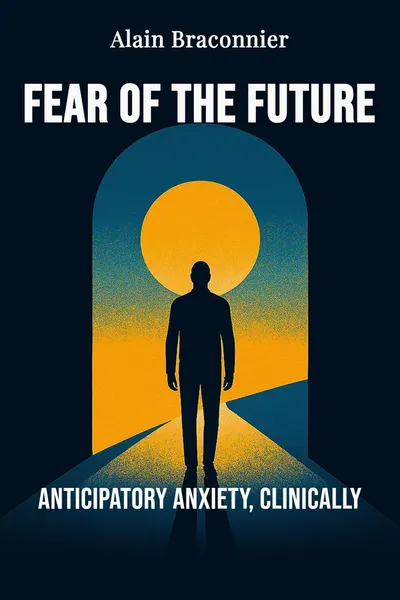
Fear of the Future
Anticipatory anxiety, clinically
Description
There's a particular flavor of dread that doesn't belong to anything happening right now. The bills are paid, the kids are asleep, the body is intact — and still, lying in the dark, the mind runs the tape of everything that could go wrong tomorrow, next month, in ten years. A medical result not yet taken. A job that might vanish. A phone call that hasn't come. The French psychiatrist and psychoanalyst Alain Braconnier, who spent decades listening to patients at the Centre Alfred Binet in Paris, gave this feeling a clinical face in his book Fear of the Future. His claim is simple and a little unsettling: a great deal of what we call anxiety is really an argument with time that hasn't happened yet.
Braconnier's interest isn't the ordinary prudence that makes us lock the door or save a little money. We all project forward; anticipation is half of what makes us human. What he tracks is the moment the projection curdles — when thinking ahead stops protecting us and starts eating us alive, when the future arrives in the body as a tightened chest and a racing pulse long before it arrives in fact. That tipping point, from useful foresight into suffering, is the whole subject.
And it matters that he keeps it distinct from the thing it most resembles. Fear of the future is not the same as being sad about the present, even though the two travel together and are endlessly confused — by patients, by families, sometimes by clinicians. Telling them apart is not a semantic nicety. It changes what we understand, and it changes what actually helps.
The question we’re asking : When does thinking ahead stop protecting us and start making us suffer — and how is that different from being depressed?What we’ll see : How a clinician reads the dread of what hasn't happened yet, where it comes from, and what loosens its grip.
Table of contents
01 Chapter 1 — The alarm that never turns off
Anxiety, in Braconnier's reading, is fundamentally an alarm system pointed at tomorrow. Fear reacts to a present danger — the car swerving toward us, the dog baring its teeth. Anxiety does something stranger: it reacts to a danger that isn't here, and may never be. The threat lives entirely in the imagination of what comes next. This is why anxious people so often can't say what, exactly, they're afraid of. There is nothing in front of them. The alarm is going off in an empty room.
What makes anticipatory anxiety so exhausting is that the body can't tell the difference between a rehearsed catastrophe and a real one. Picture the medical appointment three weeks away, or the presentation on Monday, and the heart speeds up, the stomach knots, sleep thins out — the physiology of genuine emergency, deployed against an event that hasn't occurred. The person pays the full biological price of the disaster in advance, and then, more often than not, pays it again if the disaster actually comes. Braconnier notes the cruel arithmetic of this: we suffer the future twice.

02 Chapter 2 — Not sadness, but the waiting room of dread
Here Braconnier draws the line that runs through the whole book. Depression and anxiety look alike from the outside — the sleeplessness, the fatigue, the loss of appetite, the sense that something is deeply wrong — and they frequently occur in the same person. But they face in opposite temporal directions. Depression is weighted toward the past and a foreclosed present: it says the worst has already happened, nothing will change, there is no point. Anxiety is weighted toward the future: it says the worst is still coming, stay alert, don't let your guard down. One has given up on tomorrow. The other cannot stop bracing for it.
The distinction shows up in the texture of the suffering. The depressed person is slowed, flattened, drained of desire; the world loses color and motion. The anxious person is the opposite — wound up, hypervigilant, unable to settle, the mind racing through scenarios it can't switch off. Braconnier's image is apt: depression is the room after the door has closed, anxiety is the waiting room where the door hasn't opened yet. Both are forms of entrapment in time, but they trap from different ends.
03 Chapter 3 — Where the fear comes from
If anticipatory anxiety is a stance toward the future, where does the stance get learned? Braconnier, writing from a tradition that takes early life seriously, locates much of it in the long apprenticeship of childhood. The infant lives in a world of uncertainty it cannot yet manage, and what it needs is a caregiver reliable enough to make the future feel safe — to establish that when something frightening comes, someone will be there. Where that reliability was patchy, where reassurance arrived inconsistently or not at all, the child may grow into an adult for whom the future is structurally untrustworthy, something to be guarded against rather than leaned into.
He weaves in temperament too; some of us are simply born more reactive, more quickly alarmed, and no account that ignores biology would be honest. But temperament is not destiny. What happens around a sensitive child — whether anxiety is soothed or amplified, whether a parent models calm or transmits their own dread — shapes how that reactivity settles. Braconnier is attentive to this transmission across generations, the way an anxious parent, without meaning to, teaches a child to read the horizon for threats.
04 Chapter 4 — Living forward without flinching
Step back from the clinic and anticipatory anxiety starts to look like a disorder of our basic relationship to time. To be human is to live forward, to carry a future we can imagine but not control — and that gap between imagining and controlling is exactly where the suffering opens up. The anxious person has not made an error about reality. The future really is uncertain; bad things really do happen. Their mistake, if it is one, is to demand of tomorrow a certainty it can never provide, and to treat the absence of that certainty as a threat to be eliminated. The project is doomed, which is why the anxiety never ends: there is always one more scenario to secure against.
This is why Braconnier frames recovery not as the abolition of fear but as a changed tolerance for not knowing. The goal is not a future scrubbed of risk — no such future exists — but a nervous system that can sit with openness without sounding the alarm. He is a clinician, not a sage, so the tolerance is built by concrete means: psychotherapy that traces the fear to its history and loosens its grip; cognitive and behavioral work that interrupts the loop of catastrophic rehearsal; medication where the anxiety is severe enough to warrant it, as support rather than cure. What unites the approaches is that none of them promises to make the future safe. They make the uncertainty bearable.
05 Conclusion
We began in the dark, with the mind running its tape of everything that could go wrong. Braconnier's achievement is to take that familiar, private dread and give it a precise shape: not sadness about what is, but fear of what might be — an alarm pointed at a future that hasn't arrived and may never come. Separating it cleanly from depression is not an academic exercise. It tells the sufferer, and the clinician, which door the suffering is standing at, and therefore which key to try.
Related books