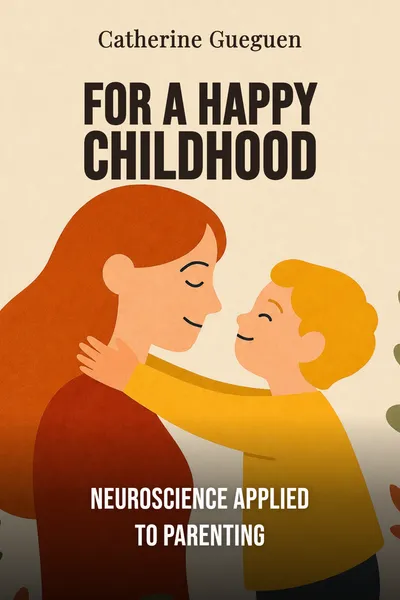
For a Happy Childhood
Neuroscience applied to parenting
Description
Dr Catherine Gueguen spent decades as a pediatrician in a Paris maternity hospital before she wrote the book that made her name. For a Happy Childhood, published in France in 2014, came out of a straightforward frustration: she kept watching loving, well-meaning parents do things that quietly worked against their own children — the raised voice, the time-out, the swat on the hand meant to teach a lesson. None of it came from cruelty. It came from the ordinary toolkit everyone inherits. What Gueguen brought to the table was unusual for a parenting author. She had gone back and read the developmental neuroscience, the work on how a young brain actually builds itself, and what she found there didn't match the folk wisdom at all.
The gap she describes is the heart of the book. We tend to treat small children as miniature adults who are being difficult on purpose — who could calm down if they wanted to, who are testing us, who need firmness. The neuroscience Gueguen gathers says something else entirely. The regions of the brain that manage emotion, impulse and self-control are, in a toddler, barely under construction. A two-year-old screaming on the floor is not manipulating anyone. That brain literally cannot yet do what we're demanding of it. Which means a great deal of standard discipline is aimed at a machine that hasn't been built.
Gueguen is not writing a manifesto against parents. She's a clinician, and her tone is closer to relief than reproach: here is what the research shows, and here is how much easier things get once we stop fighting biology. The book reads as an argument that kindness and rigor point the same direction — that what soothes a child is also what wires them well.
The question we’re asking : What does the developing brain actually need from the adults around it, and how much of ordinary parenting works against that?What we’ll see : How recent brain science reframes tears, tantrums and discipline — and lands on something unexpectedly concrete about the role of warmth.
Table of contents
01 Chapter 1 — The brain a child is actually born with
Gueguen opens with a fact that sounds obvious once stated and changes everything once absorbed: the human brain is nowhere near finished at birth. Compared to other mammals, we arrive strikingly premature, with a cortex that will keep remodeling itself well into the mid-twenties. The parts that handle reasoning, planning and the regulation of strong feeling — gathered in the prefrontal cortex — are among the very last to mature. In a small child, these circuits exist mostly as potential. They thicken and connect over years, and the pace depends heavily on what the environment supplies.
This is why, she argues, we keep misreading young children. When a three-year-old melts down over the wrong color cup, the adult reflex is to see defiance. But the brain structures that would let that child step back, name the feeling and talk themselves down are not yet operational. The emotional storm genuinely overwhelms them. Asking a toddler to 'calm down and be reasonable' is, neurologically, a bit like asking someone to read before they've learned the alphabet. The will is not the issue. The hardware isn't there yet.

02 Chapter 2 — Why punishment teaches the wrong thing
If the brain learns from what it repeatedly experiences, then the question of discipline becomes a question of what we're actually training. Gueguen takes aim at the oldest assumption in parenting: that a child who does wrong must feel something unpleasant in order to learn. Punishment, in this view, is how values get installed. She argues, from the research, that it mostly installs something else — fear, and a talent for not getting caught.
The mechanism she describes is physiological. When a child is frightened, shamed or hit, the brain's alarm system takes over. The body floods with stress hormones, attention narrows to the threat, and the higher regions that would process a lesson go briefly offline. In that state the child is in no condition to reflect on what they did or why it mattered. They are managing fear. Whatever moral content the adult intended rarely lands; what gets encoded is the fear itself, and its source — the adult.
03 Chapter 3 — The chemistry of a reassuring adult
Having described what harms the developing brain, Gueguen spends the center of the book on what helps it, and here she gets specific about chemistry. A child comforted by a calm, warm adult isn't just emotionally reassured in some vague way. Measurable things happen inside the body, and they build the brain in the right direction.
The molecule she returns to most is oxytocin, sometimes loosely called the attachment hormone. Physical closeness, gentle touch, a soothing voice, eye contact — these release oxytocin in both child and adult. It lowers stress, dampens the cortisol response, and creates the felt sense of safety that lets a frightened child settle. Over time, repeated doses of this safety help wire the circuits that will eventually let the child self-soothe without an adult present. The outside regulation becomes internal equipment.
04 Chapter 4 — What empathy does to a growing brain
Step back from the individual techniques and a single claim runs through the whole book: empathy is not a moral luxury we extend to children when we're feeling generous. It's a physical input their brains require to develop normally. This is the move that makes Gueguen's work more than a gentler parenting manual. She's shifting empathy out of the category of virtue and into the category of biology.
The argument has teeth because it cuts against a long cultural suspicion — that too much tenderness produces fragile, demanding children, that a bit of hardship toughens them up. Gueguen reads the neuroscience as saying almost the reverse. The children who become resilient, who handle stress well and relate to others with ease, tend to be the ones whose early distress was met with steady empathy. The warmth didn't weaken them. It built the very circuits that resilience runs on. Hardship without support doesn't toughen a young brain; it floods it with stress chemistry at the worst possible developmental moment.
05 Conclusion
The pediatrician who started with a frustration ends with something close to a reassurance. For Gueguen, the research doesn't hand parents a harder job; it hands them a simpler one. Stop fighting the biology of an unfinished brain, meet distress with steadiness instead of threat, and most of the daily battles lose their point. The tantrum isn't defiance to be crushed but a nervous system without its regulator yet installed — and the adult, for a few years, is that regulator.
Related books