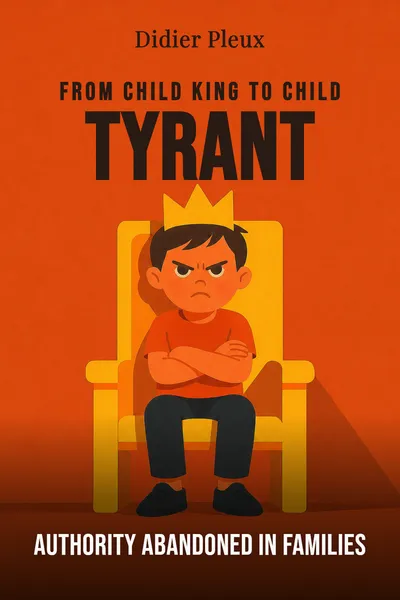
From Child King to Child Tyrant
Authority abandoned in families
Description
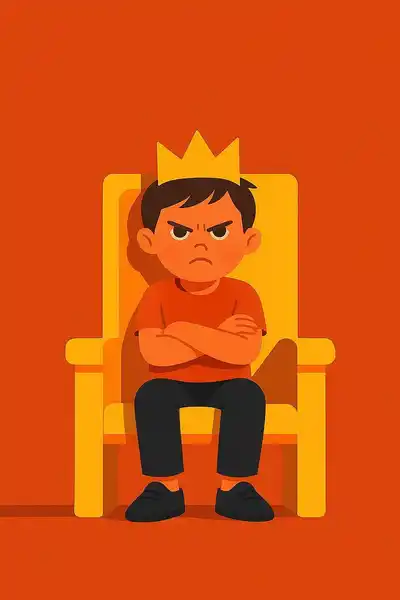
Dinner is ready, and a four-year-old decides it isn't. He wants pasta, not what's on the plate, and he wants the tablet, and he wants his mother to sit on the specific chair he has assigned her. The negotiation that follows has the shape of a hostage situation: a raised voice, a threat half-made and withdrawn, a parent who ends up reheating something else at nine at night. Nobody in the room would call this a crisis. It's just a Tuesday. And in the version of this scene that the French clinical psychologist Didier Pleux has spent decades watching from his consulting room, it is the whole problem in miniature.
Pleux built his career treating children who, by every material measure, had everything — attentive parents, stimulation, affection on tap — and who were nonetheless unhappy, anxious, and impossible to live with. In his book From Child King to Child Tyrant, he traces a drift. The child king of the late twentieth century, placed at the center of the family and adored, has in many homes curdled into something harder: a small tyrant who cannot bear to be told no, and a household quietly organized around avoiding that moment. The adults, he argues, didn't lose a battle. They stopped showing up for it.
What interests Pleux isn't the tantrum itself — every toddler has those — but the slow transfer of authority it signals, from the people who are supposed to hold it to the one person least equipped to carry it. He writes less as a scold than as a clinician describing a mechanism, and the mechanism turns out to be surprisingly specific.
The question we’re asking : How does a cherished child become a domestic tyrant, and what did the adults around him actually stop doing?What we’ll see : A clinician's account of a family where authority quietly changed hands — and of the one capacity its restoration is meant to protect.
Table of contents
01 Chapter 1 — The child who runs the house
The child tyrant, in Pleux's description, is not a monster and not unloved. He is usually the opposite — showered with attention, consulted on everything, rarely contradicted. What marks him is a particular relationship to his own desires: he experiences them as commands. A want arrives, and the world is expected to rearrange itself around it immediately. When it doesn't, the reaction isn't disappointment but something closer to outrage, as though a right had been violated.
Pleux is careful to separate this from ordinary childhood willfulness. Every young child tests limits; that is how limits get learned. The tyrant is distinguished by the fact that the testing never resolves, because the limit keeps moving. The parents, exhausted or anxious or simply hoping to keep the peace, give way a little more each time. The child isn't learning that no means no. He's learning that no means not yet, and that enough pressure converts it to yes.

02 Chapter 2 — Where the pleasure principle took over
To explain how the child king slid into tyranny, Pleux reaches back to a basic idea borrowed from psychoanalysis: the distinction between the pleasure principle and the reality principle. The infant begins life governed entirely by the first — hunger, comfort, desire, satisfied as immediately as possible. Growing up is, in large part, the long work of learning that the world has its own clock, its own refusals, its own other people whose wants compete with yours. The reality principle is what lets a person wait, share, and accept that not everything desired is owed.
That transition isn't automatic, and this is the heart of Pleux's argument. A child does not discover reality on his own; he meets it through the adults who refuse him, delay him, and survive his anger at being refused. The parent who holds a limit is, in effect, lending the child a reality principle until he builds his own. When the limit never comes, the child is left stranded in infant omnipotence long past the age where it fits him — still expecting the world to behave like a bottle on demand.
03 Chapter 3 — What frustration actually builds
The word that keeps returning in Pleux's work is frustration — not as a thing to be eliminated from childhood, but as the raw material of growing up. A frustration, in his sense, is any gap between what the child wants and what he gets: the toy denied, the bedtime enforced, the turn he has to wait for. The modern parental reflex treats these gaps as small emergencies to be closed as fast as possible. Pleux argues that closing them is precisely the mistake.
His claim is developmental, not moral. Learning to tolerate frustration is how a child acquires the capacity to wait, to persist, to manage disappointment without collapsing — the quiet machinery of resilience. A child who has never been allowed to be frustrated has never had to build it. So when real frustration finally arrives, as it always does — a friend who says no, a teacher who doesn't play favorites, a world indifferent to his preferences — he has no equipment for it. The meltdown at school is not a separate problem from the tyranny at home. It is the same deficit, seen from the outside.
04 Chapter 4 — The authority a child is waiting for
Step back from the single difficult dinner and Pleux's case is really about what a whole culture decided authority meant. For a long stretch of the twentieth century, parental authority and parental cruelty had been so tangled together that rejecting one felt like rejecting the other. The reaction against authoritarian fathers was overdue and largely good. But somewhere in that correction, authority itself got mislabeled as violence, and a generation of parents learned to be ashamed of the word.
Pleux's intervention is to pull the two apart again. Authority, in his account, is not domination; it is the adult's willingness to be the stable point the child can push against. A child who meets no resistance isn't free — he's unmoored, running a household he has no idea how to run, exhausted by a power he never asked for and cannot handle. The tantrums of the child tyrant are, read closely, a kind of appeal: a demand for someone finally to be larger than his own impulses, to hold the frame he can't hold himself.
05 Conclusion
The scene comes back around to the reheated dinner at nine at night, and it reads differently now. The parent standing at the stove isn't spoiling the child out of weakness, exactly; they're sparing him a frustration they can't bear to watch — and in doing so, quietly transferring the authority of the house into hands far too small for it. What looks like generosity is a kind of abdication, and the child, far from grateful, grows more anxious and more demanding the more he is obeyed.
Related books