
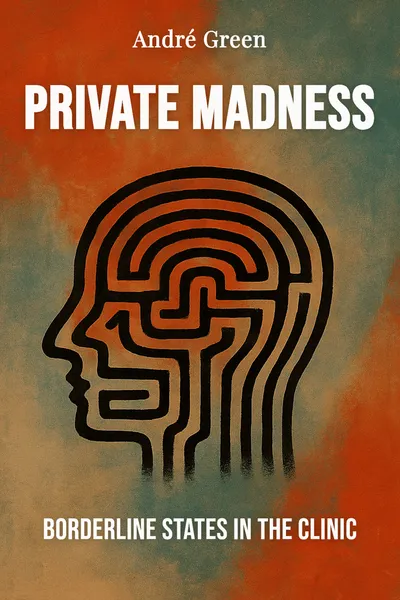
Private Madness
Borderline states in the clinic
Description
There is a kind of patient who, by the middle of the twentieth century, had become a quiet embarrassment for psychoanalysis. Not psychotic in any way a hospital would recognize — no hallucinations, no delusions, a job held, a life more or less lived. But not neurotic in the tidy sense Freud had described either. The symptoms would not settle. The transference would flare and collapse. Treatments that should have worked stalled for years, and the analyst, trained to interpret and wait, found interpretation landing on nothing. The French psychoanalyst André Green spent much of his career with exactly these patients, and in 1986 he gathered a decade of papers under a title that named the thing directly: Private Madness.
The phrase is deliberate. Green was pointing at a madness that stays indoors — invisible from the street, often invisible to the person carrying it, surfacing only in the strange weather of a close relationship or the pressurized room of an analysis. These were the cases clinicians had begun calling borderline, a word that sounds like a diagnosis of location: on the border between neurosis and psychosis, belonging fully to neither. Green's wager was that the border was not a no-man's-land to be mapped against the two countries on either side. It was its own territory, with its own logic.
Taking it seriously meant more than adding a new entry to a classification. It meant asking whether the tools Freud left behind — interpretation, the couch, the analyst who listens and says little — were built for this patient at all, and if not, what an analyst does when the usual instruments go quiet in the hand.
The question we’re asking : What does Green mean by "private madness," and why did the borderline patient unsettle psychoanalysis so deeply?What we’ll see : How a kind of suffering that hides in plain sight reshaped what an analyst listens for, feels, and finally does.
Table of contents
01 Chapter 1 — The patient who is neither neurotic nor mad
Green's starting point is a clinical frustration shared, by the 1960s and 70s, across the analytic world. Freud's great cases were neuroses: conflict between desire and prohibition, symptoms that could be read like disguised messages, a patient whose inner life held together even while it ached. Against that model, the psychotic was the opposite pole — a self broken open, reality itself in question. Between the two, classical theory left mostly empty space. And yet a growing share of people arriving for treatment seemed to live precisely in that space.
They did not look mad. That is the first thing Green insists on. Their madness was private: sealed inside, sometimes unknown even to themselves, showing only in the texture of their relationships and in the difficulty of being with them for long. A patient might function, charm, succeed, and then, under the intimacy of analysis, reveal an inner world that would not hold a steady shape — floods of feeling, sudden emptiness, a sense of not quite existing.

02 Chapter 2 — The borderline as a structure, not a leftover
The temptation, when a case resists the known categories, is to treat it as a leftover — a mixture, a transitional stage, a less severe version of something worse. Green resisted that. Drawing on Freud but reading him against the grain, and drawing heavily on the British object-relations tradition, especially Donald Winnicott and Wilfred Bion, he argued that the borderline state has its own organization. It is a structure, not a residue.
At the center of that structure sits a particular relationship to loss and absence. For the healthy or the neurotic, the absence of a loved figure can be tolerated — the mind holds an inner image that keeps the person company until they return. In Green's reading of the borderline, that capacity has been damaged early. Absence is not survivable as absence; it becomes a hole, a kind of psychic death. One of his most influential ideas, the "dead mother," describes a child who experienced not a mother's death but her sudden emotional withdrawal — present in body, absent in feeling — and who organized a whole inner life around that frozen blank at the center.
03 Chapter 3 — What the analyst actually feels in the room
Here Green turns to the experience that borderline work forces on the analyst, and it is here that his writing is at its most candid. With the classical neurotic, the analyst can maintain a certain evenly suspended attention, interpreting from a relatively steady place. With the borderline patient, that steadiness is exactly what gets attacked. The analyst finds himself bored to the point of absence, flooded with irritation, pulled toward rescue or retaliation, sometimes unable to think at all during the session.
For a long time psychoanalysis treated these reactions as noise — the analyst's own neurosis leaking into the work, to be mastered and set aside. Green, following Bion and others, reverses the polarity. What the analyst feels is not interference; it is information. The emptiness that invades the room may be the patient's own emptiness, lodged there because the patient cannot hold it. The sudden hostility may be a communication that has no words. Countertransference, long treated as a liability, becomes the analyst's most sensitive instrument precisely where interpretation goes mute.
04 Chapter 4 — A psychoanalysis that had to change its instruments
Step back from the individual case and the borderline patient looks less like a difficult exception than a challenge aimed at the method itself. Freud built psychoanalysis for a patient who could lie on a couch, associate freely, tolerate a mostly silent analyst, and make use of interpretations about buried desire. Green's work shows what happens when that patient does not arrive — when the person in the room cannot yet symbolize, cannot hold absence, cannot be reached by meaning because meaning has not formed. The technique bends or it fails.
So Green asks the analyst to change position. Less the decoder of hidden messages, more a presence that helps build a mind capable of having messages at all. The frame still matters — the regularity, the reliability, the boundaries — but now partly because its steadiness supplies something the patient never reliably had: a surface that does not vanish, an other who survives the patient's attacks and remains. Winnicott's holding and Bion's containing run through all of this. The cure, where it comes, looks less like insight arriving and more like a capacity slowly growing.
05 Conclusion
Green never promised that private madness could be dissolved like a neurotic symptom. His patients do not graduate into tidy cures; they acquire, slowly, a capacity to inhabit themselves — to bear absence, to feel without flooding, to be close without merging. The gains are real and hard-won, and they come from the relationship as much as from any single interpretation. The analyst does not stand outside the patient's trouble and explain it. He steps into the space where meaning failed to form, and lets something take shape between the two of them.
Related books