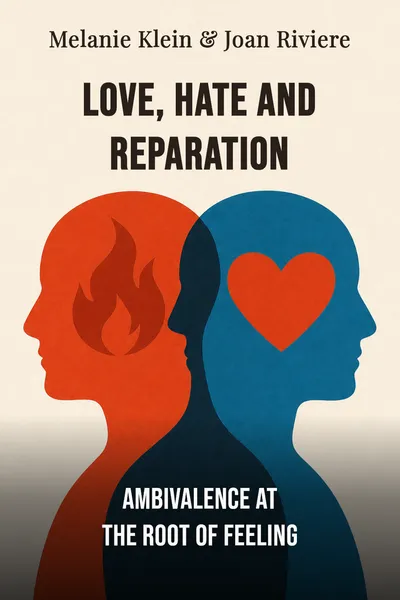
Love, Hate and Reparation
Ambivalence at the root of feeling
Description
In 1936 and 1937, two psychoanalysts, Melanie Klein and Joan Riviere, gave a pair of public lectures in London and then turned them into a short book. The title tells you most of what you need: Love, Hate and Reparation. What it doesn't tell you is how uncomfortable the argument underneath it would turn out to be. Klein had spent years sitting on the floor with small children, watching them play, and she had come to a conclusion that unsettled even her own colleagues. The people we love most, she said, are also the people we most want to destroy. Not instead of loving them. At the same time, in the same breath, aimed at the same person.
This wasn't a claim about bad children or damaged adults. It was a claim about everyone. Klein thought that from the first weeks of life, love and hate arrive together, tangled, and that the whole drama of becoming a person is the attempt to hold them both without letting either one win. Riviere, writing the book's first half, took that infant drama and followed it upward into the loves and jealousies of adult life — marriage, friendship, work, the small cruelties we barely notice ourselves committing.
The book is slim, under a hundred pages, but it carries one of the stranger and more hopeful ideas in the history of psychoanalysis. If we really do want to harm the people we love, the question becomes what we do with that. Klein's answer has a name, and it runs quietly through the rest of this short book.
The question we’re asking : If love and hate are aimed at the same person from the very start, what keeps a person — and a relationship — from coming apart?What we’ll see : How two analysts traced the warmth and the violence of adult feeling back to the cradle, and found something surprisingly tender waiting at the bottom.
Table of contents
01 Chapter 1 — The child who bites the breast that feeds it
Klein built her whole picture from the earliest months of life, before language, before anything a person could later remember. The infant, as she describes it, lives in a world of overwhelming need and almost no power. When the breast feeds it, the world is good and whole. When the breast is absent — when hunger comes and nobody arrives — the same source of all comfort becomes the source of all rage. The baby doesn't yet know these are the same thing. In its mind there is a good breast that loves it and a bad breast that withholds, and toward the bad one it feels a fury Klein did not hesitate to call murderous.
This is the part readers tend to resist, and Klein knew it. We like to imagine infancy as pure sweetness. But she had watched children in play act out, over and over, the biting, tearing, devouring impulses she was describing — doll smashed against the floor one minute, cradled the next. The violence wasn't a sign of something wrong. It was the raw material everyone starts with. Love, in her account, is not the opposite of this aggression. It grows up right alongside it.

02 Chapter 2 — What hate does to love, and what love does back
Riviere takes Klein's infant and grows it up. The ambivalence of the nursery, she argues, never leaves us; it just gets better dressed. We fall in love and, almost immediately, we resent the person we love for the hold they now have over us. We depend on them, and dependence galls. Riviere is sharp about this: the more we need someone, the more our need can curdle into a quiet hostility, because needing another person means they have the power to withhold, to disappoint, to leave. The lover and the frustrating mother are, underneath, the same figure.
She is especially good on jealousy and possessiveness, which she reads not as failures of love but as love's shadow. When we want to own another person completely, to be the only thing in their world, we are repeating the infant's wish for the breast that belongs to it alone. The adult who cannot bear a partner's independent friendships, work, or inner life is driven by something that began long before memory. Riviere doesn't sneer at this. She treats it as ordinary, as the common weather of close relationships, which makes her account oddly consoling rather than accusing.
03 Chapter 3 — Guilt is not the enemy
Most of us treat guilt as something to be rid of — a nagging, unproductive feeling that spoils the day. Klein's book quietly turns this upside down. Guilt, in her account, is the sign that love has won an important battle. The infant who realizes it has attacked the mother it loves feels something new: concern. It is sorry. It wants to undo the harm. That sorrow, uncomfortable as it is, marks the arrival of a conscience and of genuine care for another person as a person, not just as a source of supply.
This is worth sitting with, because it reframes a feeling we usually experience as purely corrosive. The capacity to feel guilty about hurting someone is, for Klein, inseparable from the capacity to love them. A person who felt no guilt at all would be a person who had never truly recognized the reality of the other — never grasped that the beloved can be wounded. The small child's dawning sorrow is the seed of every later act of apology, repair, and kindness.
04 Chapter 4 — The grown-up version of making amends
Step back from the nursery and reparation starts to look like one of the quiet engines of adult life. Klein and Riviere suggest that an enormous amount of what we do — not only in love, but in work and creativity — is, at bottom, an attempt to repair. The painter, the builder, the gardener, the person who cooks a careful meal for others: each is making something whole, and underneath the activity, Klein proposes, is the old wish to restore what we feared we had harmed. Creation is reparation turned outward, the loving impulse given something to build.
This is why the book, for all its talk of murderous rage, lands on a hopeful note rather than a grim one. It does not ask us to be free of hate — it treats that as impossible, a denial of how feeling actually works. Instead it asks what we do with the destructiveness we carry. The adult who can acknowledge their own hostility, feel honest concern about it, and turn that concern into care has done the essential human work. The one who cannot ends up either flooded by guilt or frozen in denial.
05 Conclusion
The book ends more or less where the infant began, but with the terms transformed. The baby who bit the breast and then feared it had destroyed the mother it loved is, in Klein's telling, the same creature as the adult who apologizes, repairs a friendship, plants a garden, or finishes a piece of work and feels, obscurely, that something has been set right. The rage never disappeared. It was never supposed to. What changed is that love learned to answer it.
Related books