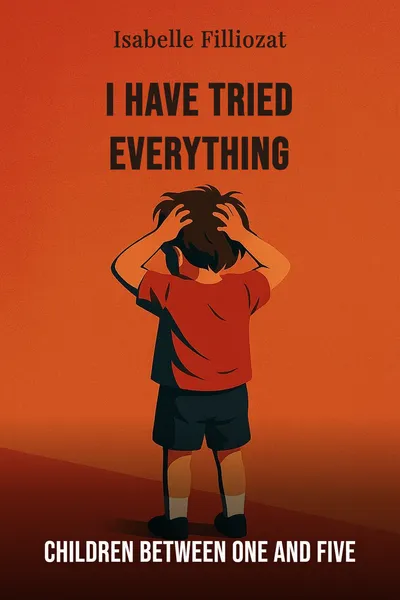
I Have Tried Everything
Children between one and five
Description
A parent stands in a supermarket aisle holding a two-year-old who has gone from cheerful to screaming in the space of a few seconds, over a yogurt that is the wrong color, or the wrong shape, or that someone else dared to put in the cart. The parent has tried the calm voice. Tried distraction. Tried saying no, then saying yes, then negotiating a third option nobody asked for. Nothing works. The child is on the floor, rigid, inconsolable, and every eye in the aisle has turned. This is the scene Isabelle Filliozat opens from — the exhaustion of a parent who has, quite literally, tried everything.
Filliozat, a French psychotherapist who has spent decades working with families, wrote the book whose title says it all: I Have Tried Everything. Her subject is the stretch between roughly one and five years old, the period parents often describe as the hardest and most baffling. The toddler who refuses shoes, melts down over a broken banana, hits, bites, says no to everything and then cries because you agreed. Conventional advice tends to treat these moments as discipline problems — the child testing limits, the parent needing to hold firm. Filliozat starts somewhere else entirely.
Her claim, drawn from developmental neuroscience, is that most of what we read as defiance is something the small child cannot yet control. The behavior isn't a strategy. It's a brain under construction doing exactly what an unfinished brain does. And once we understand what is actually happening inside that little head, the whole exhausting repertoire starts to look different — less like a war to be won, more like a storm to be weathered together.
The question we’re asking : When a small child falls apart over nothing, what is really going on — and why does nothing we try seem to work?What we’ll see : How the developing brain explains behavior that looks like defiance, and where that leaves the adult standing in the aisle.
Table of contents
01 Chapter 1 — The brain that isn't finished yet
The core of Filliozat's argument is biological, and she lays it out without drowning the reader in jargon. A child is not born with a finished brain. The structures that handle reasoning, impulse control and the regulation of strong emotion — grouped loosely under the prefrontal cortex — are among the last to mature. They are barely online in a toddler and will keep developing well into adolescence and beyond. What this means in practice is simple and a little humbling: when we ask a two-year-old to calm down, we are asking for something the equipment to do it does not yet exist.
She draws on the idea that the small child lives largely in the older, more primitive parts of the brain — the regions that register fear, hunger, frustration and the urge to act on all of them immediately. An adult who is cut off in traffic feels the surge of anger and then, usually, the upper brain steps in to say: not worth it. A toddler has the surge and nothing to apply the brakes. The feeling is the whole experience. There is no little voice counselling perspective, because that voice is still being built.

02 Chapter 2 — The crisis nobody chose
Armed with this, Filliozat turns to the tantrum itself — the full-body, red-faced collapse that defines these years. We tend to call it a crisis, and she keeps the word, but shifts its meaning. The child is not staging the crisis. The child is in the grip of it, as much a hostage to the storm as the parent watching it. When a toddler throws themselves on the floor because the toast was cut into squares instead of triangles, the toast is not the problem. The problem is that a tiny, overloaded nervous system has reached a threshold and tipped over.
She describes what is physically happening. Under intense frustration or fear, the child's body floods with stress hormones. The thinking brain, such as it is, effectively goes offline. In that state the child genuinely cannot hear reasoning, cannot accept a compromise, cannot be jollied out of it by logic — because the part of them that processes logic has temporarily left the building. This is why every clever adult intervention fails. We keep addressing a rational being who, in that moment, is not available.
03 Chapter 3 — Behind the behavior, a need
If the tantrum is a storm, the rest of the baffling behavior — the hitting, the refusing, the clinging, the endless no — needs a different lens, and here Filliozat offers her most practical move. Behind almost every behavior that drives parents to despair, she argues, there is an unmet need the child cannot name. The small child does not have the vocabulary or self-awareness to say I am overwhelmed, I need to move, I feel powerless, I missed you today. So the need comes out sideways, as action.
She works through the common cases. The child who hits is often flooded with a feeling too big to contain and has no other outlet yet — the hit is the overflow, not a decision to hurt. The child who refuses everything is frequently a child discovering that they are a separate person with a will of their own, a genuine developmental leap that happens to look like pure obstinacy. The child who will not sit still may simply have a body that needs movement to function. Reading the behavior as a message, rather than as an offense, changes what the adult looks for.
04 Chapter 4 — What the child is actually asking for
Step back from the particular ages and scenes, and a larger reframing emerges from Filliozat's work. The tantrum, in her reading, is not a flaw to be eliminated but a signal — the most honest communication a being without full language can produce. A small child who falls apart is telling us, in the only way available, that their capacity has been exceeded. Treated as information rather than insubordination, the storm stops being a verdict on the parent's competence or the child's character and becomes simply a stage of a nervous system learning to regulate itself.
This matters because the dominant cultural script runs the other way. We inherit the idea that a child who cries to get their way must not be allowed to win, that firmness now prevents manipulation later, that every meltdown indulged is a tyrant created. Filliozat's developmental account pulls the ground out from under that fear. A one-to-five-year-old does not have the cognitive machinery to manipulate in the strategic sense the script imagines. There is no little negotiator calculating leverage. There is a child who is overwhelmed, and an adult deciding how to respond to distress.
05 Conclusion
Which brings us back to the supermarket floor. The parent who has tried the calm voice, the distraction, the no and the yes has not run out of good ideas; they have been aiming those ideas at a part of the child that was offline. Filliozat's whole book is an invitation to stop fighting the storm and start understanding it — to see the screaming two-year-old not as a small adult behaving badly but as a brain in the middle of being built, doing precisely what an unfinished brain does under pressure.
Related books