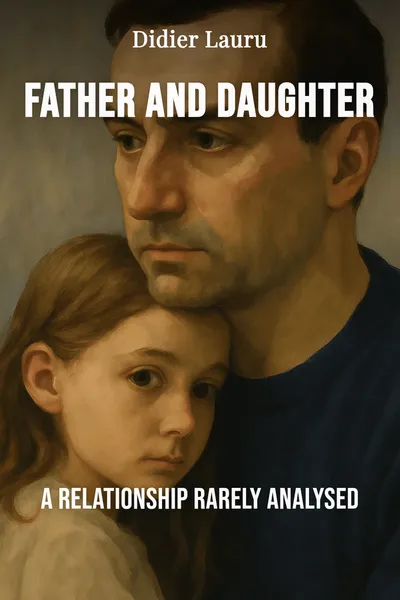
Father and Daughter
A relationship rarely analysed
Description
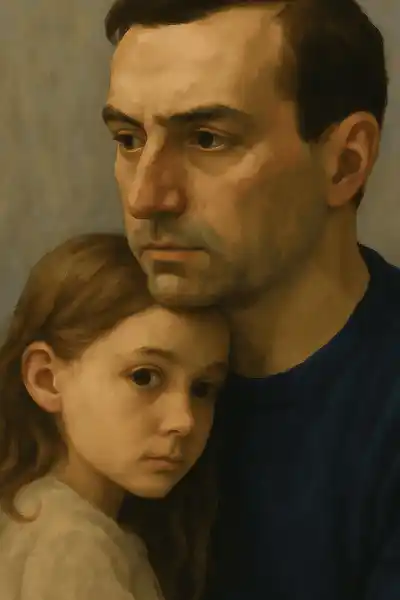
In his consulting room, the psychoanalyst Didier Lauru has spent years listening to families come apart and knit themselves back together. One pairing kept arriving under-described. Mothers and sons had Freud, Oedipus, a whole library. Fathers and sons had rivalry, succession, the weight of the name. But the father and the daughter sat in a kind of blind spot — a relationship everyone lives and almost nobody examines, tender and charged and strangely unspoken. Lauru decided to look at it straight, and the book that came out of that looking is less a theory than a careful account of what actually happens between a man and the girl who grows up calling him Dad.
The tenderness is real, and so is the awkwardness. A father can carry his small daughter on his shoulders without a second thought, then find himself not knowing where to put his hands when she turns thirteen. Something shifts, and most men feel it before they can name it. Lauru's wager is that this discomfort isn't a flaw in particular fathers — it's built into the bond itself, woven from affection, protectiveness, pride, and a desire that has to be felt and then firmly set aside. The daughter, meanwhile, is doing her own work: first adoring, then measuring, then needing him to step back.
What makes the bond so hard to talk about is precisely what makes it worth talking about. It touches the places families prefer to keep quiet — the first love a girl knows, the man who is supposed to be reliable and is also, inconveniently, a person. Lauru approaches all of it without alarm and without sentimentality, the way a clinician approaches a knot: patiently, from several angles, trusting that naming a thing takes some of its power to unsettle.
The question we’re asking : What actually happens between a father and his daughter, from the cradle to the moment she no longer needs him the same way?What we’ll see : A clinician's reading of the most under-described bond in the family — its tenderness, its hidden charge, and the letting-go it finally demands.
Table of contents
01 Chapter 1 — The bond that hides in plain sight
Lauru starts from an absence. Open the psychoanalytic canon and the father-daughter relationship is barely there as a subject in its own right. Freud built his whole architecture around the son's desire for the mother and his fear of the father; the daughter entered mostly as a complication, a case to be fitted into a frame designed for boys. The mother-daughter bond, by contrast, has been written about endlessly — its closeness, its rivalries, its difficulty separating. The father and the daughter slipped between the chapters.
Yet it is one of the most intensely lived relationships most people will ever have. The father is, for a girl, the first man — the first male body she knows, the first masculine voice, the first person of the other sex who holds her and tells her she is loved. That is an enormous role to hand a single person, and it is handed to him without instructions. Lauru's clinical point is that the very size of the role is part of why it goes undiscussed: families sense there is something delicate here and instinctively leave it alone.

02 Chapter 2 — The first man, and what he carries
The relationship begins before the daughter can remember it. In the earliest years the father is, among other things, the one who interrupts the fusion between mother and baby — the third presence who makes room, who says in effect that the child belongs to the wider world and not only to the mother's arms. Lauru keeps the psychoanalytic insight but strips it of jargon: the father's early job is partly to be the one who is not the mother, the first evidence that there are other people, other kinds of love, another way of being held.
For a girl, he is also the template of masculinity she carries forward, usually without knowing it. The way he speaks to her, whether he listens, whether he admires her or ignores her, whether he is present or perpetually elsewhere — all of it settles into a kind of baseline against which later men get measured. Lauru is careful here. He is not saying a woman is doomed to repeat her father; he is saying the father is the first draft, and that most people spend part of adulthood either confirming or editing that draft.
03 Chapter 3 — When desire enters the room
This is the part fathers find hardest to hear, and Lauru approaches it without flinching and without scandal. Between a father and a daughter there is, inevitably, a current of desire — not acted upon, not conscious most of the time, but present, the ordinary charge that runs through any close bond between people of different sexes. The taboo against incest exists precisely because the pull it forbids is real. Pretending it isn't there, Lauru argues, is worse than acknowledging it, because the unacknowledged thing has no way of being managed.
The father's task, then, is a particular kind of self-discipline. He has to feel the tenderness, the physical ease of carrying and cuddling a small child, and he has to know when to set it down — to register that his daughter is becoming a young woman and to adjust his body, his gaze, his jokes accordingly. Done well, this is almost invisible; the father simply becomes a little more reserved and nobody discusses why. Done badly, it curdles — into intrusion on one side, or into a sudden icy distance on the other, as if the only way to handle the charge were to amputate the warmth entirely.
04 Chapter 4 — Adolescence, and the work of letting go
Everything the bond has been building toward comes due in adolescence, which is where Lauru's reading finally settles. The daughter who adored her father stops adoring him. She slams doors, keeps secrets, falls for boys he distrusts, tests every limit he sets. To the father it can feel like rejection, even betrayal, and many men respond by tightening their grip or by wounded withdrawal. Lauru reframes the whole scene: the adolescent's job is to separate, and she can only separate from something solid. Her rebellion is a measure of how much he mattered.
What the father is being asked to do is hard precisely because it runs against love's instinct. Love wants to hold. The father of a teenage daughter has to do something closer to the opposite — stay present while loosening his hold, remain a reference point she can push against without being crushed, survive her anger without retaliating or collapsing. He has to let her become a woman in front of him, with all the discomfort that carries, and let her leave him for other men who are not him. The good father, in Lauru's account, is the one who makes himself gradually less necessary.
05 Conclusion
Lauru set out to describe a relationship that lives in everyone's family and almost no one's bookshelf. What he found, listening to decades of patients, was a bond built from a single tension: a love that must be felt fully and held at a distance, that adores in childhood and must learn restraint, that holds tight and then, at adolescence, has to teach itself to let go. The father is the first man a daughter knows, which makes him the first man she has to leave.
Related books