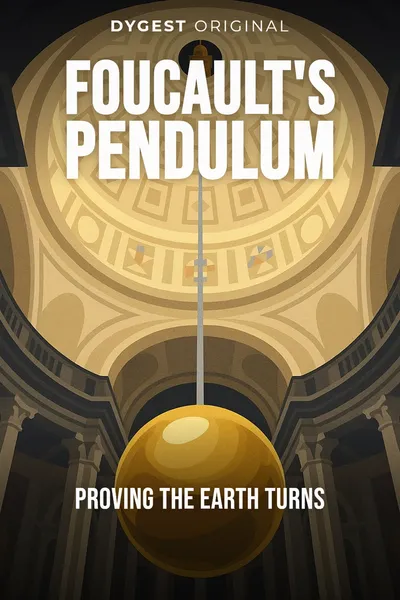
Foucault's Pendulum
Proving the Earth turns
Description
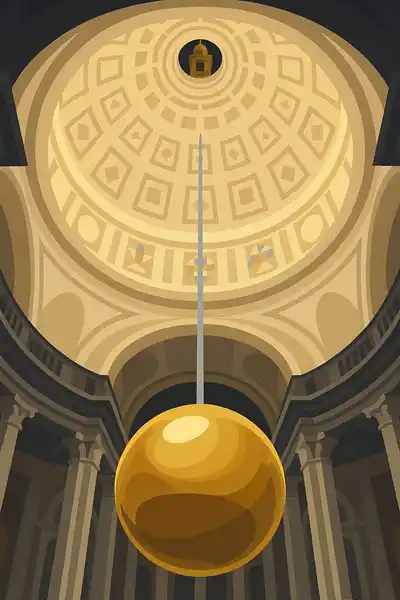
On a February morning in 1851, a French physicist named Léon Foucault hung a sixty-seven-metre wire from the dome of the Panthéon in Paris, tied a twenty-eight-kilo brass bob to the end, drew it carefully to one side, burned through a thread holding it in place, and let go. The bob began to swing. For a while nothing seemed to happen that anyone would call remarkable — a heavy ball tracing the same slow arc, back and forth, over a bed of damp sand laid out beneath it. Then the line it was drawing in the sand began, very gradually, to rotate. Foucault had promised the audience something extravagant: that they were about to see the Earth turn beneath their feet.
This was not a figure of speech. The spinning of the planet was, by 1851, something educated people accepted as true — Copernicus had argued it three centuries earlier, Newton had done the mechanics, the astronomers had the orbits down cold. But accepting a thing on authority is not the same as watching it. Nobody had ever produced a direct, sit-in-a-room-and-see-it demonstration that the ground under us is moving. The Earth gives no sensation of motion. Foucault, a self-taught experimenter who had never finished a conventional science degree, built a device that made the rotation visible to anyone with eyes and a little patience.
What makes the thing worth lingering over is not only that it worked, but how plain it was — a weight on a string, a principle a curious teenager can grasp, staged as public theatre in one of the grandest buildings in France. It turned an abstraction into an afternoon out. And it raised a question that has followed physics ever since: what does it take to make an invisible truth feel undeniable?
The question we’re asking : How can a weight on a wire show that the planet beneath us is turning, and why did that demonstration land so hard?What we’ll see : We follow the swing from a quiet workshop to the dome of the Panthéon, and watch a piece of physics become a public event.
Table of contents
01 Chapter 1 — A rope, a weight, and a doubt
Léon Foucault did not look, on paper, like the man who would settle the question. Born in Paris in 1819, he had trained briefly for medicine and abandoned it, reportedly unable to stand the sight of blood. He drifted into experimental physics as an assistant and a popular-science writer, learning the craft with his hands rather than in lecture halls. He was good with instruments — precise, patient, ingenious — and by his early thirties he had already helped measure the speed of light with a spinning mirror. He was, in the language of the time, an amateur who happened to be very, very good.
The pendulum idea seems to have come to him quietly, at home, in the winter of 1851. The story most often told is that he was watching a thin steel rod vibrate in the chuck of a lathe and noticed that the plane of its vibration stayed fixed even as he turned the clamp holding it. The rod kept swinging in the same direction in space while its support rotated around it. If a swinging thing holds its plane while its mount turns, he reasoned, then a pendulum hung on the turning Earth should appear to drift — not because the pendulum changes, but because the room, the building, the whole ground beneath it is slowly swinging around.

02 Chapter 2 — Why the plane refuses to move
The physics underneath the spectacle is almost suspiciously simple to state. A pendulum, once set swinging, wants to keep swinging in the same plane. There is nothing pushing it sideways, so — left alone — it traces the same line back and forth, fixed with respect to the distant stars rather than to the floor. The floor, however, is attached to the Earth, and the Earth is turning. So over the course of hours, the ground rotates underneath a swing that is trying to stay put. From where we stand, bolted to that ground, it looks as though the pendulum itself is slowly pivoting. In truth it is we who are being carried around.
The elegant catch is that the effect depends on where you are. At the North or South Pole, the reasoning is clean: the Earth makes one full turn in a day, so the pendulum's plane appears to complete a full circle in roughly twenty-four hours. At the equator, the plane does not rotate at all — the geometry simply does not produce the drift. Everywhere in between, the pendulum turns at a rate that depends on latitude, slower as you move toward the equator. In Paris, sitting at about forty-nine degrees north, a full rotation takes a little over thirty-one hours.
03 Chapter 3 — Paris, 1851, and the crowd that gathered
The Panthéon was the obvious theatre. A former church turned monument to the great men of France, it offered a dome high enough for a wire over sixty metres long and a floor open enough for a crowd to stand beneath it and look up. Foucault's public demonstration there, in late March 1851, was aided by official encouragement — the installation at such a prominent national building did not happen without consent from the authorities of the day. The setting mattered. This was not a lecture-hall curiosity; it was staged in a space the public already treated as grand and serious.
The bob was a polished brass sphere weighing about twenty-eight kilograms, with a fine point at its base that scratched a line in sand or knocked over small markers set in a ring around the swing. Visitors arrived, watched the pendulum trace its slow arc, and were invited to come back a little later. When they did, the line had moved. The markers were falling in sequence around the circle, one after another, with nobody touching anything. The planet was keeping time in front of them.
04 Chapter 4 — When the proof becomes the show
What Foucault really invented, alongside the measurement, was a format. The pendulum is the model case of public science as spectacle: an invisible truth made into something a crowd can stand around and witness together, with no diploma required at the door. The demonstration does its persuading not through argument but through presence. You were there, you watched the markers fall, and afterward the fact lives in you differently than it would have from a textbook. This is a specific and powerful kind of knowing, and it is not the same as understanding.
That gap is the interesting cost. A visitor to the Panthéon in 1851 could leave utterly convinced the Earth turned without being able to say a word about why the pendulum's plane stays fixed, or why the rate depends on latitude. The spectacle delivers conviction cleanly and understanding only if you go looking for it. Foucault knew this and did not seem troubled by it; the point of the public display was to make the conclusion undeniable, and the explanation could follow for those who wanted it. The theatre and the physics were doing two different jobs.
05 Conclusion
Foucault went on to a productive if unconventional career — he gave his name to the eddy currents he studied, improved the telescope mirror, and was eventually admitted to the Académie des sciences despite never holding a university post. He died in 1868, not yet fifty, of what was likely multiple sclerosis. But the pendulum remained his signature, the object that carried his name into rooms where no one could recite a single one of his other results. A self-taught experimenter who disliked the sight of blood had found the cleanest way anyone ever has to show a planet moving.
Related books